Chapters (89)
- Also by Alexander McCall Smith
- COPYRIGHT
- Contents
- Preface
- 1. Nothing But Tenderness
- 2. A Very Considerate Husband
- 3. At Big Lou’s
- 4. Auden and Burns, and Bertie
- 5. Pre-Natal Classroom – for Babies
- 6. The Ways of Ulysses
- 7. Anthropological Issues
- 8. Domenica Has Coffee With Dilly
- 9. The Grosseto Road
- 10. The Return of Pat Macgregor
- 11. Pat’s Flat
- 12. The Green Hotel
- 13. On the 23 Bus
- 14. Regurgitation Issues
- 15. Edinburgh People
- 16. For Love or Money
- 17. The News from Arbroath
- 18. Ten Years with the Pygmies
- 19. The Question of Cosmetic Surgery
- 20. The Aphrodite of Dundas Street
- 21. Impressionists and Post-Impressionists
- 22. More About Baden-Powell
- 23. The Insouciance of Tofu
- 24. Some Sophisticated Colours
- 25. 100 Things for a Boy to Do: Part 1
- 26. 100 Things for a Boy to Do: Part 2
- 27. Forgery Exposed
- 28. A Game of Bridge
- 29. Underneath the Lamplight
- 30. Trust and Revelation
- 31. Pregnancy Plans
- 32. Dramatic, Life-Enhancing News
- 33. The Implications of Boys
- 34. Carnoustie Shortbread
- 35. Édouard Vuillard and the Interior Vision
- 36. Fear a’ Bhata
- 37. Political Crisis
- 38. Show and Tell
- 39. Which World Am I Living In?
- 40. A Moment on Queen Street
- 41. Psychotherapeutic Matters
- 42. Life and Chance
- 43. A Scotsman, His Life and Marriage
- 44. A Move to Moray Place
- 45. In Moray Place
- 46. What We Really Are
- 47. The Symbolism of Birds
- 48. The Breaking of the Heart
- 49. Chinoiserie
- 50. Matthew is Decisive
- 51. A Letter of Comfort
- 52. The Meaning of Always
- 53. An Offer is Made
- 54. The Therapeutic Hour
- 55. Men Can Cry
- 56. From Scotland With Love
- 57. Bonnie Irene’s Noo Awa
- 58. Painful Questions
- 59. Regret on Corstorphine Road
- 60. The Comfort of Friends
- 61. Big Lou on Art and Fashion
- 62. Unwelcome Thoughts
- 63. Italy At Last
- 64. Services to the Republic
- 65. The Impact of Italy
- 66. Pacta Sunt Servanda
- 67. An Outing Begins
- 68. The Need for Evidence
- 69. On Subsidence
- 70. Supporting Walls
- 71. Arrival at the Villa
- 72. Mistah Kurtz, He Dead
- 73. The Possibilities of Florence
- 74. In Proper Boots
- 75. The Haar Rolls In
- 76. A Real Boy’s Room
- 77. Bertie’s Dream
- 78. An Incident in a Café
- 79. Unbearable Beauty
- 80. Antonia’s Condition Explained
- 81. A Terrible Mistake
- 82. Shocking Developments
- 83. A Hinterland of Regret
- 84. Icarus, Cyril, a Ducati
- 85. The Timetable of Happiness
‘Two years later, Gavin said to me, “Get out of my sight, St Clair. I hate you.” Just like that. I went home that day and my mother found me sitting in my bedroom looking at the ceiling. She said, “Something upset you? What is it?” And I said nothing, because children don’t tell their parents about what is wrong; they deny grief and the all the cruelties that they inflict on one another. So once she had gone out of the room, I remember just sitting there crying – crying in private – for the end of my friendship. I thought I would never find another friend like him. Never.
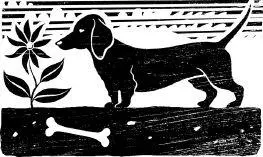
‘But I was really telling you about those two dachshunds, wasn’t I? I got sidetracked onto loyalty. Yes, they were loyal little dogs, even if they were a bit snappy from time to time. They had back problems, you see, because of being so long. Eugene had the worst twinges, I think. He was very low-slung and sometimes his stomach would touch the ground as he walked along. And if somebody patted him too vigorously his back would hurt and he could nip them. Not badly – just a small nip.
‘When I lodged at Phyllis’s place, the dogs became quite fond of me. They used to follow me around, and if there was a storm they would come into my room and hide under the bed. They were frightened of thunder, I think – Riley in particular. He used to whimper if there was any thunder or lightning about.
‘They used to love going out into the garden and digging up the flowerbeds. They were looking for something, I suppose, but I never found out what it was. Ancient bones, perhaps? Dachshund song-lines? Who knows? We’re all looking for something, of course, even if we don’t know what it is. And most of us don’t know, do we?
‘I left Phyllis’s place after I finished my PhD. A few years later, when I was working in Sydney, I had a Christmas card from her. Eugene died, she wrote. Poor dear, his back gave out eventually. Riley sends his love. He still remembers you. That’s what she wrote. And you know what? I cried. Not just for Eugene, or for Riley, who must have missed Eugene, but for everything. For the end of friendship, for loss, for the great spaces that exist between us, for the loneliness that is a condition of even this most crowded world. I cried for everything. I’m not ashamed to say it. Most men won’t admit it – but I will. I don’t care. And Gavin? I never saw him again, except once when I was in Sydney. I saw him on television. He had invented a new form of padlock and had won a prize for his invention. I saw him on the news, getting the prize. They showed a close-up of his padlock.’