Chapters (68)
- Cover Page
- Title Page
- Copyright Page
- Dedication
- Praise
- Chapter 1
- Chapter 2
- Chapter 3
- Chapter 4
- Chapter 5
- Chapter 6
- Chapter 7
- Chapter 8
- Chapter 9
- Chapter 10
- Chapter 11
- Chapter 12
- Chapter 13
- Chapter 14
- Chapter 15
- Chapter 16
- Chapter 17
- Chapter 18
- Chapter 19
- Chapter 20
- Chapter 21
- Chapter 22
- Chapter 23
- Chapter 24
- Chapter 25
- Chapter 26
- Chapter 27
- Chapter 28
- Chapter 29
- Chapter 30
- Chapter 31
- Chapter 32
- Chapter 33
- Chapter 34
- Chapter 35
- Chapter 36
- Chapter 37
- Chapter 38
- Chapter 39
- Chapter 40
- Chapter 41
- Chapter 42
- Chapter 43
- Chapter 44
- Chapter 45
- Chapter 46
- Chapter 47
- Chapter 48
- Chapter 49
- Chapter 50
- Chapter 51
- Chapter 52
- Chapter 53
- Chapter 54
- Chapter 55
- Chapter 56
- Chapter 57
- Chapter 58
- Chapter 59
- Acknowledgments
- About the Author
- Also by Rupert Holmes
- What’s next onyour reading list?
I looked over just the first two bars of the Photostatic score of Swing and found that when I made all the notes that had been distributed around the orchestra into one string of notes in the same unified key, they spelled—surprise—a Bach ache . . . which was clearly the Rosetta Stone for Swing. Its code breaker.
If this was some kind of cipher, it had actually been quadruple-encoded. The piano score I’d worked from had already been transposed up a whole tone by Gail. Then I’d innocently dealt out the notes across the orchestra to sixteen different instuments, transposing the trumpet and saxophone notes so that they were changed yet again. Then the individual parts were extracted by an equally innocent copyist. Minus the score from which the parts were originally extracted, one couldn’t decipher the code without having every single one of the instrumental parts.
I got a blank sheet of music paper from my suitcase and, standing at the dresser, quickly replicated Gail’s “A Bach Ache” from memory.
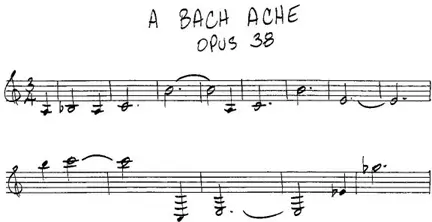
I looked at the clock. Fifteen minutes to get downstairs. A little lower on the same page of music I wrote the first eight letters of the alphabet and below them the corresponding notes in the German scale.

But that was only eight letters. I then wrote the next eight and continued the ascending scale underneath them. That took me about as high as I would write for most instruments.

I tried matching up this two thirds of an alphabet with my “Bach Ache” melody.
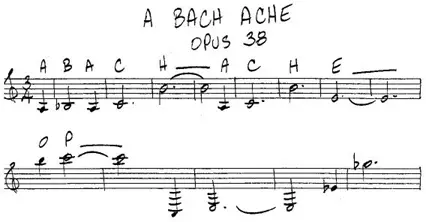
It now spelled “A BACH ACHE OP.”
O and P ... perfect. O and P were the last two letters in my scale so far . . . and brilliantly (if diabolically on Gail’s part) her subtitle, “OPUS 38,” gave a clue to the rest of the cipher. I already knew the notes for the first half of OPUS, and I’d bet anything the next two notes of “Bach Ache” ’s melody would be the U and S, and would in some way show me where to place the last third of the alphabet.
The two notes that followed O and P in “A Bach Ache” (theoretically the U and S notes) were lower in pitch than any thus far. That told me a great deal.
Maybe, not wanting to ascend any higher, she had started descending from the first available note after the A that we’d started with. I’d try that.
Yes. When I continued the scale downward, I found that its U and S gave me a perfect match for what I’d predicted would be the U and S notes in OPUS.
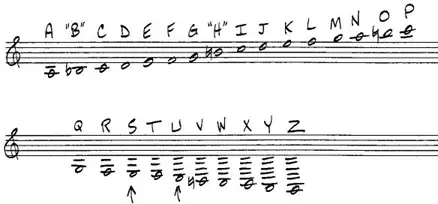
Of course, anything this low would get written in the bass clef so as to be more readable. I hastily rewrote the entire musical alphabet using both clefs so that I could decode the full orchestral score of Swing.