Chapters (68)
- Cover Page
- Title Page
- Copyright Page
- Dedication
- Praise
- Chapter 1
- Chapter 2
- Chapter 3
- Chapter 4
- Chapter 5
- Chapter 6
- Chapter 7
- Chapter 8
- Chapter 9
- Chapter 10
- Chapter 11
- Chapter 12
- Chapter 13
- Chapter 14
- Chapter 15
- Chapter 16
- Chapter 17
- Chapter 18
- Chapter 19
- Chapter 20
- Chapter 21
- Chapter 22
- Chapter 23
- Chapter 24
- Chapter 25
- Chapter 26
- Chapter 27
- Chapter 28
- Chapter 29
- Chapter 30
- Chapter 31
- Chapter 32
- Chapter 33
- Chapter 34
- Chapter 35
- Chapter 36
- Chapter 37
- Chapter 38
- Chapter 39
- Chapter 40
- Chapter 41
- Chapter 42
- Chapter 43
- Chapter 44
- Chapter 45
- Chapter 46
- Chapter 47
- Chapter 48
- Chapter 49
- Chapter 50
- Chapter 51
- Chapter 52
- Chapter 53
- Chapter 54
- Chapter 55
- Chapter 56
- Chapter 57
- Chapter 58
- Chapter 59
- Acknowledgments
- About the Author
- Also by Rupert Holmes
- What’s next onyour reading list?
As you may also have surmised from this volume’s dedication, this book has been, like me, graced by the lovely spirit of my late daughter, Wendy, and haunted by her tragedy. She was the loveliest of God’s creatures. It is my honor and heartbreak to be her father.
I remember you every moment, Wen.
My best male friend is Rob Sisco. That doesn’t mean we go pike fishing very often. We haven’t played a round of racquetball in, oh gosh, ever. He signed on for the job in 1980 and has been there for me ever since. He is the first fellow to whom I show my work, and he has assisted and supported it just as he has my life.
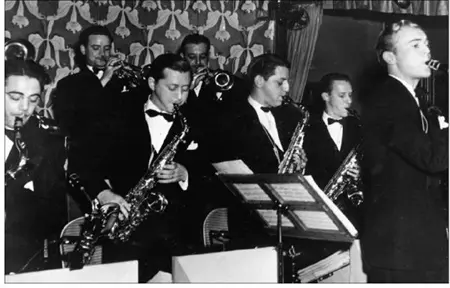
Like Ray Sherwood, my father attended the Juilliard School of Music. By age nineteen, he was playing a remarkably suave lead alto sax for xylophonist Red Norvo and his Orchestra, which also featured the vocalizations of Red’s wife, Mildred Bailey. Although Ray Sherwood, Jack Donovan, and Vera Driscoll bear no resemblance whatsoever to my father, Red, or Mildred, the tales my father spun for me about touring with a big band in 1940, and his jazz recordings, which I first spun on our record player at the age of five, greatly motivated this novel. An image of him playing with the Bobby Parks Orchestra at the Hotel Syracuse in the same year in which this story is set can be seen below. That’s Lenny there, third sax from the left. A witty, spry eighty-five as of this writing, he has always known what “swing” should sound like. Every day to this day, Jazz inspires Lenny’s life. I love you, Dad, for inspiring mine.
About the Author
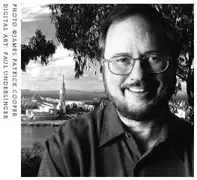
Twice a recipient of the Mystery Writers of America’s coveted Edgar Award, RUPERT HOLMES is no stranger to the worlds of mystery or music. His first novel, Where the Truth Lies, has been made into a major motion picture by director Atom Egoyan starring Kevin Bacon, Colin Firth, and Alison Lohman. For his Broadway musical The Mystery of Edwin Drood, Holmes became the first person in theatrical history to solely win Tony Awards for Best Book and Best Music and Lyrics, while Drood itself won the Tony for Best Musical. His comedy-thrillers for the stage include Broadway’s Accomplice and Solitary Confinement. His most recent work for Broadway, Say Goodnight, Gracie, earned Holmes the 2004 National Broadway Theatre Award and a Tony nomination for Best Play. He also created and wrote all four seasons of the critically acclaimed, Emmy Award–winning television series Remember WENN, set in 1940. Swing’s musical milieu is a reflection of another part of Holmes’s career: He received a Drama Desk Award for Best Orchestration and arranged and conducted Barbra Streisand’s classic album Lazy Afternoon. The Los Angeles Times has called Rupert Holmes “an American treasure.”
Also by Rupert Holmes
Also by Rupert Holmes
Where the Truth Lies