Chapters (68)
- Cover Page
- Title Page
- Copyright Page
- Dedication
- Praise
- Chapter 1
- Chapter 2
- Chapter 3
- Chapter 4
- Chapter 5
- Chapter 6
- Chapter 7
- Chapter 8
- Chapter 9
- Chapter 10
- Chapter 11
- Chapter 12
- Chapter 13
- Chapter 14
- Chapter 15
- Chapter 16
- Chapter 17
- Chapter 18
- Chapter 19
- Chapter 20
- Chapter 21
- Chapter 22
- Chapter 23
- Chapter 24
- Chapter 25
- Chapter 26
- Chapter 27
- Chapter 28
- Chapter 29
- Chapter 30
- Chapter 31
- Chapter 32
- Chapter 33
- Chapter 34
- Chapter 35
- Chapter 36
- Chapter 37
- Chapter 38
- Chapter 39
- Chapter 40
- Chapter 41
- Chapter 42
- Chapter 43
- Chapter 44
- Chapter 45
- Chapter 46
- Chapter 47
- Chapter 48
- Chapter 49
- Chapter 50
- Chapter 51
- Chapter 52
- Chapter 53
- Chapter 54
- Chapter 55
- Chapter 56
- Chapter 57
- Chapter 58
- Chapter 59
- Acknowledgments
- About the Author
- Also by Rupert Holmes
- What’s next onyour reading list?
“What are you whistling about?” asked Raleigh Subbotin, who was crouched on the floor of the lobby and not at all happy about losing one of the wheels he’d strapped onto his bass fiddle case. I said I wasn’t aware I’d been whistling.
Chapter 3
3
The Terrace
On our second break that same evening, I went to the hotel’s bank of coin telephones and tried calling the number Gail Prentice had given me. I was a little surprised when I got no answer. I suppose I’d pictured her breathlessly pacing by the phone.
I wandered myself as inconspicuously as possible to the bar in the Claremont’s Terrace Lounge. Finding a narrow vacancy alongside a woman who was dressed in turquoise, which was this season’s shade of evening blue, I brushed against her indifferent back and said to the bartender, “Rum and Coke. In the bottle.”
He appraised me. “You with the band?”
“Tenor sax, second chair.” I slipped a five-dollar bill alongside a small puddle of beer on the mahogany bar and we now understood each other.
“How much?” he asked.
It was like ordering gasoline. “Two dollars’ worth,” I said.
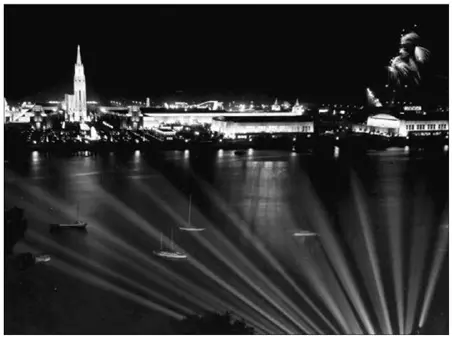
He raised a tufted eyebrow, opened a bottle of Coca-Cola, and wasted half its contents into the basin beneath him. He reached for the Bacardi (choosing the silver label from Puerto Rico, not the white label from Cuba—I was, after all, a musician) and carefully topped off the hobble-skirted Coke bottle. I took my bandstand stash with me out onto the Claremont’s fieldstone terrace and was surprised to see that the island of Atlantis—an impossible Babylonian city whose iridescent walls gleamed in pastel shades of blue and pink, ornamented in gold and dull bronze—had chosen to arise in the middle of San Francisco Bay, halfway between Telegraph Hill and the wharves of Oakland, floating nonchalantly as if it had always been there.
As I puzzled over this inexplicable apparition, which hadn’t existed when I’d last stood on this terrace over twenty years ago, I turned to see the ghostly glow of Jack Donovan’s white dinner jacket floating toward me. A second later I was relieved to see that Jack was in it. As the leader of our band, Jack always wore a white dinner jacket with black pants. We in the band had elected to wear dark brown suits, primarily because they better hid stains. We tried to go as long as possible before having to visit the local French cleaner wherever we were playing. Some of us managed to tour the country with only four suits, two for the stage and two for the civilian world.
I placed my Coca-Cola bottle on a ledge behind me. I was sure Jack knew this was how we all sneaked booze onto the stage, but he seemed content to look the other way as long as we didn’t force him to acknowledge the practice.