Chapters (68)
- Cover Page
- Title Page
- Copyright Page
- Dedication
- Praise
- Chapter 1
- Chapter 2
- Chapter 3
- Chapter 4
- Chapter 5
- Chapter 6
- Chapter 7
- Chapter 8
- Chapter 9
- Chapter 10
- Chapter 11
- Chapter 12
- Chapter 13
- Chapter 14
- Chapter 15
- Chapter 16
- Chapter 17
- Chapter 18
- Chapter 19
- Chapter 20
- Chapter 21
- Chapter 22
- Chapter 23
- Chapter 24
- Chapter 25
- Chapter 26
- Chapter 27
- Chapter 28
- Chapter 29
- Chapter 30
- Chapter 31
- Chapter 32
- Chapter 33
- Chapter 34
- Chapter 35
- Chapter 36
- Chapter 37
- Chapter 38
- Chapter 39
- Chapter 40
- Chapter 41
- Chapter 42
- Chapter 43
- Chapter 44
- Chapter 45
- Chapter 46
- Chapter 47
- Chapter 48
- Chapter 49
- Chapter 50
- Chapter 51
- Chapter 52
- Chapter 53
- Chapter 54
- Chapter 55
- Chapter 56
- Chapter 57
- Chapter 58
- Chapter 59
- Acknowledgments
- About the Author
- Also by Rupert Holmes
- What’s next onyour reading list?
No wonder I had noticed Gail’s “stylistic” tendency to shun the A in the middle of the piano keyboard, but whenever she did use it, it was always followed by the D below it. “Decoded” down a whole step, these two notes became the letters Q and U.
All you needed now were numbers and you could communicate anything.
“Opus 38,” she’d called it. The next two notes would have to be how she was going to symbolize 3 and 8.
They were flat notes, E-flat and G-flat. Significantly, there were only four remaining pitches in the chromatic scale that hadn’t been taken by a letter: A-flat, D-flat, E-flat, and G-flat. I tried constructing a scale of just those four pitches on the staff above my letter scale, the A-flat representing the number 1 aligned with the first A in my letter scale below it.
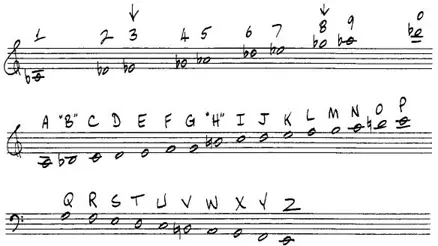
Sure enough, the next two notes in the melody line matched the numbers 3 and 8. I’d completed what I hoped was my Rosetta Stone: the key to Gail’s Swing code, by which virtually any message could be conveyed using little more than three octaves of music. All you needed were the musical parts and the master “key” to the piece (in this case “A Bach Ache,” which was on the reverse side of the dedication page that Gail had turned over to Fumio Dakuzaku).
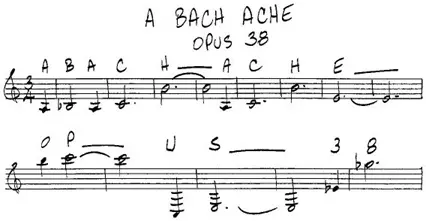
Placing my reconstructed letter-and-number code on the dresser in front of me, I tried applying it to the next two pages of the Photostatic score. I merely took each note in the order it occurred, and where there was more than one note on any given beat or subdivision of a beat, I tried “spelling” out the notes in order from lowest to highest, as is generally the practice among musicians. I added periods where they seemed appropriate.
It all worked.
And dear God, how I wished it hadn’t.
For what I’d thought was Gail’s jaunty, harmonically audacious intro to Swing was now revealed to be the words, “A BACH ACHE OPUS 38 TOP SECRET DECISION HAS BEEN MADE BY US NAVAL—
I felt foolish in more ways than I knew how to count. And yet a single emotion was greater than all my chagrin, embarrassment, and humiliation: fear. For even the very best interpretation I could put on all I’d discovered told me that Gail was lost in a dark place where I might not be able to protect her.
I hurriedly threw on my stage suit and called RC Copying. Gil Rice answered. I asked him how late his office would be open.
“Everybody wants everything for the next morning. I got three guys should be here until midnight at least.”
I asked him if I could lease a table, pen, ink, and paper from him and work through the night if need be. I told him I wouldn’t be able to be there until one A.M.