Chapters (68)
- Cover Page
- Title Page
- Copyright Page
- Dedication
- Praise
- Chapter 1
- Chapter 2
- Chapter 3
- Chapter 4
- Chapter 5
- Chapter 6
- Chapter 7
- Chapter 8
- Chapter 9
- Chapter 10
- Chapter 11
- Chapter 12
- Chapter 13
- Chapter 14
- Chapter 15
- Chapter 16
- Chapter 17
- Chapter 18
- Chapter 19
- Chapter 20
- Chapter 21
- Chapter 22
- Chapter 23
- Chapter 24
- Chapter 25
- Chapter 26
- Chapter 27
- Chapter 28
- Chapter 29
- Chapter 30
- Chapter 31
- Chapter 32
- Chapter 33
- Chapter 34
- Chapter 35
- Chapter 36
- Chapter 37
- Chapter 38
- Chapter 39
- Chapter 40
- Chapter 41
- Chapter 42
- Chapter 43
- Chapter 44
- Chapter 45
- Chapter 46
- Chapter 47
- Chapter 48
- Chapter 49
- Chapter 50
- Chapter 51
- Chapter 52
- Chapter 53
- Chapter 54
- Chapter 55
- Chapter 56
- Chapter 57
- Chapter 58
- Chapter 59
- Acknowledgments
- About the Author
- Also by Rupert Holmes
- What’s next onyour reading list?
He pulled out the chair for the secretary, who sat down with no smile for me. (For all she knew, I was going to confess to murdering someone.) “Look, Lieutenant,” I offered, “I’ll be glad to make a statement saying she looked agitated and upset when I saw her. The fact is, she did.” Culpepper smiled gratefully.
I would read in the next day’s newspaper that the death of Marie Prasquier had been officially pronounced a suicide. The fact that Marie’s motives for ending her own life were discovered by the authorities so very quickly after her death—enabling them to rule out the possibility of murder—greatly pleased the police, the press, the public, and, as you can well imagine, her killer.
Chapter 9
9
The Other Tower
I walked out of the Administration Building and into a blindingly sunny midafternoon. My watch read 2:52. When I’d last seen Gail, she’d been calling out to me about playing another carillon concert in the tower at three.
I was very anxious to locate her. This had nothing to do with her engaging personality, her memorable looks, the dancing of her eyes. Nor was it because she’d already become the sound of bowling pins clattering above my head that had aroused me from my long-bearded sleep. No, of course not. It was because I really needed a laborious arranging job for very little money.
Since I was now outside the fair, I’d begun the long trudge back to the entrance gate when a motorized tram with striped awnings, emblazoned with the same braying elephants as those above the Exposition’s portals, pulled up to the curbside. “Elephant Train to the Northwest Passage, Chinese Village, and parking,” announced its driver.
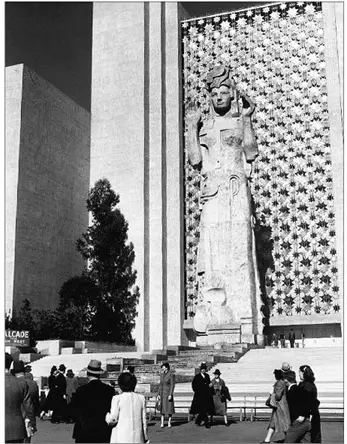
Two minutes later I was entering the fair for the second time that day. I remembered that the Tower of the Sun could be reached via the gateway that was guarded by a giant statue of a woman. I walked quickly toward the serene deity.
I’d made a major geographical mistake when I’d called this island Atlantis, for the goddess of this kingdom was officially named Pacifica and symbolized the fair’s theme of “Peace in the Pacific.” She stood eighty feet tall, backdropped by an even higher metal prayer curtain that scattered an undulating shower of sound whenever the wind stirred. The style of her face was a mix of Grecian goddess and Nubian queen. Her wide eyes were blank, but I couldn’t say whether this was because her eye sockets were void or merely closed.