Walking in Two Worlds
Chapters (72)
- Cover
- Dedication
- Epigraph
- Anishinaabe Terms and Pronunciation Guide
- CHAPTER 1
- CHAPTER 2
- CHAPTER 3
- CHAPTER 4
- CHAPTER 5
- One Year Later
- CHAPTER 6
- CHAPTER 7
- CHAPTER 8
- CHAPTER 9
- CHAPTER 10
- CHAPTER 11
- CHAPTER 12
- CHAPTER 13
- CHAPTER 14
- CHAPTER 15
- CHAPTER 16
- CHAPTER 17
- CHAPTER 18
- CHAPTER 19
- CHAPTER 20
- CHAPTER 21
- CHAPTER 22
- CHAPTER 23
- CHAPTER 24
- CHAPTER 25
- CHAPTER 26
- CHAPTER 27
- CHAPTER 28
- CHAPTER 29
- CHAPTER 30
- CHAPTER 31
- CHAPTER 32
- CHAPTER 33
- CHAPTER 34
- CHAPTER 35
- CHAPTER 36
- CHAPTER 37
- CHAPTER 38
- CHAPTER 39
- CHAPTER 40
- CHAPTER 41
- CHAPTER 42
- CHAPTER 43
- CHAPTER 44
- CHAPTER 45
- CHAPTER 46
- CHAPTER 47
- CHAPTER 48
- CHAPTER 49
- CHAPTER 50
- CHAPTER 51
- CHAPTER 52
- CHAPTER 53
- CHAPTER 54
- CHAPTER 55
- CHAPTER 56
- CHAPTER 57
- CHAPTER 58
- CHAPTER 59
- CHAPTER 60
- CHAPTER 61
- CHAPTER 62
- CHAPTER 63
- CHAPTER 64
- CHAPTER 65
- ACKNOWEDGMENTS
- RESOURCES
Cover
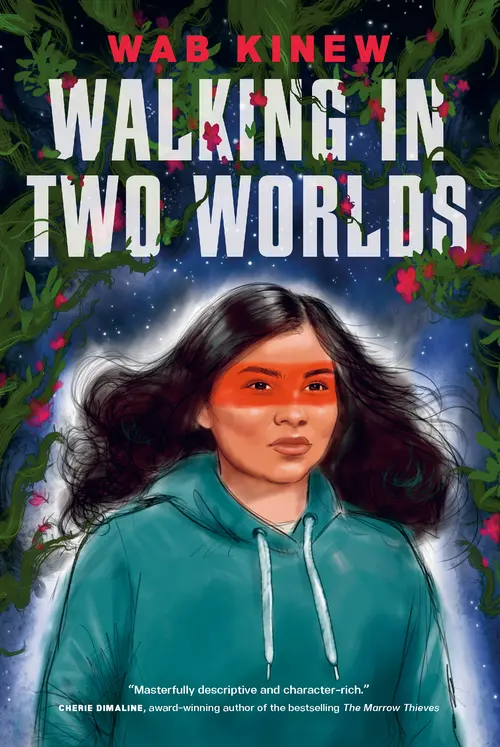
Dedication
To the students at Pelican Falls First Nations High School:
Visiting your school over the years, I’ve noticed you face many things going to school away from home, some good and some bad, but you face them all with courage.
I started this book thinking it might be cool if you could read something that represented our backgrounds and some of the realities you face.
Ando-bawaajigek—seek your dreams!
Epigraph
“We don’t want to create two worlds, but walk together in one world—relating to each other as having our own uniqueness that we mutually respect.”
—SENATOR MURRAY SINCLAIR
Anishinaabe Terms and Pronunciation Guide
Anama’edaa (ah-numb-ah-yay-TAH): Let us pray
Anishinaabe (a-nish-in-NAH-bay): Ojibwe or Indigenous
Bagonegiizhigok (bug-oh-nay-KEESH-ig-oak): Hole in the day
Baakinan (buck-in-NONE): Open it!
Binesi (bin-NEH-see): Thunderbird
Eniwek igo kiga’onji-pimaadiz ndiwe’igan (AY-knee-wake EE-go key-gohn-jih-pee-MAH-tizz in-tay-WAY-gun): Through my drum you will live just that much more
Kookom (COOK-em): Grandmother
Mishi-pizhiw (mi-SHIP-i-shoe): A supernatural being in Anishinaabe culture
Nameg (nah-MAYK): Sturgeon (plural)
Ni-noonde-pimaadiz (nih-known-day-pee-MAH-tizz): I want to live
Onizhishin Anishinaabe Aking (oh-NISH-ish-in ah-nish-in-NAW-bay AH-king): Anishinaabe country is beautiful
Onjine (OWN-jin-nay): The way you behave will come back to you
Patai’itiwin (put-TIE-it-tee-win): The way you behave will come back to your children
Waawaate (WAH-wah-tay): The northern lights
CHAPTER 1
It was the best of Bugz, it was the worst of Bugz. She created life, she destroyed worlds. She appeared invincible, she knew only defeat. She was Indigenous, she didn’t belong. She moved with absolute confidence, she couldn’t shake the tiny voice inside: It’s no big deal, it’s the end of the world. In many ways, Bugz was just like everybody else…until she went online into the Floraverse. There, Bugz’s every move was watched by the entire world, who either loved her or hated her.
Hidden by total darkness, Bugz pressed her body close to a cedar tree, edging nearer to danger. She rarely hid in the virtual world of the ’Verse. Apart from her celebrity, there was her look: she wore a custom skin with an athletic physique packed into a black, neon-pink, and Day-Glo-green outfit. The ensemble borrowed from the body armor of science-fiction superheroes and the embroidered designs of a pow-wow dancer. Floral patterns that paid homage to the beadwork of her Anishinaabe Ancestors accented her bodysuit. Her midriff was exposed in a way that would’ve raised eyebrows among the aunties back on the Rez. Those older women preached modesty, but anytime Bugz’s mom heard those so-called teachings that singled out women’s bodies, she’d always stick up for her daughter and say, “That’s just the colonization talking.”