Chapters (76)
- Title Page
- Copyright Notice
- Dedication
- Foreword: Who Is Simple?
- Feet Live Their Own Life
- Landladies
- Simple Prays A Prayer
- Conversation on the Corner
- Simple on Indian Blood
- A Toast to Harlem
- Simple and His Sins
- Temptation
- Wooing the Muse
- Vacation
- Letting off Steam
- Jealousy
- Banquet in Honor
- A Veteran Falls
- High Bed
- Final Fear
- There Ought to be a Law
- Income Tax
- No Alternative
- Springtime
- Last Whipping
- Seeing Double
- Simple on Military Integration
- Blue Evening
- A Letter from Baltimore
- Seven Rings
- What Can a Man Say?
- Empty Room
- Picture for Her Dresser
- Cocktail Sip
- Apple Strudel
- Bop
- Formals and Funerals
- Fancy Free
- Midsummer Madness
- Morals Is Her Middle Name
- They Come and They Go
- A Million—and One
- Two Loving Arms
- All in the Family
- Kick for Punt
- Subway to Jamaica
- No Tea for the Fever
- Boys, Birds, and Bees
- On the Warpath
- A Hearty Amen
- Must Have a Seal
- Shadow of the Blues
- Once in a Wife-time
- Present for Joyce
- Christmas Song
- Tied in a Bow
- Sometimes I Wonder
- Four Rings
- Simply Love
- Bang-up Big End
- Duty Is Not Snooty
- Bones, Bombs, Chicken Necks
- A Dog Named Trilby
- Enter Cousin Minnie
- Radioactive Red Caps
- Two Sides Not Enough
- Puerto Ricans
- Minnie Again
- Vicious Circle
- Again Cousin Minnie
- Name in Print
- Minnie One More Time
- An Auto-Obituary
- Jazz, Jive, and Jam
- About the Author
- Newsletter Sign-up
“Buddy’s brother talked on. ‘Officer,’ he says, ‘it were so bad in that army camp that I will tell you a story of something that happened to me. They had us colored troops quartered way down at one end of the camp, six miles back from the gate, up against the levee. One day they sent me to do some yard work up in the white part of the camp. My bladder was always weak, so I had to go to the latrine no sooner than I got there. Everything is separated in Mississippi, even latrines, with signs up WHITE and COLORED. But there wasn’t any COLORED latrine anywhere around, so I started to go in one marked WHITE.
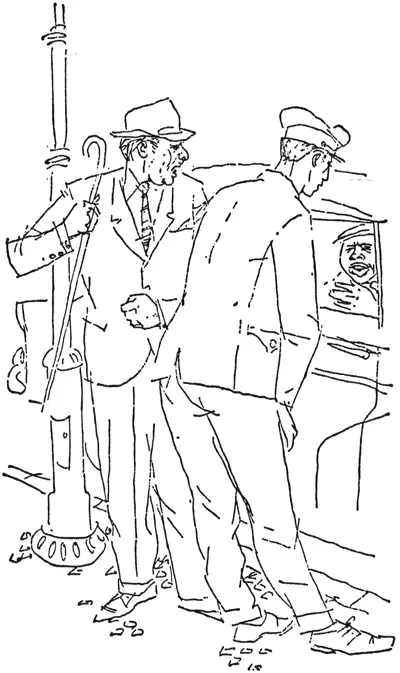
“‘A cracker M.P. yelled at me, “Halt!”
“‘When I didn’t halt—because I couldn’t—he drew his gun on me and cocked it. He threatened to shoot me if I went in that WHITE latrine.
“‘Well, he made me so mad, I walked all the way back to my barracks and got a gun myself. I came back and I walked up to that Southern M.P. I said, “Neither you nor me will never see no Germans nor no Japs if you try to stop me from going in this latrine this morning.”
“‘That white M.P. didn’t try to stop me. He just turned pale, and I went in. But by that time, officer, I was so mad I decided to set down and stay awhile. So I did. With my gun on my lap, I just sat—and every time a Southerner came in, I cocked the trigger. Ain’t nobody said a word. They just looked at me and walked out. I stayed there as long as I wanted to—black as I am—in that WHITE latrine. Down in Mississippi a colored soldier has to have a gun even to go to the toilet! So, officer, that is why I do not want to ride this man—because he is one of them that wouldn’t even let me go in their latrines down South, do you understand?’
“‘Understand?’ says the cop. ‘Of course, I understand. Be jeezus! It’s like that exactly that the damned English did the Irish. Faith, you do not have to haul him.… Stranger, get yerself another cab. Scram, now! Quick—before I run you in.’
“That white man hauled tail! And Buddy’s brother drove off saluting that cop—and blowing his horn for New York City. But me, if I’d of been there,” said Simple, “I would of asked that officer just one thing about Ireland. I would have said, ‘Well, before you-all got free—kicked around as you was—did you still have to pay taxes to the British?’”
“I can answer that for you,” I said. “Of course, the Irish had to pay taxes. All colonial peoples have to pay taxes to their rulers.”