Chapters (84)
- Cover
- Dedication
- The Lost Daughter
- Prologue
- Chapter 1
- Chapter 2
- Chapter 3
- Chapter 4
- Chapter 5
- Chapter 6
- Chapter 7
- Chapter 8
- Chapter 9
- Chapter 10
- Chapter 11
- Chapter 12
- Chapter 13
- Chapter 14
- Chapter 15
- Chapter 16
- Chapter 17
- Chapter 18
- Chapter 19
- Chapter 20
- Chapter 21
- Chapter 22
- Chapter 23
- Chapter 24
- Chapter 25
- Chapter 26
- Chapter 27
- Chapter 28
- Chapter 29
- Chapter 30
- Chapter 31
- Chapter 32
- Chapter 33
- Chapter 34
- Chapter 35
- Chapter 36
- Chapter 37
- Chapter 38
- Chapter 39
- Chapter 40
- Chapter 41
- Chapter 42
- Chapter 43
- Chapter 44
- Chapter 45
- Chapter 46
- Chapter 47
- Chapter 48
- Chapter 49
- Chapter 50
- Chapter 51
- Chapter 52
- Chapter 53
- Chapter 54
- Chapter 55
- Chapter 56
- Chapter 57
- Chapter 58
- Chapter 59
- Chapter 60
- Chapter 61
- Chapter 62
- Chapter 63
- Chapter 64
- Chapter 65
- Epilogue
- Acknowledgments
- An Excerpt from JACKIE AND MARIA
- Chapter 1
- Chapter 2
- P.S. Insights, Interviews & More . . .*
- About the Author
- About the Book
- Historical Afterword
- Sources
- The Love Lives of the Romanov Daughters
- Reading Group Questions
- Praise for The Lost Daughter
- By Gill Paul
- About the Publisher
In the years during and after the Russian civil war, between 100,000 and 200,000 White Russians fled across the country’s eastern border into Harbin, Manchuria. There was already an established Russian community there, with their own Orthodox churches and Russian businesses. Some were waiting in the hope that the Bolsheviks would be overthrown and they could return to their homeland without fear of retribution for being kulaks, or intellectuals, or Whites. But during the 1920s, Soviet influence grew stronger in the town and life must have felt more precarious. Some people emigrated back into the Soviet Union, others to Japan and South America, but a sizeable number sailed south to Australia, as I have Val’s father doing in my novel.
Some Russian political exiles had already arrived in Sydney after the February 1917 revolution, and another wave followed in the 1920s. A club known as the Russian House was founded as an organization to help new arrivals find work and a meeting place in which to celebrate Russian festivals. In 1933, Father Methodius Shlemin began to hold Orthodox services there, and in 1942 the church I describe in the novel was founded on Robertson Road, Centennial Park. Sydney retains a strong Russian community to this day.
* * *
This is my second novel about the Romanovs. The first, The Secret Wife, concerns the romance between the second-eldest daughter, Tatiana, and a cavalry officer called Dmitri Malama. I have alluded to their story in The Lost Daughter. But the family’s fate is so shocking and haunting that I couldn’t resist returning to it in 2018, the centenary of their murders. I feel as moved by it now as I did when I first read the story as a teenager.
For a regime to execute a monarch and his wife was not unheard of, but to execute their five children as well, the youngest just thirteen years old, was barbarous in the extreme. If only Nicholas’s first cousin, George V, had let them flee to safety in England. If only one of the many rescue attempts had succeeded. There is no paper trail connecting Lenin to the murders, but he could certainly have saved them had he tried.
The slaughter happened in the twentieth century, to a family who often filmed themselves with movie cameras, so you can find them on YouTube prancing through the gardens of their palaces, paddling in the sea, and playing with the sailors on their royal yacht. The girls are beautiful and utterly innocent of anything except being born into the wrong family at the wrong time. They could have been mothers and grandmothers, wives and lovers, farmers or artists or authors. In my novels, they are.
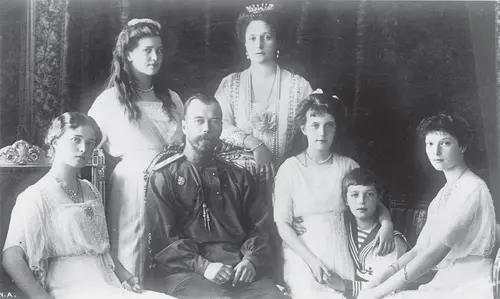
The Romanov Family. From the left: Grand Duchess Olga, Grand Duchess Maria, Tsar Nicholas II, Tsarina Alexandra, Grand Duchess Anastasia, Tsarevitch Alexei, and Grand Duchess Tatiana. Portrait by the Levitsky Studio, Livadiya