Chapters (84)
- Cover
- Dedication
- The Lost Daughter
- Prologue
- Chapter 1
- Chapter 2
- Chapter 3
- Chapter 4
- Chapter 5
- Chapter 6
- Chapter 7
- Chapter 8
- Chapter 9
- Chapter 10
- Chapter 11
- Chapter 12
- Chapter 13
- Chapter 14
- Chapter 15
- Chapter 16
- Chapter 17
- Chapter 18
- Chapter 19
- Chapter 20
- Chapter 21
- Chapter 22
- Chapter 23
- Chapter 24
- Chapter 25
- Chapter 26
- Chapter 27
- Chapter 28
- Chapter 29
- Chapter 30
- Chapter 31
- Chapter 32
- Chapter 33
- Chapter 34
- Chapter 35
- Chapter 36
- Chapter 37
- Chapter 38
- Chapter 39
- Chapter 40
- Chapter 41
- Chapter 42
- Chapter 43
- Chapter 44
- Chapter 45
- Chapter 46
- Chapter 47
- Chapter 48
- Chapter 49
- Chapter 50
- Chapter 51
- Chapter 52
- Chapter 53
- Chapter 54
- Chapter 55
- Chapter 56
- Chapter 57
- Chapter 58
- Chapter 59
- Chapter 60
- Chapter 61
- Chapter 62
- Chapter 63
- Chapter 64
- Chapter 65
- Epilogue
- Acknowledgments
- An Excerpt from JACKIE AND MARIA
- Chapter 1
- Chapter 2
- P.S. Insights, Interviews & More . . .*
- About the Author
- About the Book
- Historical Afterword
- Sources
- The Love Lives of the Romanov Daughters
- Reading Group Questions
- Praise for The Lost Daughter
- By Gill Paul
- About the Publisher
The initial plan was for them to be exiled to Britain, but arrangements were complicated by the war in Europe, and King George V dragged his heels. As Russia lurched toward civil war during the summer of 1917, the Romanovs were transported to Tobolsk, Siberia, in a move that was said to be for their own safety. Attitudes toward them hardened after Lenin seized power in the October Revolution, and in April 1918, Maria and her parents were escorted to the smaller, more heavily guarded Ipatiev House in Ekaterinburg, which is where The Lost Daughter begins.
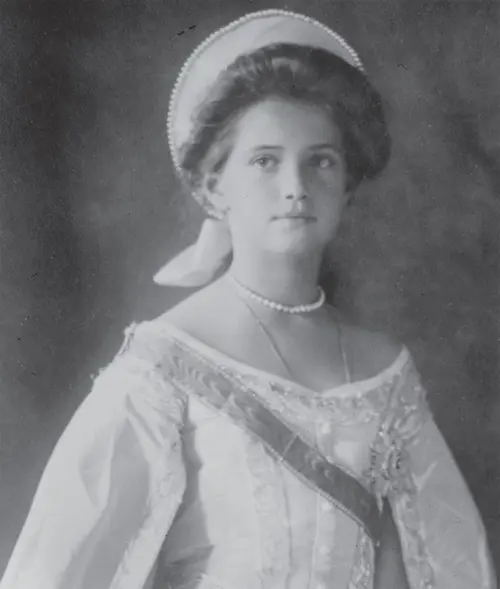
Grand Duchess Maria Nikolaevna of Russia. Library of Congress Prints and Photographs Division Washington, D.C., Bain Collection
My depiction of the character of Maria is based on facts we know about her. She did not feel secure in her parents’ affections, and once wrote to her mother saying she considered herself unloved. She was plump as a child, earning her the nickname “fat little bow-wow,” but many considered her the most beautiful of the four girls, with her huge eyes “like saucers.” She was physically the strongest of the four, able to lift and carry thirteen-year-old Alexei on her own. And although she was not academically gifted, she was artistic, enjoying drawing, painting, and photography.
Around men, Maria appears to have been naturally but innocently flirtatious. One guard, Alexander Stretokin, wrote that she was “a girl who loved to have fun.” Commandant Yurovsky wrote that she had a “sincere, modest character” that made her very popular with his men. He said that she “spent most time with the sentries” and he remembered her showing them her photograph albums.
It is well documented that a guard called Ivan Skorokhodov smuggled a cake into the house on Maria’s birthday in June 1918, then the pair of them disappeared together and were caught in what were described as “compromising circumstances.” No one knows exactly what happened, but Ivan was jailed for three months and thereafter disappears from the history books.
Maria was clearly a friendly, outgoing kind of girl with a healthy interest in the opposite sex. If the guards were going to save any one of the girls in the house, surely it would have been her? And if she did escape, her physical strength would have helped her to survive. That was my thinking when I began to shape the story of The Lost Daughter.
* * *