Chapters (46)
- Cover
- Also by Phillip B. Williams
- Epigraph
- Final First Poem
- Of the Question of Self and How It Never Quite Gets Answered
- Final Poem for the White Students Next Door Who Say “Nigga” When Singing Along to Rap Songs Loud Enough for Me to Hear
- Final Poem as Request for Maskot for White-Ran Journal, or “They Sure Do Love Them Some Black Pain.”
- Order of Events
- Final Poem for a King
- And Now Upon My Head the Crown
- Tabula Rasa
- Final Poem for War During War
- Interlude: Sasa and Zamani
- Final Poem for Amiri Baraka
- The Flying African
- Mushmouf’s Maybe-Crown
- Final Poem for the Crow
- Final Poem for the “Black Body”
- January 1, 2018
- Final Poem as Tidalectic Elegy
- Herald
- The Field
- Hunter
- Final Poem for the Deer
- Final Poem as Nocturne into Aubade, or Sonrise
- Final Poem for the Biography of a Black Man as Animal and His Enforced Embrace of a Human Praxis
- Black Joy
- Judgment
- Final Poem for the Famous Poet
- January 28, 1918
- Final Poem for the Bullet
- “Ne Me Quitte Pas”: I Put a Spell on You: Nina Simone: 1965
- Final Poem for the Moon
- The Void
- Final Poem for My Father Misnamed in My Mouth
- Final Poem for the “Field of Poetry”
- The Asphodel
- Shame
- Final Poem for Grandma Elizabeth’s Cancer
- Final Poem of Persona
- Mastery
- In the Beginning
- NOTES
- ACKNOWLEDGMENTS
- About the Author
- What’s next onyour reading list?
Primal School—“Of the Question of Self and How It Never Quite Gets Answered”
Sewanee Review—“Final Poem for Amiri Baraka” and “Final Poem for the Famous Poet”
The Shade Journal—“Final Poem for War During War” as “excerpt from ‘Interruptive’ ”
Southern Indiana Review—“Final Poem for the Bullet”
TriQuarterly—“Final Poem for the Deer,” “In the Beginning . . .”
The Yale Review—“Mushmouf’s Maybe Crown”
“Final Poem for My Grandma Elizabeth’s Cancer” appeared in the chapbook Burn (YesYes Books 2012).
“Mastery” was translated into French by Pierre Vinclair for the journal Catastrophes.
I would like to thank the following people for their unconditional support and presence, with the hope of being forgiven for anyone I forget:
Joel Dias-Porter, Saddiq Dzukogi, Aricka Foreman, Hafizah Geter, Rebecca Gayle Howell, Luther Hughes, Ashaki Jackson, Taylor Johnson, Bettina Judd, Donika Kelly, Willie Kinard III, Shayla Lawson, Nabila Lovelace, Airea D. Matthews, Ron G. Mitchell, Cheswayo Mphanza, Nicholas Nichols, Nkosi Nkululeko, Khadijah Queen, Erika Sanchez, Safiya Sinclair, Jayson Smith, and Marcus Wicker.
Special thanks to Keith S. Wilson for helping me with “Final Poem for the ‘Black Body.’ ” You’re a genius.
To my editors, Paul Slovak and Allie Merola, you are amazing. To everyone at Penguin/Viking, thank you so much for your hard work on this book.
Huge thank-you to my agent, Bill Clegg, and everyone at the Clegg Agency, especially Simon Toop.
The Harvard Radcliffe Institute, National Endowment for the Arts, and the Whiting Foundation for time and support. To my friends and colleagues at Bennington College and Randolph low-res MFA for collegiality and camaraderie.
About the Author
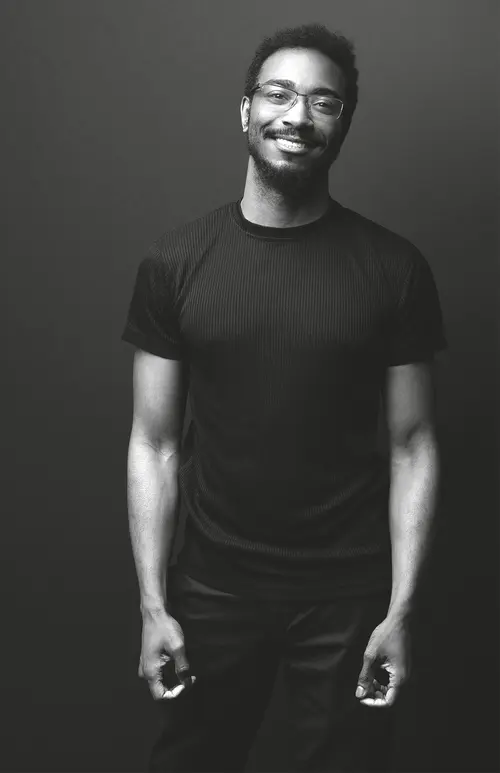
Beowulf Sheehan
Phillip B. Williams is from Chicago, Illinois, and is the author of the book Thief in the Interior (Alice James, 2016). A recipient of the Kate Tufts Discovery Award, Lambda Literary Award, and Whiting Award, he has also received fellowships from the Radcliffe Institute for Advanced Study at Harvard University and the National Endowment for the Arts. He currently teaches at Bennington College and the Randolph College low-residency MFA.

What’s next on
your reading list?
Discover your next
great read!
Get personalized book picks and up-to-date news about this author.
Sign up now.
*I tried to love them out of their caricature, back into a name, to love a name onto them, misbelieving the rendering represented anyone but these featureless tremolos beckoning in replication a need to be held. They were not children, but their want to be wanted (their being made that way) made a thin nursery of me. How can I say no to them who have contaminated my reflection? I tried to free them, but their ink-chains, their two-dimensional silence—I found not bodies, not selves or they. All is “ditto” if even one is “ditto,” a wild grammar taking the shape of what floats.