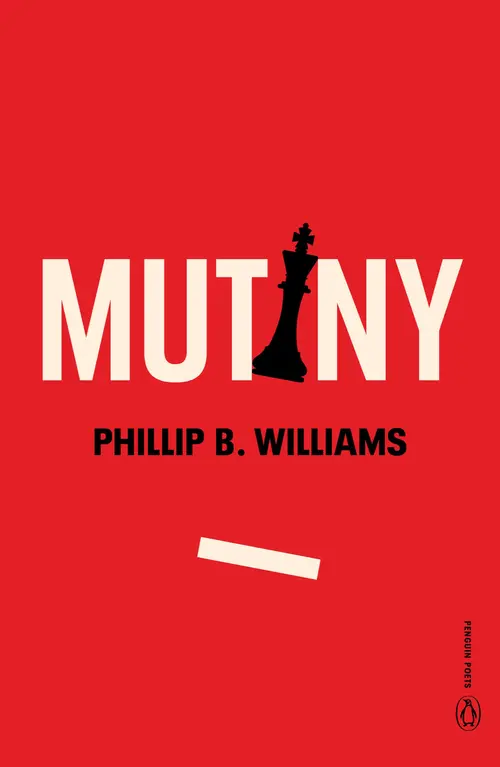
Mutiny
Cover
Also by Phillip B. Williams
Thief in the Interior (2016)
Epigraph
It’s been a long time, I shouldn’t have left you
Without a strong rhyme to step to
—Eric B. & Rakim, “I Know You Got Soul”
I got a lot to be mad about
—Solange, “Mad”
Final First Poem
FINAL FIRST POEM
In the beginning, I suspect my index is on fire.
Daystart spasmodic with hunger, my dull teeth catch
on pale figures voweling from an empty heaven. God
been left, bored too with ransom for art, allusions
stacked like reluctant saints on a pyre: Eliot, Alighieri,
Homer. The sun’s glossy odyssey traces half-
moon above the horizon, clefts these alexandrine hours
into shoddy boats I’m tired of drifting toward nothing on.
“There was once a sea,” I begin, having never seen a sea
nor been able to seam any time to once. Now, I sleep
and avoid documenting my rhyme-sourced wet dreams,
and who would collect these metered christenings?
I want to know what you must know. I own nothing
impressive. No noctuaries of gallivanting steeds, no
beloveds creeping from sun-bloodied water in a salt-
stained stolen dress, no oceans from which she stole
her voice to give to me to offer you slow-blinkingly,
awaiting “genius” and a circle of rooks (all the crows
have gone, my love, and all shovels cradling yarrow and jewels
of beetles have rusted away, revealing my face all along
held these things in unrequited climax) to crown me king.
The book is burning. Come, sit at my bedside. Let ash
fill the fugue that was your need. Now, open your hands.
Reader, read to me what you have stolen and called your life.
Of the Question of Self and How It Never Quite Gets Answered
OF THE QUESTION OF SELF AND HOW IT NEVER QUITE GETS ANSWERED
In the poem, figure A is distilled to shadow and floor-looking.
Figure B musics crane-necked, anticipatory for the nih-nig.
I’ve always been a sucker for taxonomy.
The many ways I other without knowing.
I’m so Black I’m somebody’s pappy lowering
his eyes to an unmarked grave. Shamecracked. Akimbo in exclusive gaze.
Lawd, Lawd, Lawd—who is I talking to and where is I? One must
prepare to be seen at all times astounded into erasure, ill-imagined.
Some of us eat watermelon in the closet, breath fermenting
and vulpine. Blessèd, to eat without being eaten.
Safe in the umbra room, dancing ensues, uncaricatured O.
Figure B sniffs figure A. Figure A is hips and textile. Puppet-pulled.
History yawns from the Os of likely weapons, a sniper in the shade.
I know because in me the dark is alive, and the dark makes plans.
Final Poem for the White Students Next Door Who Say “Nigga” When Singing Along to Rap Songs Loud Enough for Me to Hear
FINAL POEM FOR THE WHITE STUDENTS NEXT DOOR WHO SAY “NIGGA” WHEN SINGING ALONG TO RAP SONGS LOUD ENOUGH FOR ME TO HEAR
I caught you stealing
glances of yourselves in the shrieking
mirrors of your smiles, and still
you have not found yourselves
in this self-made history bright
as a premonition. You’ve been
looking for your mothers
with your voices and found your names
in the pulse of Lil Wayne. I knew
already what to call you was what
you thought to call me. Please
return the e and r. You must
return to what birthed you. The nothing
rhythmlessly stomps
boot-wise over the head
of my darky sleeplessness. Last night
a young Black student screamed,
“I’m Black! I’ll fuck a mother-
fucker up,” trying to convince.
Nowadays, it’s difficult niggering
to one’s self. Just yesterday, I misplaced
my bottle of melatonin but said
to a friend on the phone, “I lost my melanin.”
Sleepless and white, I fissured
my imagination to find in it
some semblance of you concussing
a book of speeches by MLK and chanting
“peace” in no specific direction. Responding
to my loss of melanin, my friend
screamed, “My nigga!” but I swore
he’d thrown his voice. Outside,
you cuss loudly, are angry about the beer.
Everyone needs to hear this. I raise
my blinds. I stare through the window
but can see myself as palimpsest over you all
as you stare back, approximate, catching on.
Final Poem as Request for Maskot for White-Ran Journal, or “They Sure Do Love Them Some Black Pain.”
FINAL POEM AS REQUEST FOR MASKOT FOR WHITE-RAN JOURNAL, OR “THEY SURE DO LOVE THEM SOME BLACK PAIN.”
Tell us duh one bout dem chirren and duh bullets dey eat
Tell us duh one bout dem roaches makin love to yo feet
Tell us duh one bout yo grandmammy’s hands:
callused and cookin, cansuh everywhere but her hands
Tell us bout her mouf too: “Oh Lawdy Jesus,” “Wrench around . . . ,”
“Bout scared me half to DEATH” she make purty sounds
Tell us duh one bout white people cuttin you
in line [did yuh neck do that back
and forf thing finguh waggin
lips lippin “nuh uh no she di-int”]
Tell us duh one bout duh woman duh rope and duh bridge
[O dere was a baby dat fell out and bumped its head
on duh wata followin duh drinkin gourd
or nah?]
Is you submittin to my journal or nah?
You spoken word or nah?
You hopin whitey gets his just due
flippin duh bird or nah?
All da boys in duh hinterland killed
cause uh duh hoodie monster
You gots anymo uh dem po-lice poems wit duh
Hippity Hop refrences wit dem thugs and da trees?
I sho love me some Hippity Hop refrences
But why thugs always smokin on dem trees
Don’t dey know dey histry is
to run from burnin trees?
Duh way you write nigga makes me thank [of] my mama
Tell us duh one bout music comin from duh eyes
Was dat “Purple Rain” or “Duh Coluh Purple” or is it a suhprise?
Tell us “stolen milk,” “watch my chirren when I’m gone,”
“Don’t let him see me dis way,” “I’m so glad Jesus is my home!”
Got anymo uh dem poems bout Celie?
Got some “Give us us free”
in yo packet, yo pote-folio, or yo spahklin CV?
How much fo duh WIC-EBT-lost-bus-card sonnet?
How much fo slave wenches wearin wata-melons as bonnets?
What you got up in dat verse what you got up in dat verse
[a couple uh guns / a couple uh blunts / a couple uh suicide
doors / Dior chokers / all duh shit you adore?]
Dat one gets me so hard/wet at night in duh dahk
Duh dahk got a poem too soundin jus like a knife
slidin through some cone-bread
Soft as a baby
Tell us duh one again bout duh baby
Order of Events
ORDER OF EVENTS
First, he taught us to use the dead as shawls
in the viscous winter escorting his arrival.
Next, he taught us to forget the dead
were dead, our dead, and dead because of a wager
we did not consent him to make with the thin-lipped
savior of his own pantomime. Third, he delivered
on promises that blew off the tops of homes
in places whose names he could not pronounce.
Uneasy lies the head that wears a crown
forced to fit a quiet country needing nothing
from a crown. Where once was honey unhived
competition. The drones meant for war
prepared for war. We dusted our shoulders
of Shadows’ silent reconnaissance, surveilled
as practice for a massacre we did not consent to.
The royal parade pride’s malady stomped
its sequence through beat drums of human skin
from which emanated a rhythm impossible
to decipher. I too would shake my ass
to the sound of stars falling night-
wise into a pit of myth-bent nomenclature
if the names sounded like home. Under eroding
circumstances, this kingdom could become home.
Under eroding circumstances, my gasp
has become home enough, love not
consented to yet detected from beneath
my mindless right hand pressing its devotion
to ritual over my heart, flag above waving heaven
and blood into the smoke-diffused sky I
quake my way through anthems beneath. Rockets
glaring off my breath forced to evidence I belong.
The crown is crooked. We straighten it
with vote-vapid hands. The crown sits too heavy
for the king to carry on his own. When it falls,
“O say can you see” strikes its inquisition.
My knees, summoned to straighten at the hinges
permission most questionably opens from,
spike the earth with a kiss. Could I
kneel my way to revolution?
Would that goad the king to unzip?
Final Poem for a King
FINAL POEM FOR A KING
I used to be friends with a man who raped a woman
whom he told was too dark for anyone to believe
though he himself was no lighter than the blackhole
he had become which means he did not believe
himself thus hated himself and will hate beyond himself
though he did not know it at the time that to rape
a Black woman was to hate the world and to be dead
to want to be dead to need to be dead because to be
born from one’s unfounded hatred is to be wholly
and forever zero to the white meat and she
the woman who shared her story had been for years
holding on to his violence his hatred toward her
handed off like a clue as in “What do you know
of yourself?” as in “My hatred birthed me, now so will you.”
I often think of that woman, whose name
was left unshared and I wouldn’t share it
even if I knew it—nor will I share his name for the law
he claims to hate for its whiteness has protected
his black revulsion, his silence an empire’s
gift to its willing slave—and I wonder how much
room there is in the world for her and how much
room have others taken from her and how her story
did not stop those who heard it from, months later,
sitting in a room with her rapist, smiling, allowing,
and how the rooms of their hearts had no space
for her either, though hadn’t she taken a step past
their thresholds, been invited in, not knowing
she had entered through the back door like a secret?
In undergrad, an acquaintance I had grown to love
told me her father had used the times of her mother’s
absence to—
I don’t know why she trusted me
to tell me this so casually in a burger joint.
And I remember wanting her to cry
because I wanted to cry but could not cry
and why could I not cry and how else do I
show her that I hear I care I believe her and she
thanked me for listening while I sat petrified
in half-smile like a delinquent who committed
a crime and almost got away thinking more
of myself than of her as is the way of men
who want most to be the unasked-for
white knight in an already-fought war.
His childhood friend, a teenage girl
when he was six. Their older cousin, fifteen,
and they were eight. His babysitter, her saying,
“Keep this between us.” Their aunt’s best friend
while the aunt ran an errand: “Girl, of course
I’ll watch him. He my lil husband.” His neighbor
who put his hand between his legs.
His teacher whom he impregnated at fifteen.
A woman his father paid and watched as they did it—
Adults in my life have come to me as the children
they were when touched too soon and asked me
if they did something wrong. I say “no” and “therapy”
and “You didn’t deserve . . .” They ask me if I’d ever
been touched too soon. I say, “I don’t remember.”
No woman in my family will tell me
what happened and I can’t tell them
I already know had been in the other
room sometimes when it happened
heard the slaps come down heard stop
ring out from my ______ heard the names
heard the threats heard the quiet after
heard about the boy who pushed
my ______ off the bus about the partner
who cut my _______ across the eye the one
neighbor carefully walking up the stairs
and my _______ running to the front door
to lock it only to have to run to lock the back
door too and the knob jiggling, jiggling, ji—
If I could kill them all, God: know I would.
I’m no saint. I too have wielded a knife
to execute someone I love more than myself
because a child’s rage is mercurial.
I could remember that feeling, that gilded heat.
If I could kill them all, God. Know I would
take my time. Would make a game of it. Often,
I sit daydreaming of hunting down rapists
in abandoned factories. Call me Jigsaw. I’ll nod
my wooden head, a yes they never saw coming.
If I could kill them all, God, know I would.
Just call them all Isaac and I’ll make them my sons.
If I could kill them all, God. Know I wouldn’t
even wash my hands after. Wouldn’t need permission.
When I was younger, I had a recurring dream
of an elderly man in a wheelchair tickling me
until it was not fun anymore. The dream stopped
some years into adolescence. I read somewhere
that repression leaves unlocked doors in the mind
you think are locked or merely empty rooms. Signs
that these rooms exist may never appear. I hear
nothing when I close my eyes, alone with myself,
and see the entrance into me expectantly open,
empty halls in memories where doors are blown
off hinges, rooms evacuated, torn white fabric draping
from the walls. There’s a condemned house in me.
I look for him in every sun-filled room,
but every beam of light and room is him.
And Now Upon My Head the Crown
AND NOW UPON MY HEAD THE CROWN
In the first place—I wanted him and said so
when I had only meant to say. His eyes
opened beyond open as if such force would unlock me
to the other side where daylight gave reason
for him to re-dress.
When he put on his shirt,
after I asked him to keep it off, to keep putting off
the night’s usual end, his face changed beneath
the shirt: surprise to grin, to how even the body
of another’s desire can be a cloak behind which
to change one’s power, to find it.
~
In the first place
he slept, he opened the tight heat of me that had been
the only haven he thought to give a name:
Is-it-mine? Why-you-running? Don’t-run-from-it—as though
through questions doubt would find its way away from me,
as though telling me what to do told me who I was.
Tabula Rasa
TABULA RASA
On the bus, a man sees me wearing a T-shirt of names
of the dead. It is his seeing my T-shirt that makes the day
glow and the inquiry in his seeing that makes it turn
cold and pause us so that between us
he builds a morgue with his gaze, and in that morgue
interpretation fashions itself from black cotton
and white letters, from impatience and mercy.
He rises to move toward me. The bus rocks
down avenues lined with playing children and liquor
stores whose painted signs read milk, cigarettes,
we accept wic. When he reaches me he reaches
for me, touches me on my shoulder until each
name listed flies from my shirt like a ribbon,
circles my head like a marquee until each name
stiffens from my head into compass needles
jutting toward their unique destinations. To be circled
that way by the dead, haloed by names
that make the bus glass shatter after each one flies
back to the site of its owner’s death.
And I know, for I am there with each name,
have been split into eleven rays of myself to fly
back to Los Angeles, Sanford, Oakland, Queens,
Jacksonville, Brooklyn, Ferguson, Cleveland,
the Bronx, Staten Island, North Charleston,
the dark bottom of the Tallahatchie River,
each place a thread to suture the grievance
left where the dead had been left, the names
magnetized to a sidewalk, a door stoop,
a parking lot, a street where the bodies are not
here, no stone rolled back but the bodies
are gone, the names cannot bring them back
and they shake as if mourning and I am made
to shake with them, can see the seams
of now snapping open, the scene behind the scenes
where vision remakes and obscures
time and place, the seams popping where
thumbs and timelines work swiftly to keep them shut.
Somewhere behind the skull of the events,
in the resonant nothing, I can hear it rupture
and wonder what was there in the inconceivable
where it seems laughter pours from the dark,
the sound of it making me afraid
to be alone in the sepulchral streets, in the gas
station’s blinding neon, in my own body,
to return to myself with that sound as part of me
and what then, and what now—
a laughter like static into which the names slip,
into where the openings have broken most
free before the eager thumbs work nimbly
to sew it all back closed, back to the surface
of the place where knowledge and arrogance
wear the same mask, where a fog of faces
in their complexions of horror blanket seeing,
and my eleven selves rush back to my twelfth self
on that bus, reenter my body, and the man
who touches my shoulder asks me the sources
of the names as though requesting a citation,
but I am wearing a blank black shirt
and tell him so, the release
complete, his confused look his own
business as he sees the names and
points, brushes
his finger against me
so that I can feel his seeing,
there, there he speaks into the wiped-clean, into
the voided-out
that is a blank screen onto which lives I cannot
ever knowingly imagine
begin to begin.
Final Poem for War During War
FINAL POEM FOR WAR DURING WAR
Questions for the war poem to host:
Who among us could weave one ghost
into another? Where find water hosted
but in the tulip’s snapped back and tilted
cup? How count the escaped’s speed by silt
dragged from one ruin to another? Wilt,
sings the sky’s dayfabric unwoven into grayscale
as though night could coax from a star a paler
face, but when night arrives on the felled
back of a mule winged on either side by baskets
of water and rotten grapes, what verb is tasked
with this weight? How many missiles cast
their light above a child’s gait? When do lions,
banished to the hills, water their hunger, lie on
their roars till the vultures pile on?
How many ways can I write exile
having myself never been exiled?
What is the face of exile
besides the one hidden beneath the pyre
of music peeling from a liar’s
head? Bless the maenads, that they retire
only after this laughable poet is dead.
Interlude: Sasa and Zamani
INTERLUDE: SASA AND ZAMANI
Because you were ancestor, because living dead and loved, in your necessary addiction you toed the roots of the banyan tree from underground, fiddling with your skullcap while saying my name in a mirror of groundwater. I saw you just the other day standing in the corner of my room at the corner of my eye, cornering my truth like a panther, remaining quarter-visible while I typed you into half-recollection, into forever the hand that held mine then undid the holding. Because I refuse to look the dead in the eye, I minded you like I mind dark shapes darting peripheral after I leave a room. My Egbe have hungers. My living makes room for finite cycles, a staircase spiraled to a point. If I die after my younger sister, you will become unknown, mortal-proofed. On the altar for my ancestors, I leave for you my favorite candy. You will love what I love. Florida water flares citrus from your obituary’s fold. You were sweet when you were here. Forever be my father in your becoming forever.
Final Poem for Amiri Baraka
The Story Continues on BooksBarbecue!
Enjoyed this preview? ❤️ Do not stop here!
Read the complete book free online → 🔗
Continue reading now on BooksBarbecue and discover every page!
Love reading? Bookmark BooksBarbecue.com for more amazing books!
Happy Reading!