Chapters (25)
- Title Page
- Dedication
- Introduction
- I - Into the Wild Blue
- Chapter 1 - Every Man a Tiger
- Chapter 2 - The Big Lie
- Chapter 3 - The Vision of Bill Creech
- II - Shield in the Sky
- Chapter 4 - Mission to Jeddah
- Chapter 5 - CENTCOM Forward
- Chapter 6 - Planning the Storm
- Chapter 7 - Band of Brothers and Sisters
- III - The Thousand-Hour War
- Chapter 8 - Storm!
- Chapter 9 - Hits and Misses
- Chapter 10 - Lost and Found
- Chapter 11 - Punch and Counterpunch
- Chapter 12 - A Day in the War
- Chapter 13 - The Ten Percent War
- Chapter 14 - Shock and Awe
- Chapter 15 - Building Coalitions
- Chapter 16 - Beyond Iraqi Freedom
- Acknowledgements
- BIBLIOGRAPHY
- INDEX
Without hesitation, Air Vice Marshal Bill Wratten spoke up: “I think that’s a good idea, and I’d like to lead the effort.” I couldn’t have been more pleased. Bill, like all the rest of us, had been in anguish over the losses. Even though there had been all sorts of speculation about the causes and the possible fixes, we needed an experienced airman close to the scene of the action to give us an objective view. Bill Wratten was just the man, and with the support of Air Chief Marshall Patty Hine, we were able to stop losses due to low-altitude tactics.
Here are some facts and figures:
We lost twelve GR-1s (of which one was Italian and two were RSAF). Nine were shot down or crashed doing low-level attacks, two were lost at medium altitude, and one ran out of fuel. The GR-1 loss rate was significantly higher than other aircraft:
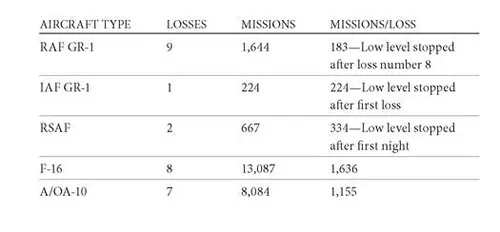
The Tornado, which flew more low-level tactics than any other aircraft, had a loss rate nine times the F-16s and over six times the fairly slow A-10s.
★ AAA and SAMs were dangerous, but the most lethal threat to our attack was the enemy’s interceptor aircraft.
Why?
Ground-based defenses stayed in one place and could be avoided by flying around them, if we knew where they were (and we usually did), or by high- or medium-altitude attack. If a SAM site shot at you, you could evade the missile and distance yourself from the site at 600 to 800 knots. A MiG, on the other hand, could encounter you anywhere over Iraq. If he jumped you, you might not be able to disengage; and since he was as fast as you, he could take a missile or gun shot if you turned tail to run.
I had studied the Iraqi Air Force for years, and had found many strengths, including a number of first-rate aircraft equipped with adequate missiles, a comprehensive command-and-control structure, and a few excellent pilots. Its single greatest weakness was its reliance on centralized command and control; but the training its pilots received was not uniformly good, and the logistics support was shaky.
To have had a chance against us, the Iraqis needed innovative tactics and an awareness of the air situation. They had neither.
In the hands of a good pilot, virtually any interceptor can badly hurt an attacking air force. Iraq had some excellent aircraft, especially their MiG-29s and Mirage F-1s, as well as an inventory of older aircraft, principally MiG-21s and MiG-23s. Though the older aircraft weren’t much of a threat on their own, if they’d been used in conjunction with the newer Russian and French models, they could have caused us serious problems. Their best tactics would have been to engage our air-to-air fighters with their top-of-the-line fighters, then run the older MiGs in on the bomb-laden aircraft using high-speed hit-and-run tactics. Even if they were unable to achieve a kill, their supersonic bounce would have forced our bombers to jettison their air-to-ground ordnance (externally stored bombs and missiles cause drag and have to be dropped).