Chapters (25)
- Title Page
- Dedication
- Introduction
- I - Into the Wild Blue
- Chapter 1 - Every Man a Tiger
- Chapter 2 - The Big Lie
- Chapter 3 - The Vision of Bill Creech
- II - Shield in the Sky
- Chapter 4 - Mission to Jeddah
- Chapter 5 - CENTCOM Forward
- Chapter 6 - Planning the Storm
- Chapter 7 - Band of Brothers and Sisters
- III - The Thousand-Hour War
- Chapter 8 - Storm!
- Chapter 9 - Hits and Misses
- Chapter 10 - Lost and Found
- Chapter 11 - Punch and Counterpunch
- Chapter 12 - A Day in the War
- Chapter 13 - The Ten Percent War
- Chapter 14 - Shock and Awe
- Chapter 15 - Building Coalitions
- Chapter 16 - Beyond Iraqi Freedom
- Acknowledgements
- BIBLIOGRAPHY
- INDEX
When I asked the F-16 and A-10 wing commanders why they didn’t ask to go back to flying among the rocks, their answer was simple: “We want to survive this war.” Why, then, did the F-111s and F-15Es have to find out the hard way? I thought about that long and hard after the war. It couldn’t have been peacetime training. No one spends more time flying at low altitude than the A-10s. Their slower speed permits the Warthogs to fly legally almost anywhere in the United States at low altitude. And yet, even with the protection of their titanium armor, the A-10s didn’t want to tool around the Iraqis at low altitude. Why F-111s and F-15Es? The answer was twofold, I reasoned. First, except for the infrared sensor, their systems were optimized for low altitude. Their attack radars worked best at the low grazing angles afforded by low-altitude ingress. Most important, in my view, one half of the crew of these two-place fighters—the weapon system operator—earned his living telling the pilot where to go. If you were at low altitude without GPS (and only the F-16s had GPS), the pilot relied on the WSO for navigational assistance. When it came to attack, the WSO was the king; but if they didn’t go low-level, the rest of the trip could be pretty meaningless.
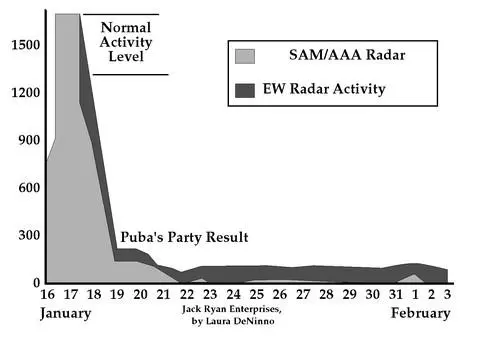
Iraqi Air Defense Radar Activity
Italian and British Tornadoes also suffered losses—all, save one, the result of low-level, low-altitude tactics. In fact, in the first two days of the war, approximately two-thirds of our losses were suffered by aircraft flying low-level tactics, even as the majority of our sorties were being flown at medium altitude.
Because they were taking on the most difficult, most well-defended targets outside of Baghdad, the RAF GR-1 Tornadoes were especially hard hit. Saudi and British Tornadoes were equipped with a munition designed to shut down airfields, the JP-233, which had to be delivered at low altitude. But the airfields bristled with defenses, especially AAA guns, which continued to take a discouraging toll of Tornadoes well after the F-111s and F-15Es got back up to medium altitude. The Tornadoes had few good alternatives to flying low altitude. And I had no alternative but to let them do it. If I was loath to dictate tactics to USAF wings, I was definitely not going to do it to an ally. But if I could find an opening to introduce the subject, I would.
One night at a gathering of national air commanders, I said, “We’ve gotten some experience in this war. This looks like a good place to take a look at what we are doing right and wrong. I suggest we form a multinational tactics team to evaluate our operations and suggest changes they think appropriate.”