Chapters (26)
- CAPTAIN COOK'S JOURNAL.FIRST VOYAGE.
- CAPTAIN COOK'S JOURNAL DURING HIS FIRST VOYAGE ROUND THE WORLD MADE IN H.M. BARK "ENDEAVOUR" 1768-71A Literal Transcription of the Original MSS.EDITED BY CAPTAIN W.J.L. WHARTON, R.N., F.R.S.
- PREFACE.
- SKETCH OF CAPTAIN COOK'S LIFE.
- PERSONS WHO LEFT ENGLAND IN H.M.S. ENDEAVOUR, 26TH AUGUST, 1768.
- A JOURNAL OF THE PROCEEDINGS OF HIS MAJESTY'S BARK ENDEAVOUR,ON A VOYAGE ROUND THE WORLD, BY LIEUTENANT JAMES COOK,COMMANDER, COMMENCING THE 25TH OF MAY, 1768.
- CHAPTER 1. ENGLAND TO RIO JANEIRO.
- CHAPTER 2. RIO JANEIRO TO TAHITI.
- MODERN CHART OF SOUTH PACIFIC OCEAN SHOWING TRACK OF H.M.S. ENDEAVOUR, 1769 TO 1770.
- CHAPTER 3. TAHITI.
- FACSIMILE OF SATURDAY, 3RD JUNE, 1769.
- CHART OF THE ISLAND OTAHEITE, BY LIEUTENANT JAMES COOK, 1769. REPRODUCTION OF THE ORIGINAL PUBLISHED CHART.
- TAHITI: TYPES OF CANOES.
- CHAPTER 4. TAHITI TO NEW ZEALAND.
- CHAPTER 5. EXPLORATION OF NORTH ISLAND OF NEW ZEALAND.
- CHAPTER 6. EXPLORATION OF MIDDLE ISLAND OF NEW ZEALAND.
- WAR CANOE OF NEW ZEALAND.
- CHAPTER 7. PASSAGE FROM NEW ZEALAND TO NEW HOLLAND.
- CHAPTER 8. EXPLORATION OF EAST COAST OF AUSTRALIA.
- CHAPTER 9. FROM TORRES STRAIT TO BATAVIA.
- TRACK OF ENDEAVOUR FROM TORRES STRAIT TO JAVA. AUGUST AND SEPTEMBER 1770.
- FACSIMILE OF TUESDAY, 23RD OCTOBER, 1770.
- CHAPTER 10. BATAVIA TO CAPE OF GOOD HOPE.
- CHAPTER 11. CAPE OF GOOD HOPE TO ENGLAND.
- INDEX.
- CHART OF NEW ZEALAND, EXPLORED IN 1769 AND 1770, BY LIEUTENANT J. COOK, COMMANDER OF HIS MAJESTY'S BARK ENDEAVOUR, ENGRAVED BY I. BAYLY.REPRODUCTION OF THE ORIGINAL PUBLISHED CHART.
The Houses or dwellings of these People are admirably calculated for the continual warmth of the Climate; they do not build them in Towns or Villages, but seperate each from the other, and always in the Woods, and are without walls, so that the air, cooled by the shade of the Trees, has free access in whatever direction it hapens to blow. No country can boast of more delightful walks than this; the whole Plains where the Natives reside are covered with groves of Bread Fruit and Cocoa Nut Trees, without underwood, and intersected in all directions by the Paths which go from House to House, so that nothing can be more grateful in a Climate where the sun hath so powerful an influence. They are generally built in form of an Oblong square, the Roofs are supported by 3 Rows of Pillars or posts, and neatly covered with Thatch made of Palm leaves. A middle-siz'd house is about 24 feet by 12, extream heigth about 8 or 9, and heigth of the Eves 3 1/2 or 4. The floors are cover'd some inches deep with Hay, upon which, here and there, lay matts for the conveniency of sitting down; few houses has more than one Stool, which is only used by the Master of the family.
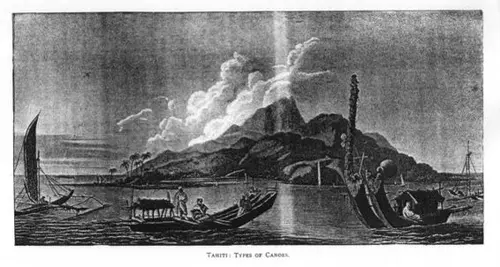
TAHITI: TYPES OF CANOES.
In their houses are no rooms or Partitions, but they all huddle and Sleep together; yet in this they generally observe some order, the Married people laying by themselves, and the unmarried each sex by themselves, at some small distance from each other. Many of the Eares or Chiefs are more private, having small movable houses in which they Sleep, man and Wife, which, when they go by Water from place to place, are tied upon their Canoes; these have walls made of Cocoa-Nut leaves, etc. I have said that the houses are without walls, but this is only to be understood in general, for many of them are walled with wickering, but not so close but to admit a free circulation of Air. The matts which serve them to sit upon in the daytime are also their beds in the night, and the Cloathes they wear in the day serve for covering, a little wood Stool, block of wood, or bundle of Cloth for a Pillow. Besides these common houses there are others much larger, 200 feet long and upwards, 30 broad, and 20 in heigth. There are generally 2 or 3 of these in every district, and seem'd not only built for the accommodation of the principal people, but common to all the inhabitants of that district, and raised and kept up by their joint Labour; these are always without walls, and have generally a large Area on one side neatly inclosed with low pallisades, etc.
[Tahitian Canoes.]