Chapters (28)
- Title Page
- Preface
- Acknowledgements
- CHAPTER ONE - Introduction
- Who Was Pol Pot?
- The First Year in Paris
- Joining the Viet Minh
- CHAPTER FIVE - “Red Khmer,” 1963—1970
- CHAPTER SIX - Coming to Power, 1970—1976
- CHAPTER SEVEN - Prairie Fire, 1976-1977
- Pol Pot in China and North Korea
- CHAPTER NINE - “Grandfather 87,” 1979—1998
- Chronology
- Appendix 1: - Non Suon’s Biography of Pol Pot
- Appendix 2: - Khmer Personnel at “Office 100,” 1963—1966
- Notes
- Chapter One
- Chapter Two
- Chapter Three
- Chapter Four
- Chapter Five
- Chapter Six
- Chapter Seven
- Chapter Eight
- Chapter Nine
- Interviews by Author
- Index
- Copyright Page
Others who have helped with correspondence, introductions, documents, conversation, and hospitality (in addition to those already listed) include Benedict Anderson, Eliza Anderson, David Ashley, Anthony Barnett, Jacques Bekaert, Elizabeth Becker, Anne Blair, Elaine Blumenthal, Georges Boudarel, Pierre Brocheux, Teri Caraway, Timothy Carney, Chea Samaun, Frances Doggett, Maurice Eisenbruch, Steven Erlanger, Grant Evans, David Feingold, David Garrioch, Marvin Gelfand, James Gerrand, Denis Grey, David Hawk, Murray Hiebert, Mary C. Jackson, Somsak Jeemtearaskul, Julio Jeldres, Justin Jordens, Peter Judd, George Kahin, E W Kent, Vorleak Leah, J. D. Legge, Hong Lim, Henri Locard, Mary-Kay Magistad, David Marr, Marie-A. Martin, Angus McIntyre, Chantal Mercier, David Monaghan, Roger Normand, Pham van Luu, Francois Ponchaud, Craig Reynolds, John Rickard, Kelvin Rowley, Jim Scott, Frank Smith, Sok Pirun, Sok Saroeun, Richard Tanter, Keith Taylor, Thel Tong, William Turley, Esta Ungar, and Karin von Strokirch.
The men and women I interviewed more formally are listed elsewhere. Without the help of all these people and institutions, I would never have been able to write this book. And without their enthusiasm and kindness, I would have had less enjoyment writing it.
D. C.
Paris
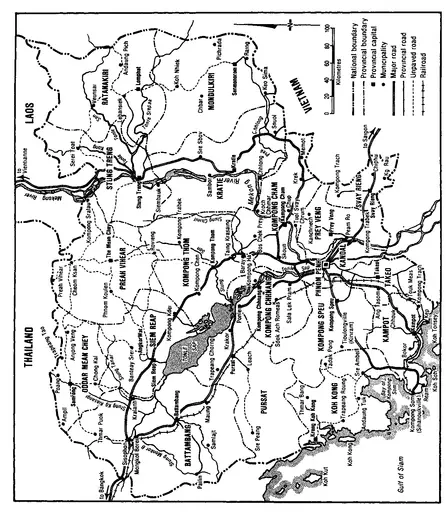
Cambodia, SOURCE: David Chandler, A History of Cambodia, 2nd ed. (boulder: Westview Press, 1992). Reprinted with permission.
CHAPTER ONE - Introduction

CHAPTER ONE
Introduction
On April 17, 1975, Cambodia emerged from five years of invasion, bombardment, and civil war when its capital, Phnom Penh, fell to the guerrilla armies known as the Khmer Rouge or Red Khmer, which had been besieging it since the beginning of the year. The city’s population included over one million refugees, driven from their homes in rural areas. During the course of the civil war, perhaps as many as half a million Cambodians had been killed. People in the cities, without knowing much about the Red Khmer, presumed that peace would be better than war and that Cambodians, working together, could reconstruct their country.
What happened next took everyone but the Red Khmer commanders by surprise. Within a week, the people of Phnom Penh, Battambang, and other cities were driven into the countryside by the Red Khmer and told to take up agricultural tasks. Thousands of evacuees, especially the very young and the very old, died over the next few weeks. Some survivors, walking toward regions where they hoped their relatives would welcome them, were on the road for over a month. When they asked questions of the heavily armed young soldiers who accompanied them, they were told to obey the “revolutionary organization” (angkar padevat), which would act as their “mother and father.” The evacuees were called “new people” or “April 17 people” because they had joined the revolution so late. Residents of the countryside were known as “base people” and were treated less harshly than the others.