Brother Number One
Title Page
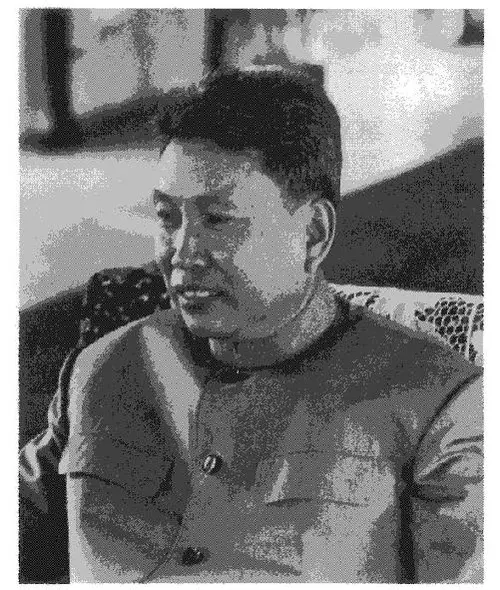
Pol Pot in Phnom Penh, December 1978. Photo by Richard Dudman. Courtesy of Sygma. Reprinted with permission. Copyright Sygma and Richard Dudman.
Chorus:
Who fights for communism must be able to fight and not to fight, to say the truth and not say the truth, to render and to deny service, to keep a promise and to break a promise, to go into danger and to avoid danger, to be known and to be unknown. Who fights for communism has of all the virtues only one: that he fights for communism.
Bertoldt Brecht, The Measures Taken
Preface

Preface to the Second Edition
I am grateful to my editors at Westview Press, Rob Williams and Kristin Milavec, the project editor, for encouraging me to prepare a second edition of this book. In bringing the narrative up to date, closing with Pol Pot’s death in April 1998, I have invaded the text and the end notes to insert new data and to correct minor errors pointed out by correspondents and reviewers. In addition, I have updated the bibliographical essay at the end of the book. The text has also benefited enormously from Jennifer Swearingen’s helpful copyediting.
In the time between the appearance of the first edition and Pol Pot’s death six years later, some interesting new biographical data have emerged, thanks in large part to enterprising research conducted by David Ashley, Chhang Youk, Stephen Heder, and Nate Thayer. I am grateful to these four people for providing me with transcripts or summaries of their interviews, and to Thayer for sending me a copy of Nuon Chea’s draft history of the “struggle movement,” which he composed in 1997. My own study of the S-21 archive in 1994—1998 revealed some new information about the Vietnamese military base known as “Office 100,” where Pol Pot and his colleagues sought refuge from Sihanouk’s police in the early 1960s; my interviews with Lim Keuky and a former Chinese diplomat speaking on condition of anonymity provided some insights, respectively, into Pol Pot’s early married life and into his friendship with the notorious Chinese official K‘ang Sheng. My revision of the final chapter benefited from conversations with Terry McCarthy, Seth Mydans, and Nate Thayer. The new data have altered the chronological outlines of Pol Pot’s life by making it four years longer, as I now prefer the birthdate of 1925 to the 1928 one I had supported in the first edition.
Pol Pot wanted to be judged by history, as his interview with Nate Thayer in October 1997 makes clear. Unfortunately from his point of view, perhaps, the material that has emerged about his life since 1992 has not made his personality any more accessible or his career any easier to admire.
David Chandler
Washington, D.C.
Acknowledgements

Acknowledgments
I am delighted to acknowledge the help and encouragement I’ve received while working on this book. Research began in 1987, when Sally Furgeson, then with Westview Press, wrote to suggest that I write a biography of Pol Pot. I was attracted by the challenge and accepted it at once, but because of prior commitments I wasn’t able to begin writing until 1990. I’m grateful to Ms. Furgeson and to Susan McEachern, who took over the project for Ms. Furgeson, for their patience and support. As the manuscript was being written and later, when she went over it, Ms. McEachern made many helpful suggestions. Deborah Lynes, the book’s editor, made helpful comments at several stages, and I benefited enormously from Michele Kendall’s fastidious, perceptive copyediting.
The Australian Research Council provided a generous grant, twice renewed, that defrayed the costs of research and overseas travel. At various times, I also received financial assistance from Yale University, the Social Science Research Council (New York), California State University at Long Beach, the Institute of International Strategic Studies, and the outside studies program of Monash University (Australia).
Kate Frieson, Christopher Goscha, Stephen Heder, and Serge Thion read the manuscript and suggested many improvements. My wife, Susan, read three successive versions. Without her insights and editorial skill, the book would be clumsier and more obtuse. Over the years, my work on Cambodia has profited from many discussions with these people, as well as with Nayan Chanda, Justin Corfield, May Ebihara, Claude Jacques, Ben Kiernan, Judy Ledgerwood, Jacques Nepote, Lionel Vairon, and Michael Vickery. Several of these friends have generously provided me with material from their personal archives unavailable elsewhere. My debts to the pioneering work on Cambodian radicalism by Heder, Kiernan, Thion, and Vickery should be apparent in the notes. When the book was nearly complete, I profited from the research in progress of J. Thomas Engelbert and Christopher Goscha; this research, since published, provided many valuable insights.
The collection of material took me to Cambodia, Canada, France, Thailand, and the United States. For hospitality and help in arranging interviews, I am particularly grateful to Lionel Vairon, Judy Ledgerwood, Mika Levesque, Tom Sakara, Suon Kaset Sokho, Serge Thion, Hin Sithan, Charles F. Keyes, and Vora Huy Kanthoul.
Others who have helped with correspondence, introductions, documents, conversation, and hospitality (in addition to those already listed) include Benedict Anderson, Eliza Anderson, David Ashley, Anthony Barnett, Jacques Bekaert, Elizabeth Becker, Anne Blair, Elaine Blumenthal, Georges Boudarel, Pierre Brocheux, Teri Caraway, Timothy Carney, Chea Samaun, Frances Doggett, Maurice Eisenbruch, Steven Erlanger, Grant Evans, David Feingold, David Garrioch, Marvin Gelfand, James Gerrand, Denis Grey, David Hawk, Murray Hiebert, Mary C. Jackson, Somsak Jeemtearaskul, Julio Jeldres, Justin Jordens, Peter Judd, George Kahin, E W Kent, Vorleak Leah, J. D. Legge, Hong Lim, Henri Locard, Mary-Kay Magistad, David Marr, Marie-A. Martin, Angus McIntyre, Chantal Mercier, David Monaghan, Roger Normand, Pham van Luu, Francois Ponchaud, Craig Reynolds, John Rickard, Kelvin Rowley, Jim Scott, Frank Smith, Sok Pirun, Sok Saroeun, Richard Tanter, Keith Taylor, Thel Tong, William Turley, Esta Ungar, and Karin von Strokirch.
The men and women I interviewed more formally are listed elsewhere. Without the help of all these people and institutions, I would never have been able to write this book. And without their enthusiasm and kindness, I would have had less enjoyment writing it.
D. C.
Paris
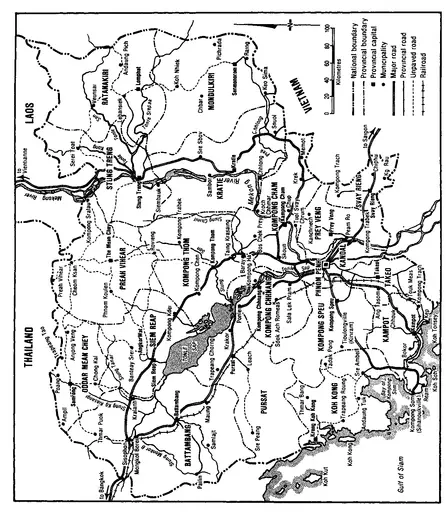
Cambodia, SOURCE: David Chandler, A History of Cambodia, 2nd ed. (boulder: Westview Press, 1992). Reprinted with permission.
CHAPTER ONE - Introduction

CHAPTER ONE
Introduction
On April 17, 1975, Cambodia emerged from five years of invasion, bombardment, and civil war when its capital, Phnom Penh, fell to the guerrilla armies known as the Khmer Rouge or Red Khmer, which had been besieging it since the beginning of the year. The city’s population included over one million refugees, driven from their homes in rural areas. During the course of the civil war, perhaps as many as half a million Cambodians had been killed. People in the cities, without knowing much about the Red Khmer, presumed that peace would be better than war and that Cambodians, working together, could reconstruct their country.
What happened next took everyone but the Red Khmer commanders by surprise. Within a week, the people of Phnom Penh, Battambang, and other cities were driven into the countryside by the Red Khmer and told to take up agricultural tasks. Thousands of evacuees, especially the very young and the very old, died over the next few weeks. Some survivors, walking toward regions where they hoped their relatives would welcome them, were on the road for over a month. When they asked questions of the heavily armed young soldiers who accompanied them, they were told to obey the “revolutionary organization” (angkar padevat), which would act as their “mother and father.” The evacuees were called “new people” or “April 17 people” because they had joined the revolution so late. Residents of the countryside were known as “base people” and were treated less harshly than the others.
After emptying the cities, the revolutionary organization embarked on a program of social transformation that affected every aspect of Cambodian life. Money, markets, and private property were abolished. Schools, universities, and Buddhist monasteries were closed. No publishing was allowed; the postal system was shut down; freedom of movement, exchange of information, personal adornment, and leisure activities were curtailed. Punishments for infractions were severe, and repeat offenders were imprisoned under harsh conditions or killed. Everyone was ordered to perform tasks set for them by the revolutionary organization. For evacuee city dwellers, these tasks seldom had any relation to their training or skills. Instead, nearly all of them became peasants and were made to wear identical black cotton clothing.
The movement’s leaders and their rationale remained concealed. To the outside world Cambodia was still ostensibly ruled by the United Front government, founded in Beijing in 1970 when Prince Norodom Sihanouk, Cambodia’s chief of state, had been overthrown in a bloodless coup while he was abroad, replaced by a government that sought an alliance with the United States. The prince had been the figurehead leader of the resistance in Beijing. By 1972 the Red Khmer controlled the resistance but for the sake of international respectability continued to operate behind the facade of Sihanouk’s coalition.
The charade continued for the remainder of 1975. In January 1976 the revolutionary organization dissolved the United Front, changed the name of the country to Democratic Kampuchea (DK), and promulgated a new constitution. The document praised collective values, identified the revolutionary organization with the people’s interests, and formalized the collectivization of Cambodian life. The words socialism or communism appeared nowhere in the text. Soon after, Radio Phnom Penh announced that elections would be held for a national assembly and broadcast the names of ministers in the new regime. The elections, it seemed, were primarily for overseas consumption. Most “new people” were not allowed to vote; “base people” voted for candidates provided by the organization.
Most of the winners were unknown outside the Red Khmer movement, although some of the new ministers, such as Ieng Sary, Khieu Samphan, and Hu Nim, were prominent leftists who had joined the resistance against Sihanouk in the 1960s. Others elected were identified sooner or later as veteran revolutionaries.
The prime minister, a “rubber plantation worker” called Pol Pot, was impossible to identify. At the moment he took power, just when he might have been expected to step into the open, he concealed himself behind a revolutionary name.
Who was he?
For over a year he revealed almost nothing about himself. When he made a state visit to China in September 1977 and was photographed there, Cambodia watchers identified Pol Pot as a fifty-two-year-old former schoolteacher named Saloth Sar, who had been secretary of the Central Committee of the clandestine Communist party of Kampuchea (CPK) since 1963. Pol Pot had announced the existence of the CPK for the first time in a triumphal speech recorded for Radio Phnom Penh just before he left for China. But very few Cambodians knew that Pol Pot was Saloth Sar. He admitted his former identity only after he was overthrown in 1979.
Mystery clung to him as news of what was happening in Cambodia between 1975 and 1978—the DK period—filtered into the outside world. Most of the news was horrible. Refugees spoke of forced labor, starvation, random executions, and the tyrannical, anonymous “organization.”
What did Pol Pot and his colleagues have in mind?
This handful of men and women presided over the purest and most thoroughgoing Marxist-Leninist movement in an era of revolutions. No other regime tried to go so quickly or so far. No other inflicted as many casualties on the country’s population.
At one level, the revolution was a courageous, doomed attempt by a group of utopian thinkers to break free from the capitalist world system, abandon the past, and rearrange the future. Many radicals in other countries interpreted events in Cambodia in this way. At another level, the revolution sprang from a colossal misreading of Cambodia’s political capacities, its freedom of maneuver vis-à-vis its neighbors, and the interests of the rural poor on whose behalf the revolution was ostensibly being waged. At a third level, Pol Pot and his colleagues displayed a thirst for power and an unlimited capacity for distrust. Believing himself surrounded by enemies, Pol Pot approved the torture and execution of almost fourteen thousand enemies (khmang) at the regime’s interrogation facility in Phnom Penh, known by the code name S-21. And thousands more died in the regional purges he set in motion in 1977. Most of those put to death at S-21 were loyal members of the party. Victims elsewhere seem, for the most part, to have been innocent of treason.
What were the sources of the revolution and its extraordinary violence? Between 1975 and 1979, those in power in Phnom Penh frequently declared that they followed no foreign models and that the Cambodian revolution was incomparable. In fact, many DK slogans—such as “storming attacks,” “leaps forward,” “independence-mastery,” and “three tons (of rice) per hectare”—came without acknowledgment from Communist China, where the regime, on the eve of Mao Zedong’s death in September 1976, was going through a peculiarly radical phase.
What the Cambodian leaders meant by independence, in large part, was that they were different from, and superior to, Vietnam, whose Communist movement had shaped and guided them for many years. Vietnamese guidance began to grate on Saloth Sar and his colleagues in the 1960s, when the Vietnamese treated them not as revolutionaries but as younger brothers in their all-absorbing war against the United States. Fighting between Cambodia and Vietnam erupted in 1977 and culminated two years later in a Vietnamese blitzkrieg that overthrew Pol Pot’s regime.
The mayhem that Democratic Kampuchea inflicted on its people led the French author Jean Lacouture to coin the word autogenocide—to differentiate events in Cambodia from previous pogroms, holocausts, purges, and vendettas. Lacouture’s horror, if not the word he coined, was justified by the facts. In less than four years, more than one million Cambodians, or one in seven, probably died from malnutrition, overwork, and misdiagnosed or mistreated illness. At least one hundred thousand, and probably more, were executed for crimes against the state. Tens of thousands perished in the conflict with Vietnam, almost certainly started by the Red Khmer. But was what happened autogenocide, without forerunners elsewhere? Clear parallels, and probably inspirations, can be found in China’s Great Leap Forward in the 1950s, in the Soviet collectivization of Ukraine twenty years before that, and in purges in both countries of “elements” considered dangerous to revolutionary leaders. In a sense, what happened in Cambodia, although more intense, was standard operating procedure in countries whose politics Pol Pot—or “Brother Number One,” as he was informally known to subordinates—admired.
The catastrophe of Democratic Kampuchea and its effects encourage an examination of Pol Pot’s political career to see what connections can be drawn between the man and what happened in Cambodia between 1975 and 1979, as well as before and since. The outline of his life has been known since the early 1980s, thanks to the path-breaking work of Australian scholar Ben Kiernan and several others. Recently, new sources have come to light that have made possible a longer, more detailed view of Pol Pot’s career than Kiernan reached in his book, which dealt primarily with the period before 1975.1
Much of what has been written about Pol Pot since his time in power has been reckless and intemperate. This is not surprising in view of the impact of the revolution; but calling him a “moon-faced monster,” a “genocidal maniac,” or “worse than Hitler” (phrases picked from journalists’ reports) has no explanatory power. To understand the man and what happened in Democratic Kampuchea, we need to place him inside a Cambodian context and inside a wider set of influences from abroad.
During my research, I talked with several people who had been to school with Saloth Sar in the 1940s, who had known him in Paris or who had known him as a schoolteacher in Phnom Penh. Those who encountered him during his years in power were more discreet with anecdotal evidence, but from all these sources, as well as printed and archival material, I was able to build a consistent, but rather two-dimensional, picture. This has been enhanced, but not deepened, by interviews conducted by others since 1992.2
None of the people I spoke to—including several who live thousands of miles from Cambodia and whose families were savaged by the Pol Pot regime—were prepared to associate the person they had known with the horrors of the 1970s. Victims of Pol Pot’s regime, they were unwilling to alter or deny their relatively pleasant recollections of the man.
To his brother and sister-in-law, for example, Saloth Sar was a sweet-tempered, equable child. Schoolmates remembered him as a mediocre student but pleasant company, a reputation that persisted among those who knew him in France. As a teacher, he was remembered as calm, self-assured, smooth featured (s‘aat s’om), honest, and persuasive, even hypnotic when speaking to small groups. Among his students and his colleagues in the clandestine Communist movement, he seems in these years to have gained some of the moral authority and stature he enjoyed among his followers up to 1997. A man who met him in the late 1950s, for example, said, “I saw immediately that I could become his friend for life.” Similar testimony has emerged in confessions from S-21 and in the 1980s and 1990s from Red Khmer defectors who attended Pol Pot’s political seminars in Thailand and Cambodia. None of the defectors, although they were free to do so (as those being tortured at S-21 were not), singled out Pol Pot’s behavior or personality as a reason for betraying the party or, in the 1980s, for deserting the Communist movement. Instead, most of them came away with memories of a man they regarded almost as a saint.
With witnesses like these, and Pol Pot’s own writings, it has been impossible for me to penetrate what may be a facade, a series of masks, or a chosen repertoire of skills to discover a rougher, more diabolical, supposedly more genuine Pol Pot. Throughout his life, the man seems to have tailored his performance to fit the people he was with, making a “genocidal maniac” hard to find. Indeed, the disjunction between his genteel charisma and the death toll of his regime is one of the mysteries that hangs over his career and poses serious difficulties in trying to make sense of his life.
The concealment or absence of conflict in Pol Pot’s personal life has also made it difficult to reach sweeping or persuasive psychological conclusions about him. Was he only apparently a happy child and an inspiring teacher? Was his kindly manner faked? Was he a cynical political animal, a true believer, or a mélange of both? Was he a paranoid nourished by a sense of betrayal or persecution, or a utopian who saw his vision wrecked by others? Is there a difference? His own writings and speeches, which avoid personal details, provide little information to help us answer any of these questions. Even after his two-hour interview with Nate Thayer in 1997, less than a year before he died, Pol Pot defies analysis.3
Pol Pot’s lifetime overlaps the story of Cambodian politics since World War II. His revolutionary movement benefited from Vietnamese help during its formative years and during Vietnam’s war with the United States. Without the war, Pol Pot’s coming to power, like Sihanouk’s demise, is inconceivable.4
Saloth Sar/Pol Pot was also a product of twentieth-century Cambodian society. From that society, he fought against, and ironically benefited from, a deeply rooted sense of hierarchy that frequently permitted a single man, properly positioned, nicely behaved, and thought to be meritorious, to exercise enormous power. Like most Khmer of his generation, he was incurious about the outside world. He distrusted foreigners and their intentions toward his country. From Cambodian Buddhism, he absorbed the ideas of disciplined personal transformation, rebirth, and enlightenment—found within the privileged, otherworldly communities of monks or Communists—through teaching, “right action,” self-denial, and meditation. As a teacher, he automatically enjoyed high status—another legacy of Buddhism.5
Although Pol Pot was introspective and xenophobic, his ideas and his career were shaped to a large extent by foreign influences. France, as a colonial power, provided him with seventeen years of formal education and the only foreign language he is known to have spoken. This education introduced him to the idea of progress and the concepts of democracy, imperialism, and revolutionary change. His three years in Paris, where he encountered Marxist-Leninist ideas, led him to adopt a radical alignment—he probably joined the Communist party of France (CPF) in 1952.
When Saloth Sar returned to Cambodia in early 1953, he became a member of the Vietnamese-dominated Indochina Communist party (ICP). For several years he worked from concealment to accomplish its objectives. From his Vietnamese-trained mentors, he learned about party discipline, organization, and theory, as well as the importance of clandestinity and concealment. The Vietnamese, for their part, seem to have assumed that he was loyal to them.
The Story Continues on BooksBarbecue!
Enjoyed this preview? ❤️ Do not stop here!
Read the complete book free online → 🔗
Continue reading now on BooksBarbecue and discover every page!
Love reading? Bookmark BooksBarbecue.com for more amazing books!
Happy Reading!