Chapters (28)
- Title Page
- Preface
- Acknowledgements
- CHAPTER ONE - Introduction
- Who Was Pol Pot?
- The First Year in Paris
- Joining the Viet Minh
- CHAPTER FIVE - “Red Khmer,” 1963—1970
- CHAPTER SIX - Coming to Power, 1970—1976
- CHAPTER SEVEN - Prairie Fire, 1976-1977
- Pol Pot in China and North Korea
- CHAPTER NINE - “Grandfather 87,” 1979—1998
- Chronology
- Appendix 1: - Non Suon’s Biography of Pol Pot
- Appendix 2: - Khmer Personnel at “Office 100,” 1963—1966
- Notes
- Chapter One
- Chapter Two
- Chapter Three
- Chapter Four
- Chapter Five
- Chapter Six
- Chapter Seven
- Chapter Eight
- Chapter Nine
- Interviews by Author
- Index
- Copyright Page
When the Khmer delegation returned to Phnom Penh, it learned that Vietnamese forces had recently crossed into Cambodia in retaliation for Cambo-dian attacks on Tay Ninh. The Vietnamese had clearly timed some of their attacks to coincide with Pol Pot’s visit to China to indicate their displeasure and reveal their military strength.6 The attacks by either side were still kept secret from the outside world. To understand why war broke out between Cambodia and Vietnam, we must look at the history and geopolitics of the region and at how the region was affected by the Sino-Soviet split and by deteriorating relations between China and Vietnam.
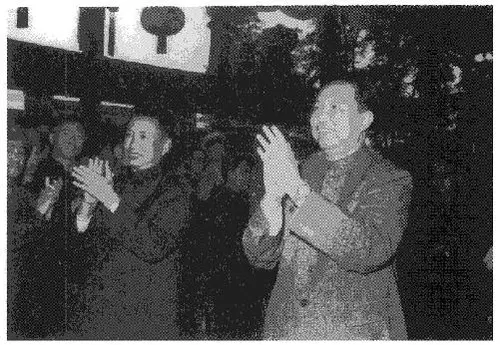
Pol Pot (left) in Beijing, October 1977, with Chinese Premier Hua Guofeng.
Since the seventeenth century, if not before, the major foreign policy concern of most Cambodian rulers has been Cambodia’s relations with Vietnam. Cambodia’s accessibility, low population, and desirable resources have made it a tempting target for the Vietnamese. At the same time, the cultural division between Cambodia and Vietnam, until recently, was one of the widest in Southeast Asia. For centuries, Vietnamese disdain and Khmer distrust have colored relations between the two nations and thwarted mutual understanding.
Pol Pot and his colleagues were nurtured in the Communist movement by the Vietnamese. The Cambodian Communist party took the form it did under Vietnamese guidance to back up Vietnam’s war with the United States. With Cambodia’s own victory, the Red Khmer declared their independence from Vietnam, expunging Vietnam from party histories and making brutal raids across the frontier. The evidence suggests that Cambodia’s leaders had always resented Vietnamese patronage. With victory, they considered themselves invulnerable because of the purity of their revolution and because of Chinese and Korean support.
To the Vietnamese Communists, Cambodia was never especially important, except as a zone to protect southern Vietnam from capitalist Thailand. Correct but cool relations with the Red Khmer were adequate for the Vietnamese, who faced massive tasks of reconstruction and political unification after their war with the United States. With Red Khmer intransigence about the borders in 1976, followed by subversion among the Cambodian minority in southern Vietnam and military attacks the following year, Cambodia became a problem that called for a politico-military solution by Vietnam. Given the balance of forces, Cambodia’s humiliation became a matter of time.