Chapters (43)
- Cover Page
- The Witch
- ACKNOWLEDGEMENTS
- ABBREVIATIONS
- INTRODUCTION
- FURTHER READING
- The Witch
- [DRAMATIS PERSONAE]
- THE WITCH
- [Act I,] Scene ii
- Act II, Scene i
- [Act II,] Scene ii
- [Act II,] Scene iii
- Act III, Scene i
- [Act III,] Scene ii
- [Act III,] Scene iii
- Act IV, Scene i
- [Act IV,] Scene ii
- [Act IV,] Scene iii
- Act V, Scene i
- [Act V,] Scene ii
- [Act V,] Scene iii
- APPENDIX
- In a maiden time profess’d
- Come Away, Hecate!
- Notes
- Thomas Holmes, Esquire
- Act I, Scene i
- [Act I,] Scene ii
- Act II, Scene i
- [Act II,] Scene ii
- [Act II,] Scene iii
- Act III, Scene i
- [Act III,] Scene ii
- [Act III,] Scene iii
- Act IV, Scene i
- [Act IV,] Scene ii
- Act IV Scene iii
- Act V, Scene i
- [Act V,] Scene ii
- [Act V,] Scene iii
- Appendix
- Footnotes
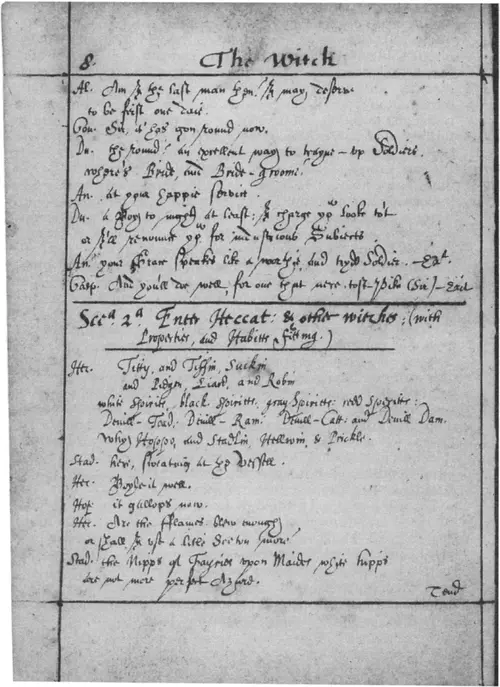
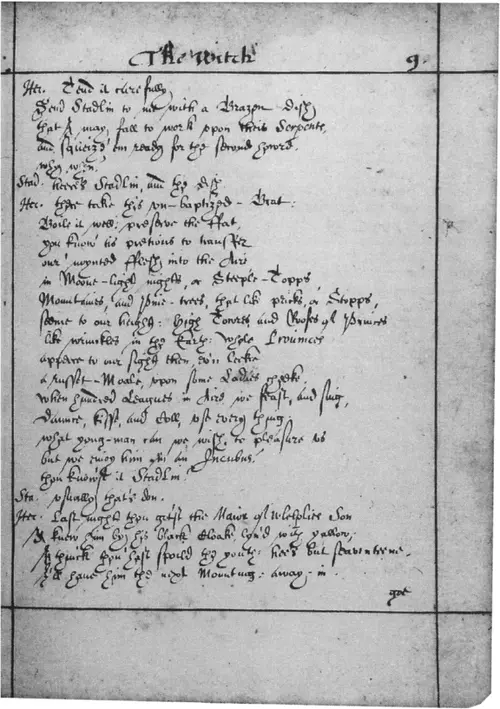
Crane edited as well as transcribed – he may well have edited out some profanity as he did in other texts – but it is largely impossible to conjecture what he may have changed or misread. When we compare a Crane transcript with a Middleton manuscript of A Game at Chess, patterns in Crane’s alterations (usually expansions) of Middleton’s favourite elisions appear. However, this edition follows Crane’s elisions most of the time and modernises elisions such as ‘h’as’ (I.i.40, 41) for clarity. Crane also occasionally uses elision to mark the omission of a word such as ‘the’ or ‘is’.
Crane often marks entries early, but some entries and exits he does not mark at all. I have altered stage entrances and exits wherever it seems appropriate.
It is often difficult to tell whether Crane is representing verse or prose: prose lines are not written out as markedly longer than verse lines, and he does not capitalise the first word of a verse line. This problem is compounded by Middleton’s flexible verse forms, which make the distinction between the two unclear. Certain characters (Firestone, Almachildes) seem to use prose more frequently, but many of the verse/prose distinctions in this edition are not meant to be categorical.
The Witch was first printed by Isaac Reed in 1778. It has been edited several times since, and several new editions are about to be published. The nineteenth-century editions tend to punctuate very heavily and to regularise the verse lines over-enthusiastically.
In this edition spelling has been modernised, abbreviations have been expanded and substantive changes to the copy text have been recorded in the notes. Spelling has also been modernised in the quotations from Scot and Jonson.
FURTHER READING
A. A. Bromham, ‘The Date of The Witch and the Essex Divorce Case’, NQ 225 (1980), 149–52
A. A. Bromham and Zara Bruzzi, ‘The Changeling’ and the Years of Crisis, 1619–24 (1990)
Peter Corbin and Douglas Sedge, eds., Three Jacobean Witchcraft Plays, Revels Plays Companion Library (1986)
Inga-Stina Ewbank, ‘The Middle of Middleton’, in The Arts of Performance in Elizabethan and Early Stuart Drama: Essays for G. K. Hunter, ed. Murray Biggs et al. (1991)
Margot Heinemann, Puritanism and Theatre: Thomas Middleton and Opposition Drama under the Early Stuarts (1980)
Anne Lancashire, ‘The Witch: Stage Flop or Political Mistake?’ in ‘Accompaninge the Players’, Essays in Celebration of Thomas Middleton, 1580–1980, ed. Kenneth Friedenreich (1983)
John F. McElroy, Parody and Burlesque in the Tragicomedies of Thomas Middleton (1972)
Keith Thomas, Religion and the Decline of Magic (1971)
Beatrice White, Cast of Ravens: The Strange Case of Sir Thomas Overbury (1965)
The Witch
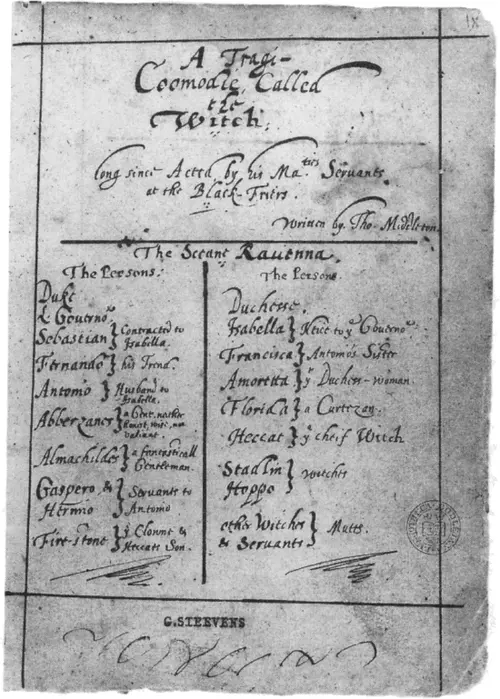
The Bodleian Library, Oxford, MS Malone 12, title page
[DRAMATIS PERSONAE]
A Tragi-Comedy, called ‘The Witch’
Long since acted by his Majesty’s Servants at the Blackfriars, written by Thomas Middleton.