The Witch
Cover Page
The Witch

THE NEW MERMAIDS
General Editor: Brian Gibbons
Professor of English Literature, University of Münster
THE NEW MERMAIDS
The Alchemist
All for Love
Arden of Faversham
The Atheist’s Tragedy
Bartholmew Fair
The Beaux’ Stratagem
The Broken Heart
Bussy D’Ambois
The Changeling
A Chaste Maid in Cheapside
The Country Wife
The Critic
The Devil’s Law-Case
The Double-Dealer
Dr Faustus
The Duchess of Malfi
Eastward Ho!
Edward the Second
Epicoene or The Silent Woman
Every Man in His Humour
A Fair Quarrel
An Ideal Husband
The Importance of Being Earnest
The Jew of Malta
The Knight of the Burning Pestle
Lady Windermere’s Fan
London Assurance
Love for Love
The Malcontent
The Man of Mode
Marriage A-la-Mode
A New Way to Pay Old Debts
The Plain Dealer
The Playboy of the Western World
The Provoked Wife
The Recruiting Officer
The Relapse
The Revenger’s Tragedy
The Rivals
The School for Scandal
She Stoops to Conquer
The Shoemaker’s Holiday
The Spanish Tragedy
Tamburlaine
Three Late Medieval Morality Plays
Mankind
Everyman
Mundus et Infans
Thyestes
’Tis Pity She’s a Whore
Volpone
The Way of the World
The White Devil
The Witch
A Woman Killed with Kindness
A Woman of No Importance
Women Beware Women
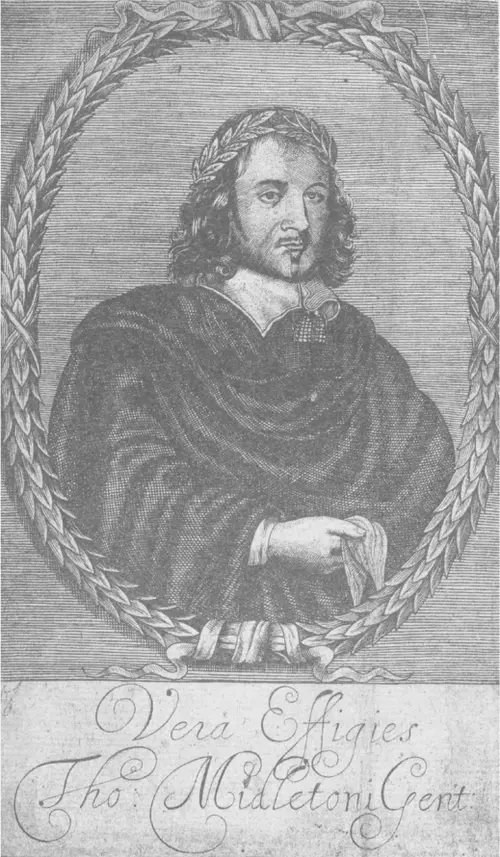
Portrait of Thomas Middleton from Dyce Collection 25 E 46 reproduced by courtesy of the Board of Trustees of the V & A
The Witch

THOMAS MIDDLETON
Edited by
ELIZABETH SCHAFER
Royal Holloway, University of London

ACKNOWLEDGEMENTS
Thanks to Richard Allen Cave, Richard Proudfoot, Ian Spink, David Ward and the general editor, Brian Gibbons, for comments and suggestions, and to William C. Carroll for his article on the author.
ABBREVIATIONS
Editions of the play cited
| Revels | Three Jacobean Witchcraft Plays, ed. Peter Corbin and Douglas Sedge, Revels Plays Companion Library (1986) |
| Dyce | The Works of Thomas Middleton, ed. A. Dyce (1840) |
Periodicals and reference works
| Chambers | E. K. Chambers, The Elizabethan Stage (1923) |
| Grove | The New Grove Dictionary of Music and Musicians, ed. Stanley Sadie (1980) |
| Masque of Queens | Ben Jonson, Masque of Queens, ed. C. H. Herford, Percy and Evelyn Simpson, vol. 7 (1941) |
| NQ | Notes and Queries |
| OED | Oxford English Dictionary |
| Scot | Reginald Scot, The Discovery of Witchcraft, reprint of the 1584 edition (1973) |
| Tilley | M. P. Tilley, A Dictionary of Proverbs in England in the Sixteenth and Seventeenth Centuries (1950) |
Works by Middleton
| CM | A Chaste Maid in Cheapside. All references to the works of Middleton are to A. H. Bullen’s 8-volume edition (1885). |
| s.d. | stage direction |
| s.h. | speech heading |
Shakespeare references are to The Riverside Shakespeare, ed. G. Blakemore Evans (1974).
INTRODUCTION
THE AUTHOR
THOMAS MIDDLETON lived and worked in London nearly all his life.1 Born in 1580, he was christened at St Lawrence Jewry on 18 April, and was buried on 4 July 1627 at his parish church in Newington Butts, where he had lived from at least 1609. His father, William, was a bricklayer and gentleman with his own coat of arms; he died in January 1585/86, and in November 1586 his widow, Anne, married Thomas Harvey, who had just returned, impoverished, from a voyage to Virginia. Within weeks of the marriage, Harvey was revealed to be an unscrupulous adventurer, almost solely interested in gaining control of his wife’s estate. A protracted, confusing and ugly series of lawsuits engulfed the family over the next two decades, all beginning with Harvey’s attempt to take over the property which Anne had put in trust for her children before she met him. Allen Waterer, who married Middleton’s sister, Avis, in 1596, immediately became a party to the lawsuits as well. By 1603, when both Anne Harvey and Allen Waterer died, Middleton had spent a good part of his time assisting his mother in the various legal battles. Even after Waterer’s death, Avis and her second husband, John Empson, continued legal action over the family property.
Middleton’s life was early and frequently connected to the professional theatre. A large part of the family property at question in the various lawsuits was ‘the grounde called the Curteyn where now comenlye the Playes be playde’ – that is, the Curtain Theatre (built in 1577). After matriculating at Queen’s College, Oxford (the most popular college of the time) in April 1598, moreover, Middleton was forced in June 1600 to convey his half-share of the Curtain property to his brother-in-law Waterer for money ‘paid and disbursed for my advauncement & preferment in the university of Oxford where I am nowe a student’. Some time during the next eight months, however, he had to return to London to deal with the continuing series of lawsuits, and it was reported, as of 8 February 1600/1, that Middleton ‘remaynethe heare in London daylie accompaninge the players’. In a final twist, Middleton’s brother-in-law Thomas Marbeck was an actor for the Admiral’s Men; Middleton thus may have met his wife through this association. Middleton in any event never graduated from Oxford, and was already a professional playwright at the time he would have been receiving his diploma.
Since his son Edward was aged nineteen in 1623, we assume Middleton was married about 1602. His wife, Magdalen (she is ‘Maria’ or Mary in one document), was the granddaughter of the famous composer and organist John Marbeck; Eccles believes she was probably the Maulyn Marbeck christened on 9 July 1575 at St Dunstan’s in the West. Middleton’s widow petitioned in February 1627/28 for a gift of money from the city of London, which suggests that his estate had been small. She died five months later, in July 1628, and was also buried at Newington.
Middleton published one book of verse. The Wisdom of Solomon Paraphrased (1597), before he entered Oxford, and two more, Micro-Cynicon (1599) and the Ghost of Lucrece (1600), while presumably still a student. In 1602 Henslowe recorded that he was working on three plays: a collaboration with Dekker, Munday, Drayton and Webster on Caesar’s Fall (now lost); Randal, Earl of Chester (also lost); and an unnamed play. Two years later, in 1604, he published two satiric prose pieces, The Black Book and The Ant and the Nightingale. His earliest surviving play, The Family of Love (c. 1602–3), also dates from this period. If the quality of these early works is debatable, it is clear that, after he left Oxford, Middleton was both an active and a highly productive writer. Beginning in 1613 and continuing until his death, he also wrote a number of civic pageants and entertainments; as early as 1604, he had written a speech given as part of Dekker’s The Magnificent Entertainment for King James’s official entry into London. Middleton was appointed City Chronologer in 1620, to record the memorable acts and occurrences of the city; he was succeeded in this position by Ben Jonson.
Middleton wrote in a variety of genres, but his greatest achievements came in two distinct dramatic forms: (1) city comedies, including Michaelmas Term (c. 1605), A Mad World, My Masters (c. 1605), A Trick to Catch the Old One (c. 1606) and A Chaste Maid in Cheapside (c. 1611–13); and (2) tragedies, including The Revenger’s Tragedy (c. 1606–7), Women Beware Women (c. 1621) and The Changeling, with William Rowley (1622). Middleton’s accomplishments in tragicomedy – The Witch (c. 1615), A Fair Quarrel (c. 1615–17) and The Old Law (1618), among others – were also substantial. In 1624 he wrote the political satire A Game at Chess, which had the longest consecutive run of any play in the Jacobean period (indeed, the first long run in English theatrical history), nine days at the Globe, and caused a sensation in London; the play was finally suppressed by the government, though it had been properly licensed. Middleton and the players were summoned before the Privy Council (his son Edward answered for him, as Middleton seems to have been lying low), but no action was taken.
Middleton wrote for the children’s companies of Paul’s and Blackfriars, and after they disbanded, for Prince Henry’s (formerly the Admiral’s) Men, the Lady Elizabeth’s company, and for Shakespeare’s company, the King’s Men. He collaborated on plays with many other dramatists of the period, possibly with Shakespeare himself on Timon of Athens, and seems to have revised Shakespeare’s Macbeth some years after its first performance.2 From his inheritance in The Curtain to his pageants for the city, Middleton’s whole life traces the arc of the recently invented career of the professional playwright.
WILLIAM C. CARROLL
DATE
I believe The Witch to have been written in 1615–16. The manuscript states that the play was ‘long since acted, by his majesty’s servants at the Black friars’. This ‘long since’ has to be placed by the date of the manuscript, which is likely to be between 1619 – the date of the first recorded dramatic transcript by Ralph Crane, the scribe who produced the manuscript – and 1627, the date of Middleton’s death. (Although the manuscript is not signed by Middleton, the epistle suggests that he was personally involved with it.) The play is likely to date from after 1609–10, as before that date ‘his majesty’s servants’, that is the King’s Men, Shakespeare’s theatre company, did not use the Blackfriars theatre. Middleton seems to have started writing regularly for the King’s Men around 1614–15.
Some have argued that The Witch was influenced or inspired by Ben Jonson’s Masque of Queens (presented on 2 February 1609). More recently commentators have dated the play between 1613 and 1616, believing it to be related to a contemporary scandal involving the Howard family, the Earl of Essex, Robert Carr, a Scottish favourite of James I and later Earl of Somerset, and Sir Thomas Overbury. The evidence for this is summarised in the section below on topical satire (pp. xv-xix). I believe that The Witch was written late in the Overbury affair as deliberate, particularised and dangerous satire which was suppressed by the government before it could have the sort of success Middleton was to have later with another political satire, A Game at Chess.
In his Oxford edition of Macbeth Nicholas Brooke discusses the dating implications of the music written for the songs in The Witch.3 One song, ‘Come away, Hecate!’, which also appears in Macbeth, appears with music in a collection in which most of the music is known to be by Robert Johnson, who worked for the King’s Men from 1609 to around 1615. The other song in The Witch that has its original music, ‘In a maiden-time professed’, is by John Wilson, who was born in 1595 and worked for the King’s Men from around 1615 onwards. The fact that he composed the music for this song suggests a date for The Witch around 1613–15 because he would have been too young to be working for the King’s Men much earlier (the earliest music known to be by him dates from 1614). The intersection between these two careers suggests a date for The Witch that also fits in logically with the tragicomedies Middleton was writing around 1615–16, such as A Fair Quarrel.
Middleton’s play A Chaste Maid in Cheapside (c. 1613) also offers several analogues with The Witch: the comic construing joke of Il.ii. (cf. CM I.i.65–77); the emphasis on drink in Francisca’s lying-in (cf. CM’s treatment of Mistress Allwit’s delivery); the casual abandonment of Francisca’s unwanted baby (cf. CM II.ii); and the duke unexpectedly rising from the dead (cf. the rising up from the dead of Moll and Touchwood junior).
If The Witch was written and suppressed around 1615, the revival of interest in the scandal about Frances and Carr when they were released from the Tower in 1622 may have inspired the dedicatee Thomas Holmes’s interest in the play. Equally the success of the satire of A Game at Chess (1624) may have stirred his interest in an earlier politically sensitive play written by the same author. Andrew Gurr points out that plays which survive in manuscript form are often controversial ones;4 the fact that The Witch was written on the same batch of paper as one of the manuscripts of A Game at Chess suggests an association with this extremely controversial play.5
SOURCES
The main source for much of the witchcraft material in The Witch is Reginald Scot’s Discovery of Witchcraft (1584), a humane and intelligent book that treats witchcraft sceptically: it argues that many of the women executed as witches were in fact senile, confused or brow-beaten. Scot’s book was burnt in the Scotland of James VI as an outlawed and heretical treatise, and the king wrote Demonology (1597, reprinted in 1603 as soon as James became King of England) in part to refute Scot.6 Middleton often uses Scot verbatim, as will be seen from footnotes to the witch scenes, especially I.ii. Although no audience would recognise Scot as Middleton’s source, the fact that when Middleton wanted detail on witch practices he went to a sceptical source is suggestive of his general strategy in this play, which I believe to be satiric.
The Witch also uses Thomas Bedingfield’s 1595 version of Machiavelli’s Florentine History as a source for the story of the duchess’s revenge for being forced to drink from a cup made of the skull of her father. G. B. Cinthio’s 4th novella of the fourth day in Hecatommithi (1574) has been identified along with Tourneur’s The Atheist’s Tragedy as a source for Isabella’s story and the plot of the woman tricked into a never-to-be-consummated marriage when she is presented with faked evidence that her true love is dead.7 Jonson’s Masque of Queens has been suggested as a source of witch material and also possibly of costumes (hypothetically used in the masque and then passed on to the actors to be used in the first performance of The Witch); however, much of the common ground between the Masque of Queens and The Witch seems unremarkable given their shared interest in presenting witches on-stage. Virgil’s Eclogues 8 is clearly a source for the love charm in II.ii, and the text Middleton used has been identified through the mistake he copied from it.8 Contemporary scandal (the Overbury affair) also constitutes a source.
Macbeth is in some ways a source for The Witch, but the relationship between the two plays is very complex. Until recently critics have constructed the relationship in ways which worked to the disadvantage of Middleton’s play. Because The Witch was believed to have failed in the theatre, the fact that it shares two songs and some dialogue with Macbeth was interpreted as proving that Macbeth was damaged by the ‘inferior’ material that Middleton added to it when he revised it in 1609 or 1610. The traditional view was that Shakespeare could not have authorised such interpolations. It is true that the songs fit more closely with the characters and situations of The Witch than with those of Macbeth, but it is simplistic just to disparage Middleton’s interpolations, as so many editors of Macbeth have done. Recently the opposite critical approach to these passages has appeared. For example, Anne Lancashire, after arguing that the artistic merit of The Witch has been undervalued, suggests (p. 174) that after the play was suppressed, Macbeth was revived partly to keep The Witch’s political satire in circulation. Inga-Stina Ewbank follows Lancashire’s lead, noting how the first Jacobean audience could see The Witch ‘in the same playhouse and with the same cast’ as ‘they had seen the tragedy of Macbeth’.9
The two songs that appear in both the Folio text of Macbeth and The Witch are ‘Come away, Hecate!’ (Macbeth III.v; The Witch III.iii) and ‘Black spirits’ (Macbeth IV.i, The Witch V.ii). In neither case does the Folio text of Macbeth provide the full text of the songs, and until the two recent Oxford editions most editors of Shakespeare followed suit.10 Consequently these songs are rarely performed as part of Macbeth.
Brooke’s edition of Macbeth is remarkable for taking the songs from The Witch seriously, and he proposes the following hypoth esis: Middleton wrote ‘Come away, Hecate!’ when he was revising Macbeth in 1609–10, and in 1615, when he was writing The Witch, he reused the song. (Brooke (p. 58) cites R. V. Holds-worth’s work on other instances of Middleton’s reuse of songs from plays he had written earlier.) This theory also fits what we know about the music composed for The Witch (see p. xii) by Robert Johnson (‘Come away, Hecate!’) and John Wilson (‘In a maiden-time professed’). The use of two different composers suggests that they collaborated or worked at different periods. Brooke favours the latter theory, suggesting that when Middleton came to write ‘his entertainingly bawdy burlesque of witchcraft’ in The Witch, he already had a ‘cast and themes to develop’ from his work on Macbeth (p. 66).
The relationship between The Witch and Macbeth is rendered still more complicated by the fact that two possible mistakes in Ralph Crane’s transcription of The Witch – e.g. III.iii.71: ‘steepe’ for ‘steeple’; V.ii.70: ‘againe’ for ‘a grain’ – can be deduced from William Davenant’s Restoration adaptation of Macbeth, which includes the Hecate additions and songs. Davenant worked for the King’s Men in the 1630s, and it is assumed that he used a playhouse copy of Macbeth as the basis for his adaptation.
TOPICAL SATIRE
A summary of the sensational events of the scandal involving Frances Howard, the Earl of Essex, Robert Carr and Sir Thomas Overbury will help demonstrate their relevance to The Witch.11
Frances Howard was married to Robert Devereux, Earl of Essex, in 1606, when she was thirteen and he was fourteen. Because of their youth, the marriage was not consummated, and the Earl went travelling in Europe. When he returned in 1609 Frances was no longer interested in him. She had been leading a lively existence at court and may have had an affair with Prince Henry, James I’s eldest son, before starting an affair with Robert Carr. On 25 September 1613, Frances secured a divorce from Essex – after much active support and lobbying by James I – and on Sunday, 26 December 1613, Frances married Carr. The wedding celebrations included a masque by Middleton (now lost) called The Masque of Cupid.12 The grounds for the divorce were that Essex was subject to witchcraft and could not have sex with his wife, although he was not rendered incapable in relation to other women. The claim that Essex had been bewitched occasioned much gossip, particularly because the ‘proof’ included a test for Frances’s virginity; she was physically examined by several women, but the fact that she appeared for the examination veiled led to speculation that she knew she could not pass the test and persuaded another woman to take her place.
It was subsequently discovered that Frances had paid various people to practise witchcraft against Essex and also by witchcraft to bind Robert Carr’s affections to her alone. These dealings came to light in the course of the investigation into the death of Sir Thomas Overbury (d. September 1613), a close associate and probably lover of Carr for many years, who had implacably opposed Carr’s marriage to Frances. Frances had paid for witchcraft against Overbury, but when she found that this was not working, she attempted to have him poisoned. It is unclear what role Carr played in this; he always maintained his innocence, and it is possible that Overbury died from the effects of potions he was taking through choice at the time. Those who had attempted to poison Overbury, Frances’s accomplices, were all executed, but when both Carr and Frances were tried in 1616 and found guilty, they were merely sent to the Tower. They were released in 1622, shortly before Middleton and Rowley’s play The Changeling was licensed. The Changeling may indicate a renewed interest in the scandal as it seems to make reference to it – most obviously in the virginity test of IV.i.13
The intersections between this scandal and The Witch can be summarised as follows:
a) A woman of murderous inclinations named Frances/Francisca. There is the pun Frances Carr/Francisca, if the last syllable of ‘Francisca’ is stressed.
b) A separation between a man (Antonio, Essex) and wife (Isabella, Frances) to allow the remarriage of the wife (to Sebastian, Carr) as a virgin in circumstances where the fact of the virginity is stressed and is supposedly a result of the first husband being bewitched.
c) Sensational poisoning narratives. The duchess tries to murder her husband; Frances was rumoured to have attempted to poison Essex. The duchess attempts to murder Almachildes because he is in the way of her marriage to the Lord Governor, which would be politically advantageous for her. This parallels the attempt by Frances to have Overbury, the underling who opposed her marriage to Carr, murdered.
d) A court environment like that of James I.
e) An interest in love charms. The charms Almachildes uses to win Amoretta are like those Frances used to secure Carr’s attentions. In order to stress the love charm element, Middleton was willing to allow the plot to creak audibly (the coincidence of Amoretta and the duchess having the same names). This suggests that Middleton’s main focus was not plausible narrative but topical satire.
The Story Continues on BooksBarbecue!
Enjoyed this preview? ❤️ Do not stop here!
Read the complete book free online → 🔗
Continue reading now on BooksBarbecue and discover every page!
Love reading? Bookmark BooksBarbecue.com for more amazing books!
Happy Reading!