Chapters (42)
- Contents
- The Cast
- The Stage
- Map of Venice
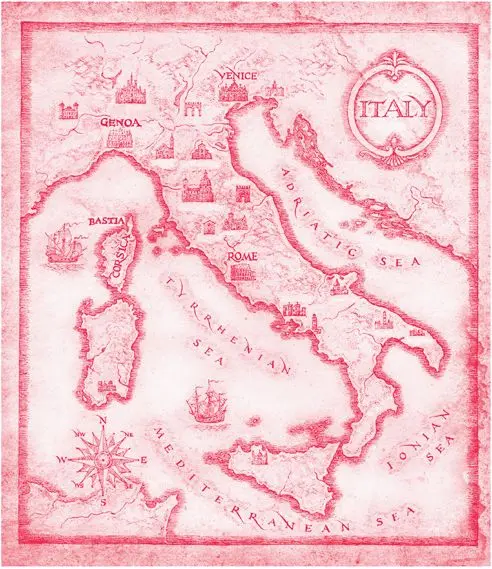
- Map of Italy
- Act I: Fortunato’s Fate
- One: The Trap
- Two: The Dark
- Three: A Spot of Bother
- Four: How Much for the Monkey?
- Five: Ladies of the Lagoon
- Six: The Players
- Act II: The Watery City
- Seven: La Giudecca
- Eight: A Pound of Flesh
- Nine: Two Thousand Nine Hundred and Ninety-nine Golden Ducats
- Ten: Intrigue Beneath the Bawd
- Eleven: Siren Ascending
- Twelve: To Belmont and Beyond
- Act III: The Moor of Venice
- Thirteen: Bold and Saucy Wrongs
- Fourteen: A World of Sighs
- Fifteen: What Wicked Webs
- Sixteen: A Nasty Piece of Work
- Seventeen: A Fool’s Ransom
- Act IV: The Green-eyed Monster
- Eighteen: Cloak, Dagger, Wimple, and Veil
- Nineteen: Well Met in Corsica Once More
- Twenty: The Art of Persuasion
- Act V: A Pound of Flesh
- Twenty-one: Savage Puppets
- Twenty-two: No Shit, Shylock
- Twenty-three: The Trial
- Twenty-four: The Verdict
- Twenty-five: Arise! Black Vengeance!
- Twenty-six: Off Jolly Rogering!
- Afterword
- About the Author
- Also by Christopher Moore
- Credits
- Copyright
- About the Publisher
Map of Italy
MAP OF ITALY
Act I: Fortunato’s Fate
ACT I
Fortunato’s Fate
Hell and Night must bring this monstrous birth to light.
—Iago, Othello, Act I, Scene 3
CHORUS:
INVOCATION
Rise, Muse!
Darkwater sprite,
Bring stirring play
To vision’s light.
Rise, Muse!
On fin and tail
With fang and claw
Rend invention’s veil.
Come, Muse!
’Neath harbored ship,
Under night fisher’s torch,
And sleeping sailors slip.
To Venice, Muse!
Radiant venom convey,
Charge scribe’s driven quill
To story assay.
Of betrayal, grief and war,
Provoke, Muse, your howl
Of love’s laughter lost and
Heinous Fuckery, most foul . . .
One: The Trap
ONE
The Trap
They waited at the dock, the three Venetians, for the fool to arrive.
“An hour after sunset, I told him,” said the senator, a bent-backed graybeard in a rich brocade robe befitting his office. “I sent a gondola myself to fetch him.”
“Aye, he’ll be here,” said the soldier, a broad-shouldered, fit brute of forty, in leather and rough linen, full sword and fighting dagger at his belt, black bearded with a scar through his right brow that made him look ever questioning or suspicious. “He thinks himself a connoisseur, and can’t resist the temptation of your wine cellar. And when it is done, we shall have more than Carnival to celebrate.”
“And yet, I feel sad,” said the merchant. A soft-handed, fair-skinned gent who wore a fine, floppy velvet hat, and a gold signet ring the size of a small mouse, with which he sealed agreements. “I know not why.”
They could hear the distant sounds of pipes, drums, and horns from across the lagoon in Venice. Torches bounced on the shoreline near Piazza San Marco. Behind them, the senator’s estate, Villa Belmont, stood dark but for a storm lantern in an upper window, a light by which a gondolier might steer to the private island. Out on the water, fishermen had lit torches, which bobbed like dim, drunken stars against the inky water. Even during Carnival, the city must eat.
The senator put his hand on the merchant’s shoulder. “We perform service to God and state, a relief to conscience and heart, a cleansing that opens a pathway to our designs. Think of the bounteous fortune that will find you, once the rat is removed from the granary.”
“But I quite like his monkey,” said the merchant.
The soldier grinned and scratched his beard to conceal his amusement. “You’ve seen to it that he comes alone?”
“It was a condition of his invitation,” said the senator. “I told him out of good Christian charity all his servants were to be dismissed to attend Carnival, as I assured him I had done with my own.”
“Shrewdly figured,” said the soldier, looking back to the vast, unlit villa. “He’ll think nothing out of order then when he sees no attendants.”
“But monkeys can be terribly hard to catch,” said the merchant.