The Serpent of Venice
Contents
CONTENTS
The Cast
The Stage
Map of Venice
Map of Italy
Act I: Fortunato’s Fate
One: The Trap
Two: The Dark
Three: A Spot of Bother
Four: How Much for the Monkey?
Five: Ladies of the Lagoon
Six: The Players
Act II: The Watery City
Seven: La Giudecca
Eight: A Pound of Flesh
Nine: Two Thousand Nine Hundred and Ninety-nine Golden Ducats
Ten: Intrigue Beneath the Bawd
Eleven: Siren Ascending
Twelve: To Belmont and Beyond
Act III: The Moor of Venice
Thirteen: Bold and Saucy Wrongs
Fourteen: A World of Sighs
Fifteen: What Wicked Webs
Sixteen: A Nasty Piece of Work
Seventeen: A Fool’s Ransom
Act IV: The Green-eyed Monster
Eighteen: Cloak, Dagger, Wimple, and Veil
Nineteen: Well Met in Corsica Once More
Twenty: The Art of Persuasion
Act V: A Pound of Flesh
Twenty-one: Savage Puppets
Twenty-two: No Shit, Shylock
Twenty-three: The Trial
Twenty-four: The Verdict
Twenty-five: Arise! Black Vengeance!
Twenty-six: Off Jolly Rogering!
Afterword
About the Author
Credits
Also by Christopher Moore
Copyright
About the Publisher
The Cast
THE CAST
Chorus—a narrator
Antonio—a Venetian merchant
Brabantio—a senator of Rome, father of Desdemona and Portia
Iago—a soldier
Rodrigo—a gentleman soldier, friend of Iago
Pocket—a fool
Portia—a lady, younger daughter of Brabantio, sister to Desdemona
Nerissa—maid to Portia
Desdemona—a lady, elder daughter of Brabantio, sister to Portia
Emilia—wife of Iago, maid to Desdemona
Othello—a Moor, commanding general of the Venetian military
Shylock—a Jew, Venetian moneylender, father of Jessica
Jessica—Shylock’s daughter
Bassanio—friend of Antonio, suitor to Portia
Lorenzo—friend of Antonio, suitor to Jessica
Gratiano—young friend of Antonio, a merchant
Salanio—young friend of Antonio, a merchant
Salarino—also a young friend of Antonio, interchangeable with Salanio, may have been born of a typo
Drool—a fool’s apprentice
Jeff—a monkey
Cordelia—a ghost. There’s always a bloody ghost.
The Stage
THE STAGE
The stage is a mythical late-thirteenth-century Italy, where independent city-states trade and war with one another. Venice has been at war with Genoa, off and on, for fifty years, over control of the shipping routes to the Orient and the Holy Land.
Venice has been an independent republic for five hundred years, governed by an elected senate of 480 men, who in turn elect a doge, who, advised by a high council of six senators, oversees the senate, the military, and civil appointments. Senators come mostly from Venice’s powerful merchant class, and until recently could be elected, by neighborhood, from any walk of life. But the system that has made Venice the richest and most powerful maritime nation in the world has changed. Recently, privileged senators, interested in passing the legacy of power and wealth to their families, voted to make their elected positions inheritable.
Strangely, although most of the characters are Venetian, everybody speaks English, and with an English accent.
Unless otherwise described, assume conditions to be humid.
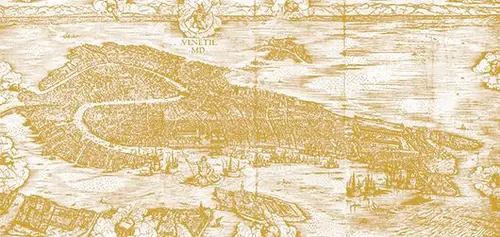
Map of Venice
MAP OF VENICE
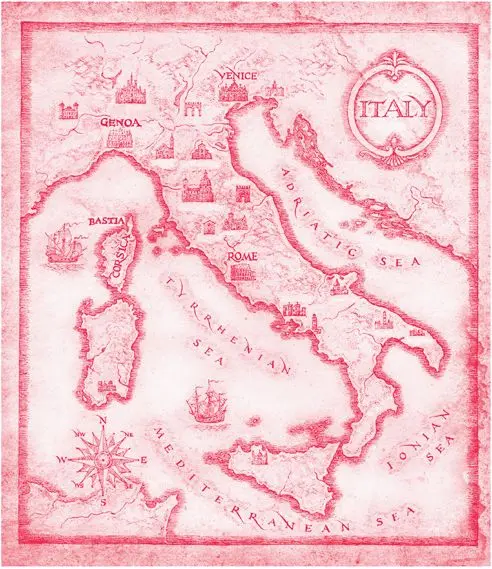
Map of Italy
MAP OF ITALY
Act I: Fortunato’s Fate
ACT I
Fortunato’s Fate
Hell and Night must bring this monstrous birth to light.
—Iago, Othello, Act I, Scene 3
CHORUS:
INVOCATION
Rise, Muse!
Darkwater sprite,
Bring stirring play
To vision’s light.
Rise, Muse!
On fin and tail
With fang and claw
Rend invention’s veil.
Come, Muse!
’Neath harbored ship,
Under night fisher’s torch,
And sleeping sailors slip.
To Venice, Muse!
Radiant venom convey,
Charge scribe’s driven quill
To story assay.
Of betrayal, grief and war,
Provoke, Muse, your howl
Of love’s laughter lost and
Heinous Fuckery, most foul . . .
One: The Trap
ONE
The Trap
They waited at the dock, the three Venetians, for the fool to arrive.
“An hour after sunset, I told him,” said the senator, a bent-backed graybeard in a rich brocade robe befitting his office. “I sent a gondola myself to fetch him.”
“Aye, he’ll be here,” said the soldier, a broad-shouldered, fit brute of forty, in leather and rough linen, full sword and fighting dagger at his belt, black bearded with a scar through his right brow that made him look ever questioning or suspicious. “He thinks himself a connoisseur, and can’t resist the temptation of your wine cellar. And when it is done, we shall have more than Carnival to celebrate.”
“And yet, I feel sad,” said the merchant. A soft-handed, fair-skinned gent who wore a fine, floppy velvet hat, and a gold signet ring the size of a small mouse, with which he sealed agreements. “I know not why.”
They could hear the distant sounds of pipes, drums, and horns from across the lagoon in Venice. Torches bounced on the shoreline near Piazza San Marco. Behind them, the senator’s estate, Villa Belmont, stood dark but for a storm lantern in an upper window, a light by which a gondolier might steer to the private island. Out on the water, fishermen had lit torches, which bobbed like dim, drunken stars against the inky water. Even during Carnival, the city must eat.
The senator put his hand on the merchant’s shoulder. “We perform service to God and state, a relief to conscience and heart, a cleansing that opens a pathway to our designs. Think of the bounteous fortune that will find you, once the rat is removed from the granary.”
“But I quite like his monkey,” said the merchant.
The soldier grinned and scratched his beard to conceal his amusement. “You’ve seen to it that he comes alone?”
“It was a condition of his invitation,” said the senator. “I told him out of good Christian charity all his servants were to be dismissed to attend Carnival, as I assured him I had done with my own.”
“Shrewdly figured,” said the soldier, looking back to the vast, unlit villa. “He’ll think nothing out of order then when he sees no attendants.”
“But monkeys can be terribly hard to catch,” said the merchant.
“Would you forget about the monkey,” growled the soldier.
“I told him that my daughter is terrified of monkeys, could not be in the same room with one.”
“But she isn’t here,” said the merchant.
“The fool doesn’t know that,” said the soldier. “Our brave Montressor will cast his younger daughter as bait, even after having the eldest stolen from the hook by a blackfish.”
“The senator’s loss cuts deep enough without your barbs,” said the merchant. “Do we not pursue the same purpose? Your wit is too mean to be clever, merely crude and cruel.”
“But, sweet Antonio,” said the soldier. “I am at once clever, crude, and cruel—all assets to your endeavor. Or would you rather partner with the kindly edge of a more courtly sword?” He laid his hand on the hilt of his sword.
The merchant looked out over the water.
“I thought not,” said the soldier.
“Put on friendly faces, you two.” The senator stepped between them and squinted into the night. “The fool’s boat approaches. There!”
Amid the fishing boats a bright lantern drifted, and slowly broke rank as the gondola moved toward them. In a moment it was gliding into the dock, the gondolier so precise in his handling of the oar that the black boat stopped with its rails only a handsbreadth from the dock. A louvered hatch clacked open and out of the cabin stepped a wiry little man dressed in the black-and-silver motley and mask of a harlequin. By his size, one might have thought him a boy, but the oversize codpiece and the shadow of a beard on his cheek betrayed his years.
“One lantern?” said the harlequin, hopping up onto the dock. “You couldn’t have spared an extra torch or two, Brabantio? It’s dark as night’s own nutsack out here.” He breezed by the soldier and the merchant. “Toadies,” he said, nodding to them. Then he was on his way up the path to the villa, pumping a puppet-headed jester’s scepter as he went. The senator tottered along behind him, holding the lantern high to light their way.
“It’s an auspicious night, Fortunato,” said the senator. “And I sent the servants away before nightfall so—”
“Call me Pocket,” said the fool. “Only the doge calls me Fortunato. Wonder that’s not his nickname for everyone, bloody bung-fingered as he is at cards.”
At the dock, the soldier again laid hand on sword hilt, saying, “By the saints, I would run my blade up through his liver right now, and lift him on it just to watch that arrogant grin wither as he twitched. Oh how I do hate the fool.”
The merchant smiled and talked through his teeth as he pressed the soldier’s sword hand down, throwing a nod toward the gondolier, who was standing on his boat, waiting. “As do I, in this pantomime we perform for Carnival, he is our jibing clown. Ha! The Punchinello in our little puppet show, all in good fun, am I right?”
The soldier looked to the boatman and forced a grin. “Quite right. All in good cheer. I play my part too well. One moment, signor. I will have your instructions.” He turned and called up the path. “Montressor! The gondolier?”
“Pay him and tell him to go, be merry, and return at midnight.”
“You heard him,” said the soldier. “Go celebrate, but not so much that you cannot steer. I would sleep in my own bed this night. Pay him, Antonio.” The soldier turned and headed up the path.
“Me? Why is it always me?” He dug into his purse. “Very well, then.” The merchant tossed a coin to the gondolier, who snatched it out of the air and bowed his head in thanks. “Midnight then.”
“Midnight, signor,” said the gondolier, who twisted his oar, sending the gondola sliding away from the dock silent and smooth as a knife through the night.
Outside the grand entrance of the palazzo the fool paused. “What’s that above your door, Montressor?” There was a coat of arms inlaid in the marble, ensconced in shadow. The senator held up his lantern, illuminating the crest, showing the relief of a man’s foot in gold, trampling a jade serpent, even as its fangs pierced the heel.
“My family crest,” said the senator.
“Reckon they were all out of proper dragons and lions down at the crest shop so you had to settle for this toss, eh?”
“Think they’d have thrown in a fleur-de-lis,” said the fool’s puppet stick, in a voice just a note above the fool’s own. “Montressor’s fucking French, innit?”
The senator whirled around to face the puppet. “Montressor is a title bestowed upon me by the doge. It means ‘my treasure’ and notes that he holds me highest in regard of the six senators of the high council. This is the crest of the family Brabantio, one our family has worn with pride for four hundred years. Do note the motto, fool, ‘Nemo me impune lacessit.’ ” He bounced the lantern with each syllable as he read through gritted teeth. “It means, ‘No one attacks me with impunity.’ ”
“Well, that’s not fucking French,” said the puppet, turning to look at the fool.
“No,” said the fool. “The puppet Jones is quite fluent in fucking French,” he explained to the senator.
“But Montressor is French, right?”
“Froggy as a summer day on the Seine,” said the fool.
“Thought so,” said the puppet.
“Stop talking to that puppet!” barked the senator.
“Well, you were just shouting at him,” said the fool.
“And now I’m shouting at you! You are working the puppet’s mouth and giving it voice.”
“No!” said the puppet, his wooden jaw agape, looking to the fool, then to the senator, then back to the fool. “This bloody toss-bobbin is running things?”
The fool nodded; the bells on his hat jingled earnestly.
The puppet turned to the senator. “Well, if you’re going to be a bastard about it, your bloody motto is nicked.”
“What?” said the senator.
“Plagiarized,” said the fool, still nodding solemnly, the bringer of sad news.
The merchant and the soldier had caught up to them and could see that their host was incensed, so they stood at the bottom of the steps, watching. The soldier’s hand fell to the hilt of his sword.
“It’s the Scottish motto, innit?” said the puppet. “Bloody Order of the Fistle.”
“It’s true,” said the fool. “Although it’s Thistle, not Fistle, Jones, you Cockney berk.”
“What I said,” said the puppet Jones. “Piss off.”
The fool glared at the puppet, then turned back to the senator. “Same motto is inscribed over the entrance to Edinburgh Castle.”
“You must be remembering it wrong. It is in Latin.”
“Indeed,” said the fool. “And I am raised by nuns in the bosom of the church. Could speak and write Latin and Greek before I could see over the table. No, Montressor, your motto couldn’t be more Scottish if it was painted blue and smelled of burning peat and your ginger sister.”
“Stolen,” said the puppet. “Pilfered. Swiped. Filched, as it fucking were. A motto most used, defiled, and besmirched.”
“Besmirched?” said the fool. “Really?”
The puppet nodded furiously on the end of his stick. The fool shrugged to the senator. “A right shite crest and a motto most besmirched, Montressor. Let’s hope this amontillado you’ve promised can comfort us in our disappointment.”
The merchant stepped up then and put his hand on the fool’s shoulder. “Then let’s waste no more time out here in the mist. To the senator’s cellar and his cask of exquisite amontillado.”
“Yes,” said the senator. He stepped through the doorway into a grand foyer, took tapers from a credenza, lit them from his lantern, and handed one to each of his guests. “Mind your step,” said the senator. “We’ll be going down ancient stairs to the very lowest levels of the palazzo. Some ceilings will be quite low, so, Antonio, Iago, watch your heads.”
“Did he just besmirch our height?” asked the puppet.
“Can’t say,” said the fool. “I’m not entirely sure I know what besmirched means. I’ve just been going along with you because I thought you knew what you were talking about.”
“Quiet, flea,” growled the soldier.
“That there’s a besmirchin’, “ said the puppet.
“Oh, well, yes then,” said the fool. He raised his taper high, illuminating a thick coat of mold on the low ceiling. “So, Montressor, is the lovely Portia waiting down here in the dark?”
“I’m afraid my youngest daughter will not be joining us. She’s gone to Florence to buy shoes.”
They entered a much wider vault now, with casks set into the walls on one side, racks of dusty bottles on the other; a long oak table and high-backed chairs ran down the middle. The senator lit lanterns around the chamber until the entire room was bathed in a warm glow that belied the dampness that permeated the cellar.
“Just as well,” said the fool. “She’d just be whingeing about the dark and the damp and how Iago reeks of squid and we’d never get any proper drinking done.”
“What?” said the soldier.
The fool leaned into Antonio and bounced his eyebrows so they showed above his black mask. “Don’t get me wrong, Portia’s a luscious little fuck-bubble to be sure, but prickly as a gilded hedgehog when she doesn’t get her way.”
The senator looked up with murderous fire in his eyes, then quickly looked down and shuddered, almost, it seemed, with pleasure.
“I do not reek of squid,” said the soldier, as if overcome by a rare moment of self-consciousness. He sniffed at the shoulder of his cape, and finding no squidish aroma, returned his attention to the senator.
“If you’d be so kind as to decant the amontillado, Iago,” said the senator, “we can be about getting the opinion of this distinguished connoisseur.”
“I never said I was a connoisseur, Montressor. I just said I’d had it before and it was the mutt’s nuts.”
“The dog’s bollocks,” said the puppet, clarifying.
“When you were king of Spain, correct?” said the merchant, with a grin and a sarcastic roll of the eyes toward the senator.
“I’ve had various titles,” said Fortunato. “Only fool seems constant.”
The soldier cradled the heavy cask under his arm as if he was strangling a bullnecked enemy and filled a delicate Murano glass pitcher with the amber liquid.
The senator said: “The wine dealer has five more casks coming from Spain. If you pronounce it genuine, I’ll buy the others and have one sent round to you in thanks.”
“Let’s have a taste, then,” said the fool. “Although, without it’s poured by a properly wanton, olive-skinned serving wench, you can’t really call it authentic, but I suppose Iago will have to suffice.”
“Won’t be the first time he’s filled that role, I’ll wager,” said the puppet Jones. “Lonely nights in the field, and whatnot.”
The soldier grinned, set the cask on the table, and with a nod from the senator poured the sherry into four heavy glass tumblers with pewter bases cast in the shape of winged lions.
“To the republic,” said the senator, raising his glass.
“To the Assumption,” said the merchant. “To Carnival!”
“To Venice,” said the soldier.
“To the delicious Desdemona,” said the fool.
And the merchant nearly choked as he looked to the senator, who calmly drank, then lowered his glass to the table, never looking from the fool.
“Well?”
The fool swished the liquid in his cheeks, rolled his eyes at the ceiling in consideration, then swallowed as if enduring an especially noxious medicine. He shuddered and looked over the rim of his glass at the senator. “I’m not sure,” he said.
“Well, sit, try a bit more,” said the merchant. “Sometimes the first drink only clears the dust of the day off a man’s palate.”
The fool sat, as did the others. They all drank again. The glasses clunked down. The three looked to the fool.
“Well?” asked Iago.
“Montressor, you’ve been had,” said the fool. “This is not amontillado.”
“It’s not?” said the senator.
“Tastes perfect to me,” said the merchant.
“No, it’s not amontillado,” said the fool. “And I can see from your face that you are neither surprised nor disappointed. So while we quaff this imposter—which tastes a bit of pitch, if you ask me—shall we turn to your darker purpose? The real reason we are all here.” The fool drained his glass, leaned on the table, and rolled his eyes coyly at the senator in the manner of a flirting teenage girl. “Shall we?”
The soldier and the merchant looked to the senator, who smiled.
“Our darker purpose?” asked the senator.
“Tastes of pitch?” asked the merchant.
“Not to me,” said the soldier, now looking at his glass.
“Do you think me a fool?” said the fool. “Don’t answer that. I mean, do you think me foolish? An ill-formed question as well.” He looked at his hand and seemed surprised to find it at the end of his wrist, then looked back to the senator. “You brought me here to convince me to rally the doge for you, to back another holy war.”
“No,” said the senator.
“No? You don’t want a bloody war?”
“Well, yes,” said the soldier. “But that’s not why we’ve brought you here.”
“Then you wish me to entreat my friend Othello to back you in a Crusade, from which you all may profit. I knew it when I got the invitation.”
“Hadn’t thought about it,” said the senator. “More sherry?”
The fool adjusted his hat, and when the bells jingled he followed one around with his eyes and nearly went over backward in his chair.
Antonio, the merchant, steadied the fool, and patted his back to reassure him.
The fool pulled away, and regarded the merchant, looking him not just in the eye, but around the eyes, as if they were windows to a dark house and he was looking for someone hiding inside.
“Then you don’t want me to use my influence in France and England to back a war?”
The merchant shook his head and smiled.
“Oh balls, it’s simple revenge then?”
Antonio and Iago nodded.
The fool regarded the senator, and seemed to have difficulty focusing on the graybeard. “Everyone knows I’m here. Many saw me board the gondola to come here.”
“And they will see a fool return,” said the senator.
“I am a favorite of the doge,” slurred the fool. “He adores me.”
“That is the problem,” said the senator.
In a single motion the fool leapt from his chair to the middle of the table, reached into the small of his back, and came up with a wickedly pointed throwing dagger, which caught his eye as it flashed in his hand before him. He wobbled and shook his head as if to clear his vision.
“Poison?” he said, somewhat wistfully. “Oh, fuckstockings, I am slain—”
His eyes rolled back in his head, his knees buckled, and he fell face-forward on the table with a thump and a rattle of his blade across the floor.
The three looked from the prostrate Fortunato to each other.
The soldier felt the fool’s neck for a pulse. “He’s alive, but I can remedy that.” He reached for his dagger.
“No,” said the senator. “Help me get him out of his clothes and to a deeper section of the cellar, then take your leave. You last saw him alive, and you can swear on your soul that is all you know.”
Antonio the merchant sighed. “It’s sad we must kill the little fool, who, while wildly annoying, does seem to bring mirth and merriment to those around him. Yet I suppose if there is a ducat to be made, it must be made. If a profit blossoms, so must a merchant pluck it.”
“Duty to God, profit, and the republic!” said the senator.
“Many a fool has found his end trying to resist the wind of war,” said Iago. “So shall this one.”
Two: The Dark
TWO
The Dark
What are you doing?” I asked.
“I’m walling you up in the dungeon,” said the senator, who crouched in the arched doorway to the chamber in which I was chained to the wall.
“No you’re not,” said I.
Indeed, it appeared that he was walling me up, but I wasn’t going to concede that simply because I was chained, naked, and water was rising about my feet. Cautious, I was, not to instill a sense of confidence in my enemy.
The Story Continues on BooksBarbecue!
Enjoyed this preview? ❤️ Do not stop here!
Read the complete book free online → 🔗
Continue reading now on BooksBarbecue and discover every page!
Love reading? Bookmark BooksBarbecue.com for more amazing books!
Happy Reading!