Chapters (90)
- Title Page
- Copyright Notice
- Contents
- Maps
- Chapter 1
- Chapter 2
- Chapter 3
- Chapter 4
- Chapter 5
- Chapter 6
- Chapter 7
- Chapter 8
- Chapter 9
- Chapter 10
- Chapter 11
- Chapter 12
- Chapter 13
- Chapter 14
- Chapter 15
- Chapter 16
- Chapter 17
- Chapter 18
- Chapter 19
- Chapter 20
- Chapter 21
- Chapter 22
- Chapter 23
- Chapter 24
- Chapter 25
- Chapter 26
- Chapter 27
- Chapter 28
- Chapter 29
- Chapter 30
- Chapter 31
- Chapter 32
- Chapter 33
- Chapter 34
- Chapter 35
- Chapter 36
- Chapter 37
- Chapter 38
- Chapter 39
- Chapter 40
- Chapter 41
- Chapter 42
- Chapter 43
- Chapter 44
- Chapter 45
- Chapter 46
- Chapter 47
- Chapter 48
- Chapter 49
- Chapter 50
- Chapter 51
- Chapter 52
- Chapter 53
- Chapter 54
- Chapter 55
- Chapter 56
- Chapter 57
- Chapter 58
- Chapter 59
- Chapter 60
- Chapter 61
- Chapter 62
- Chapter 63
- Chapter 64
- Chapter 65
- Chapter 66
- Chapter 67
- Chapter 68
- Chapter 69
- Chapter 70
- Chapter 71
- Chapter 72
- Chapter 73
- Chapter 74
- Chapter 75
- Chapter 76
- Chapter 77
- Chapter 78
- Chapter 79
- Chapter 80
- Chapter 81
- Chapter 82
- Chapter 83
- Acknowledgments
- By Kim Stanley Robinson from Tom Doherty Associates
- Copyright
Houston grimaces. “The necessary dwell time is just too long, Mac. Too long.” He sighs. “It’s always been the toughest requirement in the whole system’s architecture, if you ask me. The Soviets have got their fast-burn boosters down to sixty seconds, so most of their ICBMs will only be in boost phase for that minute, and half that time they’ll be in the atmosphere where the lasers won’t do much. So for our purposes we’re talking about a window of thirty seconds.”
He scribbles down the figures on the tablecloth as he talks, nervously, without looking at them, as if they are his signature or some other deeply, even obsessively memorized sign. tB = 30.
“Now, during that time we’ve got to locate the ICBMs, track them, and get the mirrors into the correct alignment to bounce the lasers. Art’s team has got that down to around ten seconds, which is an incredible technical feat, by the way.” He nods mulishly, writes tT = 10. “And then there’s the dwell time, the time the beam has to be fixed on the missile to destroy it.” He writes tD = , hesitates, leaves the other side of the equation blank.
“You told the Air Force we could pulse a large burst of energy, right?” McPherson asks. “So the damage is done by a shock wave breaking the skin of the missile?”
Dan nods. “That’s right.”
“So dwell time should be short.”
“That’s right! That’s right. Dwell time should be on the order of two seconds. That means that each laser station can destroy N missiles, where,” and he writes:
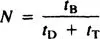
“However,” Dan continues carefully, looking down on the simple equation, one of the basic Field-Spergels that he has to juggle every day, “dwell time in fact depends on the hardness of the missile, the distance to the target, the brightness of the laser beam, and the angle of the incidence between the beam and the surface of the missile.” He writes down H, B, R, and 0, and then, obsessively, writes down this equation too, another Field-Spergel:
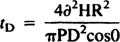
“And we’ve been getting figures for hardness of about forty kilojoules per square centimeter.” He writes H = 40 KJcm2. “Our lasers have twenty-five megawatts of power hitting ten-meter-diameter mirrors at wavelength two point seven nanometers, so even with the best angle of incidence possible, dwell time is,” and he writes, very carefully:
tD = 53 seconds.
“What?” says McPherson. “What happened to this pulse shock wave?”