The Dictionary of Lost Words
Chapters (42)
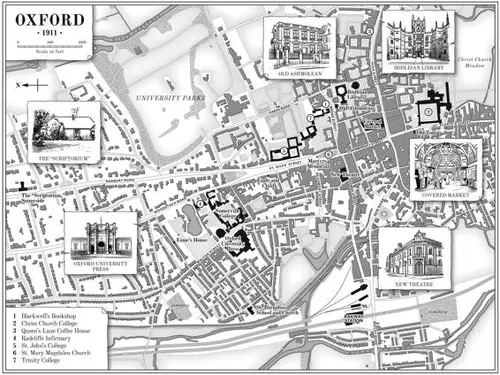
- Map
- Prologue | February 1886
- PART 1 | 1887–1896
- May 1887
- April 1888
- April 1891
- August 1893
- September 1896
- PART 2 | 1897–1901
- August 1897
- April 1898
- September 1898
- August 1901
- PART 3 | 1902–1907
- May 1902
- May 1906
- June 1906
- December 1906
- March 1907
- PART 4 | 1907–1913
- September 1907
- November 1907
- November 1908
- May 1909
- December 1912
- January 1913
- May 1913
- PART 5 | 1914–1915
- August 1914
- May 1915
- July 1915
- September 1915
- PART 6 | 1928
- November 1928
- Epilogue | Adelaide, 1989
- Author’s Note
- Dedication
- Acknowledgements
- Timeline of the Oxford English Dictionary
- Timeline of Major Historical Events Featured in the Novel
- About the Author
- What’s next onyour reading list?
Map
Prologue | February 1886
Before the lost word, there was another. It arrived at the Scriptorium in a second-hand envelope, the old address crossed out and Dr. Murray, Sunnyside, Oxford, written in its place.
It was Da’s job to open the post and mine to sit on his lap, like a queen on her throne, and help him ease each word out of its folded cradle. He’d tell me what pile to put it on and sometimes he’d pause, cover my hand with his, and guide my finger up and down and around the letters, sounding them into my ear. He’d say the word, and I would echo it, then he’d tell me what it meant.
This word was written on a scrap of brown paper, its edges rough where it had been torn to match Dr. Murray’s preferred dimensions. Da paused, and I readied myself to learn it. But his hand didn’t cover mine, and when I turned to hurry him, the look on his face made me stop; as close as we were, he looked far away.
I turned back to the word and tried to understand. Without his hand to guide me, I traced each letter.
“What does it say?” I asked.
“Lily,” he said.
“Like Mamma?”
“Like Mamma.”
“Does that mean she’ll be in the Dictionary?”
“In a way, yes.”
“Will we all be in the Dictionary?”
“No.”
“Why?”
I felt myself rise and fall on the movement of his breath.
“A name must mean something to be in the Dictionary.”
I looked at the word again. “Was Mamma like a flower?” I asked.
Da nodded. “The most beautiful flower.”
He picked up the word and read the sentence beneath it. Then he turned it over, looking for more. “It’s incomplete,” he said. But he read it again, his eyes flicking back and forth as if he might find what was missing. He put the word down on the smallest pile.
Da pushed his chair back from the sorting table. I climbed off his lap and readied myself to hold the first pile of slips. This was another job I could help with, and I loved to see each word find its place among the pigeon-holes. He picked up the smallest pile, and I tried to guess where Mamma would go. “Not too high and not too low,” I sang to myself. But instead of putting the words in my hand, Da took three long steps towards the fire grate and threw them into the flames.
There were three slips. When they left his hand, each was danced by the draught of heat to a different resting place. Before it had even landed, I saw lily begin to curl.
I heard myself scream as I ran towards the grate. I heard Da bellow my name. The slip was writhing.