The Dictionary of Lost Words
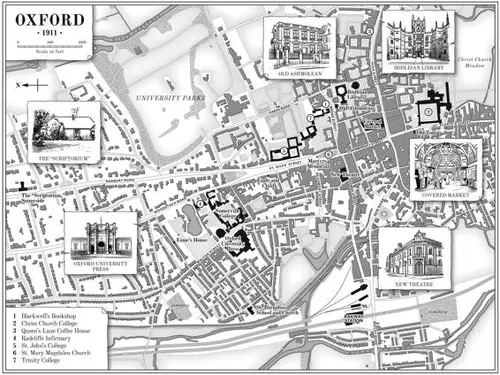
Map
Prologue | February 1886
Before the lost word, there was another. It arrived at the Scriptorium in a second-hand envelope, the old address crossed out and Dr. Murray, Sunnyside, Oxford, written in its place.
It was Da’s job to open the post and mine to sit on his lap, like a queen on her throne, and help him ease each word out of its folded cradle. He’d tell me what pile to put it on and sometimes he’d pause, cover my hand with his, and guide my finger up and down and around the letters, sounding them into my ear. He’d say the word, and I would echo it, then he’d tell me what it meant.
This word was written on a scrap of brown paper, its edges rough where it had been torn to match Dr. Murray’s preferred dimensions. Da paused, and I readied myself to learn it. But his hand didn’t cover mine, and when I turned to hurry him, the look on his face made me stop; as close as we were, he looked far away.
I turned back to the word and tried to understand. Without his hand to guide me, I traced each letter.
“What does it say?” I asked.
“Lily,” he said.
“Like Mamma?”
“Like Mamma.”
“Does that mean she’ll be in the Dictionary?”
“In a way, yes.”
“Will we all be in the Dictionary?”
“No.”
“Why?”
I felt myself rise and fall on the movement of his breath.
“A name must mean something to be in the Dictionary.”
I looked at the word again. “Was Mamma like a flower?” I asked.
Da nodded. “The most beautiful flower.”
He picked up the word and read the sentence beneath it. Then he turned it over, looking for more. “It’s incomplete,” he said. But he read it again, his eyes flicking back and forth as if he might find what was missing. He put the word down on the smallest pile.
Da pushed his chair back from the sorting table. I climbed off his lap and readied myself to hold the first pile of slips. This was another job I could help with, and I loved to see each word find its place among the pigeon-holes. He picked up the smallest pile, and I tried to guess where Mamma would go. “Not too high and not too low,” I sang to myself. But instead of putting the words in my hand, Da took three long steps towards the fire grate and threw them into the flames.
There were three slips. When they left his hand, each was danced by the draught of heat to a different resting place. Before it had even landed, I saw lily begin to curl.
I heard myself scream as I ran towards the grate. I heard Da bellow my name. The slip was writhing.
I reached in to rescue it, even as the brown paper charred and the letters written on it turned to shadows. I thought I might hold it like an oak leaf, faded and winter-crisp, but when I wrapped my fingers around the word, it shattered.
I might have stayed in that moment forever, but Da yanked me away with a force that winded. He ran with me out of the Scriptorium and plunged my hand into the snow. His face was ashen, so I told him it didn’t hurt, but when I unfurled my hand, the blackened shards of the word were stuck to my melted skin.

Some words are more important than others—I learned this, growing up in the Scriptorium. But it took me a long time to understand why.
PART 1 | 1887–1896
May 1887
Scriptorium. It sounds as if it might have been a grand building, where the lightest footstep would echo between marble floor and gilded dome. But it was just a shed, in the back garden of a house in Oxford.
Instead of storing shovels and rakes, the shed stored words. Every word in the English language was written on a slip of paper the size of a postcard. Volunteers posted them from all over the world, and they were kept in bundles in the hundreds of pigeon-holes that lined the shed walls. Dr. Murray was the one who named it the Scriptorium—he must have thought it an indignity for the English language to be stored in a garden shed—but everyone who worked there called it the Scrippy. Everyone but me. I liked the feel of scriptorium as it moved around my mouth and landed softly between my lips. It took me a long time to learn to say it, and when I finally did nothing else would do.
Da once helped me search the pigeon-holes for scriptorium. We found five slips with examples of how the word had been used, each quotation dating back little more than a hundred years. All of them were more or less the same, and none of them referred to a shed in the back garden of a house in Oxford. A scriptorium, the slips told me, was a writing room in a monastery.
But I understood why Dr. Murray had chosen it. He and his assistants were a little like monks, and when I was five it was easy to imagine the Dictionary as their holy book. When Dr. Murray told me it would take a lifetime to compile all the words, I wondered whose. His hair was already as grey as ash, and they were only halfway through B.

Da and Dr. Murray had been teachers together in Scotland long before there was a Scriptorium. And because they were friends, and because I had no mother to care for me, and because Da was one of Dr. Murray’s most trusted lexicographers, everyone turned a blind eye when I was in the Scriptorium.
The Scriptorium felt magical, like everything that ever was and ever could be had been stored within its walls. Books were piled on every surface. Old dictionaries, histories and tales from long ago filled the shelves that separated one desk from another, or created a nook for a chair. Pigeon-holes rose from the floor to the ceiling. They were crammed full of slips, and Da once said that if I read every one, I’d understand the meaning of everything.
In the middle of it all was the sorting table. Da sat at one end, and three assistants could fit along either side. At the other end was Dr. Murray’s high desk, facing all the words and all the men who helped him define them.
We always arrived before the other lexicographers, and for that little while I would have Da and the words all to myself. I’d sit on Da’s lap at the sorting table and help him sort the slips. Whenever we came across a word I didn’t know, he would read the quotation it came with and help me work out what it meant. If I asked the right questions, he would try to find the book the quotation came from and read me more. It was like a treasure hunt, and sometimes I found gold.
“This boy had been a scatter-brained scapegrace from his birth.” Da read the quotation from a slip he had just pulled out of an envelope.
“Am I a scatter-brained scapegrace?” I asked.
“Sometimes,” Da said, tickling me.
Then I asked who the boy was, and Da showed me where it was written at the top of the slip.
“Ala-ed-Din and the Wonderful Lamp,” he read.
When the other assistants arrived I slipped under the sorting table.
“Be quiet as a mouse and stay out of the way,” Da said.
It was easy to stay hidden.
At the end of the day I sat on Da’s lap by the warmth of the grate and we read “Ala-ed-Din and the Wonderful Lamp.” It was an old story, Da said. About a boy from China. When I asked if there were others, he said there were a thousand more. The story was like nothing I had heard, nowhere I had been, and no one I knew of. I looked around the Scriptorium and imagined it as a genie’s lamp. It was so ordinary on the outside, but on the inside full of wonder. And some things weren’t always what they seemed.
The next day, after helping with the slips, I pestered Da for another story. In my enthusiasm I forgot to be as quiet as a mouse; I was getting in his way.
“A scapegrace will not be allowed to stay,” Da warned, and I imagined being banished to Ala-ed-Din’s cave. I spent the rest of the day beneath the sorting table, where a little bit of treasure found me.
It was a word, and it slipped off the end of the table. When it lands, I thought, I’ll rescue it, and hand it to Dr. Murray myself.
I watched it. For a thousand moments I watched it ride some unseen current of air. I expected it to land on the unswept floor, but it didn’t. It glided like a bird, almost landing, then rose up to somersault as if bidden by a genie. I never imagined that it might land in my lap, that it could possibly travel so far. But it did.
The word sat in the folds of my dress like a bright thing fallen from heaven. I dared not touch it. It was only with Da that I was allowed to hold the words. I thought to call out to him, but something caught my tongue. I sat with the word for a long time, wanting to touch it, but not. What word? I wondered. Whose? No one bent down to claim it.
After a long while I scooped the word up, careful not to crush its silvery wings, and brought it close to my face. It was difficult to read in the gloom of my hiding spot. I shuffled along to where a curtain of sparkling dust hung between two chairs.
I held the word up to the light. Black ink on white paper. Eight letters; the first, a butterfly B. I moved my mouth around the rest as Da had taught me: O for orange, N for naughty, D for dog, M for Murray, A for apple, I for ink, D for dog, again. I sounded them out in a whisper. The first part was easy: bond. The second part took a little longer, but then I remembered how the A and I went together. Maid.
The word was bondmaid. Below it were other words that ran together like a tangle of thread. I couldn’t tell if they made up a quotation sent in by a volunteer or a definition written by one of Dr. Murray’s assistants. Da said that all the hours he spent in the Scriptorium were to make sense of the words sent in by volunteers, so that those words could be defined in the Dictionary. It was important, and it meant I would get a schooling and three hot meals and grow up to be a fine young lady. The words, he said, were for me.
“Will they all get defined?” I once asked.
“Some will be left out,” Da said.
“Why?”
He paused. “They’re just not solid enough.” I frowned, and he said, “Not enough people have written them down.”
“What happens to the words that are left out?”
“They go back in the pigeon-holes. If there isn’t enough information about them, they’re discarded.”
“But they might be forgotten if they’re not in the Dictionary.”
He’d tilted his head to one side and looked at me, as if I’d said something important. “Yes, they might.”
I knew what happened when a word was discarded. I folded bondmaid carefully and put it in the pocket of my pinny.
A moment later, Da’s face appeared under the sorting table. “Run along now, Esme. Lizzie’s waiting for you.”
I peered between all the legs—chairs’, table’s, men’s—and saw the Murrays’ young maid standing beyond the open door, her pinafore tied tight around her waist, too much fabric above and too much fabric below. She was still growing into it, she told me, but from under the sorting table she reminded me of someone playing at dressing-up. I crawled between the pairs of legs and scampered out to her.
“Next time you should come in and find me; it would be more fun,” I said, when I got to Lizzie.
“It’s not me place.” She took my hand and walked me to the shade of the ash tree.
“Where is your place?”
She frowned, then shrugged. “The room at the top of the stairs, I s’pose. The kitchen when I’m helping Mrs. Ballard, but definitely not when I ain’t. St. Mary Magdalen on a Sunday.”
“Is that all?”
“The garden, when I’m caring for you—so we don’t get under Mrs. B’s feet. And more and more the Covered Market, ’cos of her cranky knees.”
“Has Sunnyside always been your place?” I asked.
“Not always.” She looked down at me, and I wondered where her smile had gone.
“Where did it used to be?”
She hesitated. “With me ma and all our littluns.”
“What are littluns?”
“Children.”
“Like me?”
“Like you, Essymay.”
“Are they dead?”
“Just me ma. The littluns was taken away, I don’t know where. They was too young for service.”
“What’s service?”
“Will you never stop asking questions?” Lizzie picked me up under the arms and swung me round and round until we were both so dizzy we collapsed on the grass.
“Where’s my place?” I asked as the dizziness faded.
“The Scrippy, I guess, with your father. The garden, my room, and the kitchen stool.”
“My house?”
“ ’Course your house, though you seem to spend more time here than there.”
“I don’t have a Sunday place like you do,” I said.
Lizzie frowned. “Yes, you do, St. Barnabas church.”
“We only go sometimes. When we do, Da brings a book. He holds it in front of the hymns and reads instead of singing.” I laughed, thinking of Da’s mouth opening and closing in imitation of the congregation, but not a sound coming out.
“That’s nothing to laugh at, Essymay.” Lizzie held her hand against the crucifix I knew rested beneath her clothes. I worried she would think badly of Da.
“It’s because Lily died,” I said.
Lizzie’s frown turned sad, which wasn’t what I wanted either.
“But he says I should make up my own mind. About God and Heaven. That’s why we go to church.” Her face relaxed, and I decided to get back to an easier conversation. “My best place is Sunnyside,” I said. “In the Scriptorium. Then in your room, then in the kitchen when Mrs. Ballard is baking, especially when she’s baking spotted scones.”
“You’re a funny little thing, Essymay—they’re called fruit scones; the spots are raisins.”
Da said Lizzie was no more than a child herself. When he was talking to her, I could see it. She stood as still as she could, holding her hands so they wouldn’t fidget, and nodding at everything with barely a word. She must have been scared of him, I thought, the way I was scared of Dr. Murray. But when Da was gone, she’d look at me sideways and wink.
As we lay on the grass with the world spinning above our heads, she suddenly leaned over and pulled a flower from behind my ear. Like a magician.
“I have a secret,” I told her.
“And what would that be, me little cabbage?”
“I can’t tell you here. It might blow away.”
We tip-toed through the kitchen towards the narrow stairs that led to Lizzie’s room. Mrs. Ballard was bent over a flour bin in the pantry and all I saw of her was her very large behind, draped in folds of navy gingham. If she saw us, she’d find something for Lizzie to do and my secret would have to wait. I put a finger to my lips but a giggle rose in my throat. Lizzie saw it coming, so she scooped me into her bony arms and trotted up the stairs.
The room was cold. Lizzie took the coverlet off her bed and laid it on the bare floor like a rug. I wondered if there were any Murray children in the room on the other side of Lizzie’s wall. It was the nursery, and we sometimes heard little Jowett crying, but not for long. Mrs. Murray would come soon enough, or one of the older children. I tilted my ear towards the wall and heard the baby’s waking noises, little sounds that were not quite words. I imagined him opening his eyes and realising he was alone. He whimpered for a while, then cried. This time it was Hilda who came. When the crying stopped, I recognised the tinkle of her voice. She was thirteen, like Lizzie, and her littlest sisters, Elsie and Rosfrith, were never far behind her. When I sat on the rug with Lizzie, I imagined them all doing the same on the other side of the wall. I wondered what game they might play.
Lizzie and I sat opposite each other, legs crossed, knees just touching. I raised both hands to begin a clapping game, but Lizzie paused at the sight of my funny fingers. They were puckered and pink.
“They don’t hurt anymore,” I said.
“You sure?”
I nodded, and we began to clap, though she was too soft with my funny fingers to make the right sound.
“So, what’s your big secret, Essymay?” she asked.
I’d almost forgotten. I stopped clapping, reached into the pocket of my pinny and pulled out the slip that had landed in my lap earlier that morning.
“What kind of secret is that?” asked Lizzie, taking the slip in her hand and turning it over.
“It’s a word, but I can only read this bit.” I pointed to bondmaid. “Can you read the rest for me?”
She moved a finger across the words, just as I had done. After a while, she handed it back.
“Where did you find it?” she asked.
“It found me,” I said. And when I saw that wasn’t enough, “One of the assistants threw it away.”
“Threw it away, did they?”
“Yes,” I said, without looking down, even a little bit. “Some words just don’t make sense and they throw them away.”
“Well, what will you do with your secret?” Lizzie asked.
I hadn’t thought. All I’d wanted was to show it to Lizzie. I knew not to ask Da to keep it safe, and it couldn’t stay in my pinny forever.
“Can you keep it for me?” I asked.
“I s’pose I can, if you want me to. Though I don’t know what’s so special about it.”
It was special because it had come to me. It was almost nothing, but not quite. It was small and fragile and it might not mean anything important, but I needed to keep it from the fire grate. I didn’t know how to say any of this to Lizzie, and she didn’t insist. Instead, she got to her hands and knees, reached under her bed and pulled out a small wooden trunk.
I watched as she drew a finger through the thin film of dust that covered the scarred top. She wasn’t in a hurry to open it.
“What’s inside?” I asked.
“Nothing. Everything I came with has gone into that wardrobe.”
“Won’t you need it to go on journeys?”
“I won’t be needing it,” she said, and released the latch.
I placed my secret in the bottom of the trunk and sat back on my haunches. It looked small and lonely. I moved it to one side, and then to the other. Finally, I retrieved it and cradled it in both hands.
Lizzie stroked my hair. “You’ll have to find more treasures to keep it company.”
I stood, held the slip of paper as high as I could above the trunk and let go, then I watched it float down, swaying from side to side until it came to rest in one corner of the trunk.
“This is where it wants to be,” I said, bending down to smooth it flat. But it wouldn’t flatten. There was a lump under the paper lining that covered the bottom of the trunk. The edge had already lifted, so I peeled it back a little more.
“It’s not empty, Lizzie,” I said, as the head of a pin revealed itself.
Lizzie leaned over me to see what I was talking about.
“It’s a hat pin,” she said, reaching down to pick it up. On its head were three small beads, one on top of the other, each a kaleidoscope of colour. Lizzie turned it between her thumb and finger. As it spun, I could see her remembering it. She brought it to her chest, kissed me on the forehead then placed the pin carefully on her bedside table, next to the small photograph of her mother.

Our walk home to Jericho took longer than it should, because I was small and Da liked to meander while he smoked his pipe. I loved the smell of it.
We crossed the wide Banbury Road and started down St. Margaret’s, past tall houses standing in pairs with pretty gardens and trees shading the path. Then I led us on a zigzagging route through narrow streets where the houses were tightly packed, one against the other, just like slips in their pigeon-holes. When we turned into Observatory Street, Da tapped his pipe clean against a wall and put it in his pocket. Then he lifted me onto his shoulders.
“You’ll be too big for this soon,” he said.
“Will I stop being a littlun when I get too big?”
“Is that what Lizzie calls you?”
“It’s one of the things she calls me. She also calls me cabbage and Essymay.”
“Littlun I understand, and Essymay, but why does she call you cabbage?”
Cabbage always came with a cuddle or a kind smile. It made perfect sense, but I couldn’t explain why.
Our house was halfway down Observatory Street, just past Adelaide Street. When we got to the corner, I counted out loud: “One, two, three, four, stop right here for our front door.”
We had an old brass knocker shaped like a hand. Lily had found it at a bric-a-brac stall in the Covered Market—Da said it had been tarnished and scratched, and there’d been river sand between the fingers, but he’d cleaned it up and attached it to the door on the day they were married. Now, he took his key from his pocket and I leaned down and covered Lily’s hand with mine. I knocked it four times.
“No one’s home,” I said.
The Story Continues on BooksBarbecue!
Enjoyed this preview? ❤️ Do not stop here!
Read the complete book free online → 🔗
Continue reading now on BooksBarbecue and discover every page!
Love reading? Bookmark BooksBarbecue.com for more amazing books!
Happy Reading!