Chapters (42)
- Map
- Prologue | February 1886
- PART 1 | 1887–1896
- May 1887
- April 1888
- April 1891
- August 1893
- September 1896
- PART 2 | 1897–1901
- August 1897
- April 1898
- September 1898
- August 1901
- PART 3 | 1902–1907
- May 1902
- May 1906
- June 1906
- December 1906
- March 1907
- PART 4 | 1907–1913
- September 1907
- November 1907
- November 1908
- May 1909
- December 1912
- January 1913
- May 1913
- PART 5 | 1914–1915
- August 1914
- May 1915
- July 1915
- September 1915
- PART 6 | 1928
- November 1928
- Epilogue | Adelaide, 1989
- Author’s Note
- Dedication
- Acknowledgements
- Timeline of the Oxford English Dictionary
- Timeline of Major Historical Events Featured in the Novel
- About the Author
- What’s next onyour reading list?
Finally, I acknowledge that this book has been written on Kaurna and Peramangk Countries. For millennia, the languages of these first peoples was shared through oral storytelling, and the words they used gave meaning to their landscape, their cultures and their beliefs. While many of these words have been lost to time, others have been found. They are being shared anew.
I pay my respects to the elders of the Kaurna and Peramangk Peoples, past, present and emerging. I acknowledge their stories and their languages, and I have the deepest respect for the meaning of what has been lost.
Timeline of the Oxford English Dictionary
| 1857 | The Unregistered Words Committee of the Philological Society of London calls for a new English Dictionary to succeed Samuel Johnson’s Dictionary of the English Language (1755). |
| 1879 | James Murray appointed as Editor. |
| 1881 | Edith Thompson publishes History of England (Pictorial course for schools)—multiple editions follow as well as adaptations for American and Canadian markets. |
| 1884 | “A to Ant” published. It is the first of approx. 125 fascicles. |
| 1885 | James and Ada Murray move from London to Oxford, erecting a large corrugated iron shed in the garden of their house. The house is known as Sunnyside. The shed is known as the Scriptorium. |
| 1885 | Pillar post box placed outside Sunnyside in recognition of the high volume of mail generated by the Scriptorium. |
| 1887 | Henry Bradley appointed as second Editor. |
| 1888 | A and B published. It is the first of twelve volumes originally titled A New English Dictionary on Historical Principles. |
| 1901 | William Craigie appointed as third Editor. |
| 1901 | Bradley and Craigie move into the “Dictionary Room” at the Old Ashmolean. |
| 1901 | Bondmaid discovered missing following a letter from a member of the public. |
| 1914 | Charles Onions appointed as fourth Editor. |
| 1915 | Sir James Murray dies. |
| 1915 | Staff and contents of the Scriptorium are moved to the Old Ashmolean. |
| 1928 | V to Z published as Volume 12. |
| 1928 | 150 men gather in London’s Goldsmiths’ Hall to celebrate the publication of the Oxford English Dictionary, seventy-one years after it was proposed. Prime Minister Stanley Baldwin presides. Women are not invited, though three are allowed to sit in the balcony and watch the men eat. Edith Thompson is one of them. |
| 1929 | Edith Thompson dies aged 81. |
| 1989 | Publication of the second edition of the Oxford English Dictionary. |
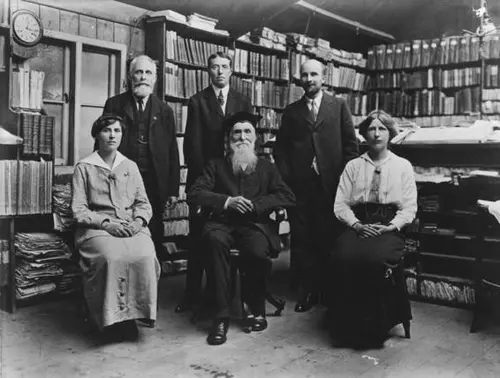
Staff of the Scriptorium, Oxford. Photographed for The Periodical on July 10, 1915. (Back row) Arthur Maling, Frederick Sweatman, F. A. Yockney. (Seated) Elsie Murray, Sir James Murray, Rosfrith Murray. image reprinted with permission of oxford university press.