Chapters (28)
- Title Page
- Preface
- Acknowledgements
- CHAPTER ONE - Introduction
- Who Was Pol Pot?
- The First Year in Paris
- Joining the Viet Minh
- CHAPTER FIVE - “Red Khmer,” 1963—1970
- CHAPTER SIX - Coming to Power, 1970—1976
- CHAPTER SEVEN - Prairie Fire, 1976-1977
- Pol Pot in China and North Korea
- CHAPTER NINE - “Grandfather 87,” 1979—1998
- Chronology
- Appendix 1: - Non Suon’s Biography of Pol Pot
- Appendix 2: - Khmer Personnel at “Office 100,” 1963—1966
- Notes
- Chapter One
- Chapter Two
- Chapter Three
- Chapter Four
- Chapter Five
- Chapter Six
- Chapter Seven
- Chapter Eight
- Chapter Nine
- Interviews by Author
- Index
- Copyright Page
After securing what he thought was his place in history, Pol Pot was more interested in talking about his illness and his family and about his times in Paris and Yugoslavia than about his time in power. He told Thayer about his stroke in 1995, his boredom under house arrest. He mentioned his daughter fondly but seemed prepared to die. When the interview ended, he said, “I feel very, very tired,” but could not resist a parting sentence, as he was helped into the Toyota van. “I want you to know,” he said, “that everything I did, I did for my country.” Perhaps as he drove away, another Red Khmer adage occurred to him, one that cadre had used with the movement’s enemies. “The wheel of history turns relentlessly,” it runs. “Don’t put your hand or foot in it or they will surely be cut off.”45
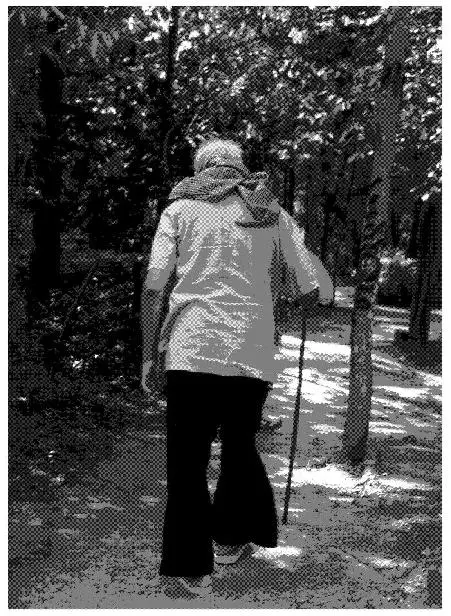
Pol Pot on his way to his interview with journalist Nate Thayer in October 1997. Copyright 1997 Nate Thayer and Tom Keller & Associates LLC.
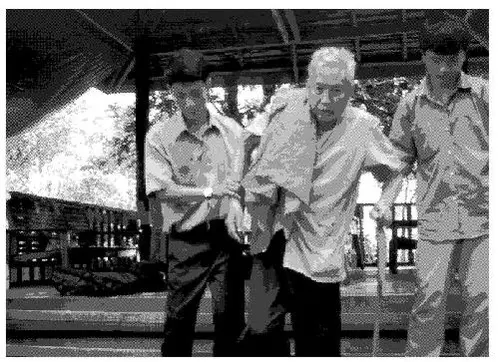
Pol Pot is escorted away from the interview with Nate Thayer in October 1997 in Anlong Veng, Cambodia. Copyright 1997 Nate Thayer, and Tom Keller & Associates LLC.
Over the next few months, Pol Pot’s health declined, and so did the fortunes of the people holding him prisoner. In March government forces drove the Red Khmer out of Anlong Veng into a makeshift base, nine miles away, just inside Cambodia from Thailand. Pol Pot lived, under guard, in a roughly built three-room house.
On April 15, 1998, he tuned in as usual at 8:00 P.M. to the Khmer language broadcast of the Voice of America. The lead story was a report, sourced to Nate Thayer, that his captors had decided to turn him over to a tribunal to face charges of crimes against humanity. The effect of the broadcast may have been fatal. On April 16, after Pol Pot had died, Ta Mok described the sequence of events to Nate Thayer: “He was sitting in his chair waiting for the car to come. But he felt tired. His wife asked him to take a rest. He lay down on his bed. His wife heard a gasp of air. It was the sound of dying. When she touched him he had already passed away. It was at 10:15 last night.”46
Pol Pot’s body was shown to journalists on April 16 and 17, twenty-three years to the day after the Red Khmer had marched triumphantly into Phnom Penh. On April 18, he was cremated beneath a pile of rubbish and personal possessions in a jungle clearing 500 yards inside Cambodia. No senior figures attended the cremation; neither did his wife or daughter. A Red Khmer cadre spoke to reporters after the ceremony was over. “Most people are happy because Pol Pot is finished,” he said. “There is no more Khmer Rouge, no more bad reputation.”47