Chapters (28)
- Title Page
- Preface
- Acknowledgements
- CHAPTER ONE - Introduction
- Who Was Pol Pot?
- The First Year in Paris
- Joining the Viet Minh
- CHAPTER FIVE - “Red Khmer,” 1963—1970
- CHAPTER SIX - Coming to Power, 1970—1976
- CHAPTER SEVEN - Prairie Fire, 1976-1977
- Pol Pot in China and North Korea
- CHAPTER NINE - “Grandfather 87,” 1979—1998
- Chronology
- Appendix 1: - Non Suon’s Biography of Pol Pot
- Appendix 2: - Khmer Personnel at “Office 100,” 1963—1966
- Notes
- Chapter One
- Chapter Two
- Chapter Three
- Chapter Four
- Chapter Five
- Chapter Six
- Chapter Seven
- Chapter Eight
- Chapter Nine
- Interviews by Author
- Index
- Copyright Page
About this time, Pol Pot also spoke to some of the returned intellectuals at a seminar in Phnom Penh. One returnee told Marie-A. Martin:
He spoke for two days. He wished the state to be first in all domains and to become the model for non-aligned states. He wanted its [agricultural] yields to exceed those of Japan. He said Cambodia was an under-developed country, that it needed to wake up rapidly, make progress, make a great leap. At first we were a little surprised, and then we were hooked (on s‘est accroché) by his skillful words“ (emphasis added).31
Pol Pot had been mesmerizing small audiences in this fashion for over twenty years, and continued to do so well into the 1990s. His ability to enchant his listeners was a crucial part of his equipment as a leader. In 1991 a Cambodian official who remembered his speeches said that what was striking was his “everyday” (samanh) manner of speaking, “like a father speaking to his children.”32
Many survivors recalled celebrations throughout Cambodia to mark the party’s anniversary in 1978. They remembered having enough (and in some cases even too much) to eat. In Phnom Penh, Chinese and Albanian films were shown and special meals were provided for government workers. Pol Pot’s speech for the occasion was delivered at the Olympic Stadium and later published in Tung Padevat. It dealt with the inevitability of a Vietnamese defeat, the clear-sightedness of the party, the virtues of collectivism, and the need to build a socialist revolution. “If we open the door to capitalism,” Pol Pot declared, “we will lose the country.” Under the party, he continued, the people’s livelihood had improved dramatically for “90 percent of the population.” Men and women who had once had neither land nor food and who had “sold their sons and daughters to other people [now] eat three times a day; sweet desserts and sugar are readily available.” Because “99 percent of the people” were united with the party, the remaining contradictions were unimportant. The problem of subsistence had been solved, Pol Pot stated, but he cited no figures and said nothing about rice exports. Efforts could now concentrate on other crops and on developing industry.
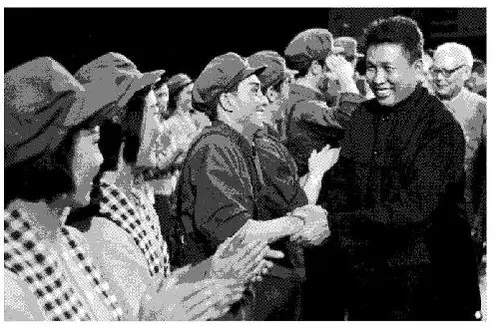
Pol Pot (right) with Chinese opera troupe, the dancers in Cambodian attire, Beijing, October 1977.