Chapters (28)
- Title Page
- Preface
- Acknowledgements
- CHAPTER ONE - Introduction
- Who Was Pol Pot?
- The First Year in Paris
- Joining the Viet Minh
- CHAPTER FIVE - “Red Khmer,” 1963—1970
- CHAPTER SIX - Coming to Power, 1970—1976
- CHAPTER SEVEN - Prairie Fire, 1976-1977
- Pol Pot in China and North Korea
- CHAPTER NINE - “Grandfather 87,” 1979—1998
- Chronology
- Appendix 1: - Non Suon’s Biography of Pol Pot
- Appendix 2: - Khmer Personnel at “Office 100,” 1963—1966
- Notes
- Chapter One
- Chapter Two
- Chapter Three
- Chapter Four
- Chapter Five
- Chapter Six
- Chapter Seven
- Chapter Eight
- Chapter Nine
- Interviews by Author
- Index
- Copyright Page
That world came to life whenever the corps de ballet performed for the king and his guests, enacting scenes and stories taken from Indian mythology at a painstakingly slow pace to the music of xylophones, flutes, and Indian-style stringed instruments. Most of the more than three hundred dancers had been recruited into the troupe before they were ten years old; the leading dancers were in their twenties. Some performances were keyed to the Buddhist calendar or to brahmanical ceremonies peculiar to the palace. Others were in honor of important visitors to Phnom Penh. The performances, which lasted for several hours, occurred at night when it was cooler. They depicted a goldencrusted world of princes and princesses, hermits, demons, and magical beasts. Like the puppet theater in Java, which was also based on classical Hindu stories, the dances had strong religious overtones. Through them, the dancers gained access to the supernatural forces that affected people’s lives and were thought to govern the agricultural year.8
It is easy to imagine Saloth Sar in the 1930s huddled at the edge of the stage watching the masked and powdered dancers, trained by his cousin and perhaps including his sister and his brother’s wife, perform by the light of hundreds of candles (and the moon). Each dance involved thousands of movements, each keyed to moments in a particular story and to the mythological character being portrayed. None of the gestures was improvised. Al-though some dancers might be more beautiful or more graceful than others, their movements depended on memory, tradition, and practice—in other words, on what they had been taught—rather than on what the individual wanted to express. The dancers were vehicles for tradition rather than its interpreters. Effacing one’s creativity by memorizing what the teacher imparts is an integral part of traditional Hindu and Buddhist teaching for vocations as diverse as dancing and monastic life. It also characterizes the painstaking way in which Pol Pot trained his subordinates in the Cambodian Communist party. Pol Pot’s modesty as well as his teaching earned his students’ admiration. Perhaps this tradition of self-concealment, combined with the costume donning and role playing and the empowerment that came from performing, helped Saloth Sar to shape his public persona—he was perceived by many throughout his career as “clean and smooth,” almost as if he were a dancer hiding behind a mask.
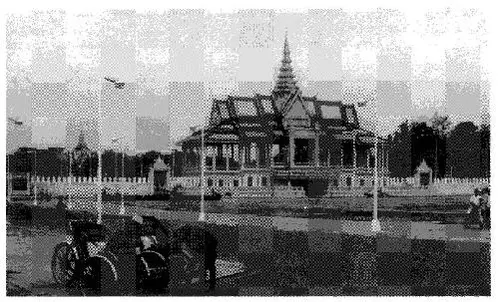
Chan Chhaya Pavilion, Royal Palace, Phnom Penh. Photo by Bruce Sharp. Copyright 1991 Bruce Sharp.