Chapters (100)
- Half Title
- Also By Natalie Fergie
- Title Page
- Copyright
- Dedication
- Contents
- 2011
- Chapter 1
- Chapter 2
- 1908
- Chapter 3
- 1910
- Chapter 4
- Chapter 5
- Chapter 6
- Chapter 7
- Chapter 8
- Chapter 9
- Chapter 10
- Chapter 11
- Chapter 12
- Chapter 13
- Chapter 14
- Chapter 15
- Chapter 16
- Chapter 17
- Chapter 18
- Chapter 19
- Chapter 20
- Chapter 21
- Chapter 22
- Chapter 23
- Chapter 24
- Chapter 25
- Chapter 26
- Chapter 27
- Chapter 28
- Chapter 29
- Chapter 30
- 1921
- Chapter 31
- 1931
- Chapter 32
- Chapter 33
- Chapter 34
- Chapter 35
- Chapter 36
- Chapter 37
- Chapter 38
- Chapter 39
- Chapter 40
- Chapter 41
- Chapter 42
- Chapter 43
- Chapter 44
- Chapter 45
- Chapter 46
- Chapter 47
- Chapter 48
- Chapter 49
- 1951
- Chapter 50
- 2011
- Chapter 51
- Chapter 52
- Chapter 53
- Chapter 54
- Chapter 55
- Chapter 56
- Chapter 57
- Chapter 58
- Chapter 59
- Chapter 60
- Chapter 61
- Chapter 62
- Chapter 63
- Chapter 64
- Chapter 65
- Chapter 66
- Chapter 67
- Chapter 68
- Chapter 69
- Chapter 70
- Chapter 71
- Chapter 72
- Chapter 73
- Chapter 74
- Chapter 75
- Chapter 76
- Chapter 77
- 2021
- Chapter 78
- Chapter 79
- Chapter 80
- 2022
- Chapter 81
- Parkin
- Acknowledgements
- About the Author
- About Embla Books
David Blair and Dave Furries (QFSM) from the Museum of Scottish Fire and Heritage on McDonald Road in Edinburgh shared their expertise, and gave me a proper explanation of the present-day significance of the two-and-a-half-minute rule. I had read academic papers and looked at historical documents, but they told me all about Occupation Capacity and Exit Door Widths and explained the formulae that make it possible for all of us to escape a building which is on fire. Any errors in explaining these engineering and safety rules are mine. My thanks are offered to all firefighters, past and present.
Mary Whitehouse, Fiona Hulme and Ann Carrier were my beta readers. They each brought different talents and perspectives to the task I gave them. I hope they like the end result.
The floorplans of 25 Library Terrace were expertly drawn by Peter Kelly, Architectural Technician.
From the publishing world I must first thank my agent Charlotte Seymour, who has guided me through several iterations of 25 Library Terrace. Thanks also to Anna Dawson and Ed Wilson.
Thank you to Hayley Shepherd, Imogen Denny, and Tamsin Shelton for editing support and advice. From Embla, Emma Wilson and Anna Perkins.
Various friends were surprised by a gift of parkin in 2024. It was usually delivered in several boxes because I was trying out more than one version of the recipe at a time, and it was accompanied by an inquisition about which one they preferred and why. My thanks (and more parkin) are offered to Mary, Julian, Helen, Adam, Graham, Fran, Susan, Iain, Petra, Alison and Richard.
My friend Sally Atkinson test-baked the final parkin recipe in a way only a scientist can. There was mention of lab books, her ingredient weighing was gram-perfect, and the oven timings were precise. If you enjoy your parkin, Sally was a big part of it.
Mary Whitehouse did equally important parkin-testing involving different sugars and crystallised ginger.
Warm thanks are also due to Lesley Harcourt who brought the voices on the page to life in the audiobook, with skill and sensitivity.
Annie’s handbag can be found on the Victoria and Albert Museum website. It is just identified as Handbag ca 1910, but from the description of the colours and the image itself, I think it simply has to be a suffragette bag. You can see it here https://collections.vam.ac.uk/item/O353733/handbag-unknown/
Lastly, a huge thank you to my Mum, Adam, Simon and Becky. This is for you.
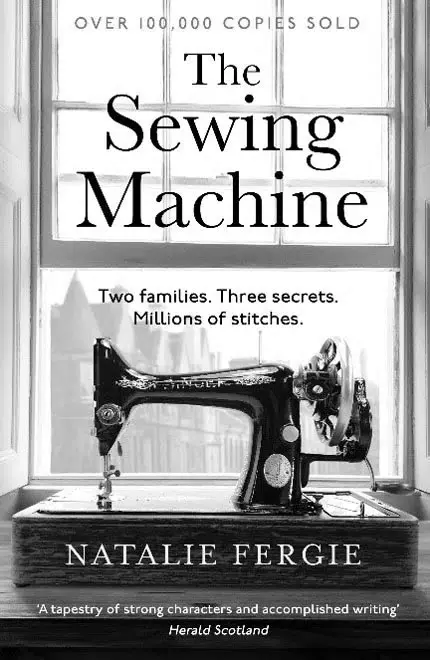
Two families. Three secrets. Millions of stitches.
It is 1911, and Jean is about to join the mass strike at the Singer factory. For her, nothing will be the same again.
Decades later, in Edinburgh, Connie sews coded moments of her life into a notebook, as her mother did before her.
More than 100 years after his grandmother's sewing machine was made, Fred discovers a treasure trove of documents. His family history is laid out before him in a patchwork of unfamiliar handwriting and colourful seams.