Chapters (41)
- Cover
- Dedication
- 1. Highly Superior Autobiographical Memory (HSAM for Short)
- 2. The Brain
- 3. Temporal Lobe
- 4. Hippo Brain
- 5. Limbic System
- 6. Gone with the Cerebellum
- 7. Meninges
- 8. Give Me a C
- 9. Declarative Memory
- 10. Golden Gate Corpus Callosum
- 11. The Brain Stem Is a Spy
- 12. Frontal Lobe
- 13. Skull
- 14. Basal Ganglia
- 15. Snap, Crackle, Pop
- 16. Flashbulb Memory
- 17. Sensory Stage
- 18. Insula the Great
- 19. Amygdala
- 20. Dendrites
- 21. Engram Cells: The Brain Instagram
- 22. Medulla Oblongata
- 23. Cerebrum
- 24. Hypothalamus
- 25. Glial Cells: The Stars of the Show
- 26. Thalamus: The Inner Chamber
- 27. Neurotransmitters
- 28. The Outer Zone of the Cerebral Cortex
- 29. Axon
- 30. Occipital Lobe
- 31. Soma
- 32. Breaking Our DNA
- 33. Myelin
- 34. Nodes of Ranvier
- 35. Saltatory Conduction
- 36. Von Economo Neurons
- 37. Lulu’s Journal
- Acknowledgments
- About the Author
I don’t know how to answer. I guess it would be okay if it were just because she wanted to spend time with me. But what if this is about her and Dad shipping Gram off to a home?
“Olivia’s mom will be here in five minutes. I’ll just meet her down the road so she doesn’t have to back up.” I grab a granola bar and duck out the door before Mom can say anything else.
I don’t give her time to ask when I’ll be home or any of the other hundreds of questions Gram would ask. In this instance, it works in my favor. I hurry down the road just in time to see the same Uber driver pull over.
“Hey again,” she says with a friendly smile.
“Thanks for getting me.”
“It’s my job. Where are your friends?”
Even the Uber driver pays more attention to me. I look out the window. “I’m meeting up with them,” I say. I spend the ride twisting my fingers and seeing how far they can bend.
17. Sensory Stage
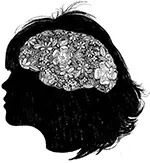
We store memories in three different ways: first in the sensory stage, then in short-term, and then in long-term for those memories that stand out. Before a memory makes it to the big time, it has to get past the other two. It’s kind of like our memories are auditioning for a bigger role on the stage of our lives. Will they be famous and remembered for all time, or will they be one of those actors no one knows and instantly forgets? To remember something, first we see, smell, touch, or hear something, and it triggers an emotion. The emotion, especially if it’s strong enough, then pulls up the stored memory.
I see Max smile at me. The stables are filled with the smell of hay and manure. His voice is kind of rumbly, but it cracks and goes higher when he’s excited about something. He reaches over and hands me an envelope, and his hand brushes mine. Sensory memory leaps right past short-term and straight to long-term memory. The moment I stopped thinking of Max as a jerk.
“Open it.” He glances at the envelope I clutch in my hands.
I fold the gold-colored metal clips back so they can fit through the holes, and I take my time sliding the papers out. They slip out, inch by inch, until they’re in my lap.
I glance down and then look up so fast my neck cracks. “What?”
“I know!” he says, his voice sliding up and down like a violin. “This is a file I found on your gram. It’s all crossed out.”
“But—but what does it mean?” I scour the pages for any words that aren’t completely blotted out with thick black lines. I hold the paper up to the light, but there’s no way to see what’s written underneath.