The Fall of Valor
Chapters (51)
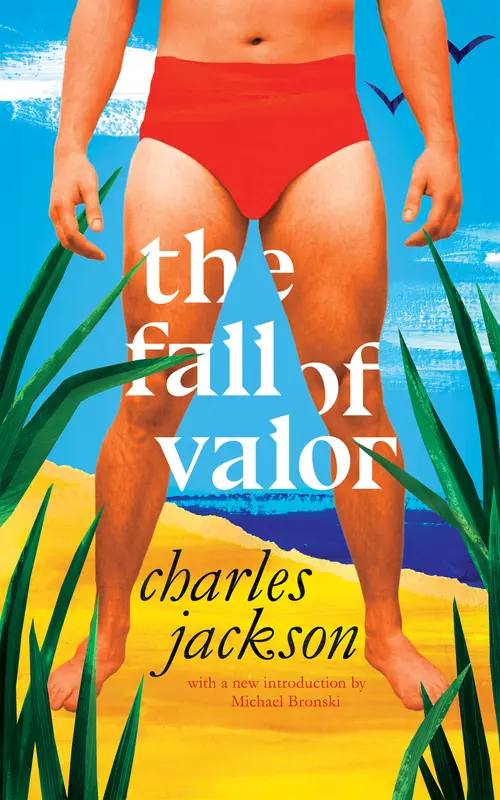
CHARLES JACKSON
THE FALL OF VALOR
. . . Being unprepar’d,
Our will became the servant
to defect.
Macbeth
with a new introduction by
MICHAEL BRONSKI
VALANCOURT BOOKS
Introduction by Michael Bronski
INTRODUCTION
Contemporary readers know of Charles Jackson’s 1946 novel The Fall of Valor—if they know it at all—from the iconic cover of the original Signet paperback edition published in 1949. The image—now a common refrigerator magnet and illustration of books on “queer pulp”—is in the style of the great cover artist James Avati, who defined paperback art covers in the 1940s and ’50s. In the foreground is an attractive woman with bare shoulders and red hair and a prominent wedding ring, holding a pair of sunglasses. Her eyes are averted to the left as she surreptitiously gazes at two men. A younger blond man, in a tight yellow bathing suit and a red beach robe, is lighting the cigarette of the older man, bare-chested and wearing looser-fitting swimming trunks. The look of anxiety and dread in the woman’s face is tensely juxtaposed with the implicit eroticism of the men behind her. The narrative could not be clearer. But to leave no doubt, the text across the bright yellow band at the top of the cover reads: The Powerful Story of a Man’s Conflicting Loves.
People today are often surprised that the cover of a 1949 paperback book—openly sold on newsstands, drugstore racks, and in bus depots and train stations—could be so overtly gay. But in the world of postwar literary fiction gay male themes—particularly related to issues of masculinity and World War II—were very common. They are in best-selling novels such as Norman Mailer’s 1948 The Naked and the Dead and James Jones’s 1951 From Here to Eternity, but also novels such as Carson McCullers’s 1941 Reflections in a Golden Eye, John Horne Burns’s 1947 The Gallery, Calder Willingham’s 1947 End as a Man, and Gore Vidal’s 1948 The City and the Pillar, which became the most notorious of these new novels with open homosexual themes and, at times, even sympathies.