Chapters (32)
- The Alienist by Machado de Assis
- Title page
- I. How Itaguai Acquired a Madhouse
- II. A Torrent of Madmen
- III. God Knows What He is Doing
- IV. A New Theory
- V. The Terror
- VI. The Rebellion
- VII. The Unexpected
- VIII. The Druggist’s Dilemma
- IX. Two Beautiful Cases
- X. The Restoration
- XI. Release and Joy
- XII. The Last Part of the Fourth Item
- XIII. Plus Ultra
- Notes
- Illuminations for The Alienist by Machado de Assis
- Title page
- Machado de Assis’ Rio de Janeiro
- The Bay of Rio by Fannie E. Coe
- The City and Its Institutionsby A.J. Lamoureux
- Photograph
- Photograph
- Reading I
- Photograph
- Art and Insanity in the 19th century
- Genius and Insanityby Dr. William Hirsch
- Reading II
- Illustration
- Illustration
- Reading III
- Photograph
Facing on the western side of the Campo are the Senate and Mint, and on the eastern side the City Hall and National Museum. The central station of the D. Pedro II railway is at its northwestern corner. There are several other public squares in the city, most of them with small gardens, but none of them offer any special attraction. The Praca Municipal in the Sande district possesses a fountain whose distinctive feature is a granite column commemorating the landing there of the Empress in 1843. The public garden at the Largo do Machado—officially designated as the “Praca Duque de Caxias” —lying just at the entrance to the Larangeiras valley, possesses some attractions, but none of great interest. By far the prettiest garden in the city, though not the largest, is the “Passeio Publico,” which is Famio situated on the shore of the bay facing the harbor entrance. This charming little garden was laid out by Valentim da Fonseca e Silva under the orders of Viceroy Luiz de Vasconcellos e Souza, and was formally opened in 1783. Many of its original features have now disappeared, but the garden still retains most of the characteristic beauties of its first design. It is filled with choice native and exotic plants in whose arrangement exceptional good taste has been shown. For its present appearance much credit is due to its efficient superintendent Dr. A. Glaziou, under whose direction the garden, which had fallen into a state of great neglect, was thoroughly reformed and improved in 1861. In this improvement the front wall was substituted by an iron fence, which was set farther back to widen the street. On the side facing the bay is a large elevated terrace, which is a favorite resort for evening promenades. From this spot can be obtained a fine view of the lower bay and harbor entrance. Whether for a stroll through its winding, shady walks and a view from its terrace in the day time, or for a promenade through its shadowy gas-lighted paths and on its crowded terrace in the cool of the evening, with the sounds of music stealing softly through the foliage, the Passeio Publico is a place which never fails to give pleasant impressions. More attention has been bestowed upon other public gardens of the city, but this oldest of Rio’s pleasure resorts still holds first place in the affections of the people. The National Library and Casino face upon this garden.
—from “The City and Its Institutions,” The Handbook of Rio de Janeiro, by A.J. Lamoureux, 1887
Photograph
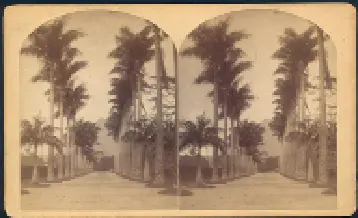
Botanical Garden, Rio de Janeiro, by William Bell, 1882
Photograph
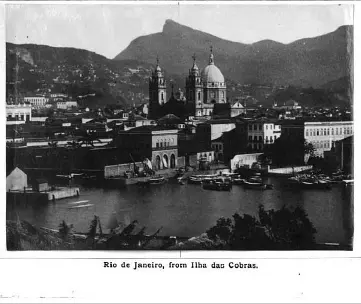
View of Rio de Janeiro, from Ilha das Cobras, 1885, by The Editors of the Rio News