Chapters (32)
- The Alienist by Machado de Assis
- Title page
- I. How Itaguai Acquired a Madhouse
- II. A Torrent of Madmen
- III. God Knows What He is Doing
- IV. A New Theory
- V. The Terror
- VI. The Rebellion
- VII. The Unexpected
- VIII. The Druggist’s Dilemma
- IX. Two Beautiful Cases
- X. The Restoration
- XI. Release and Joy
- XII. The Last Part of the Fourth Item
- XIII. Plus Ultra
- Notes
- Illuminations for The Alienist by Machado de Assis
- Title page
- Machado de Assis’ Rio de Janeiro
- The Bay of Rio by Fannie E. Coe
- The City and Its Institutionsby A.J. Lamoureux
- Photograph
- Photograph
- Reading I
- Photograph
- Art and Insanity in the 19th century
- Genius and Insanityby Dr. William Hirsch
- Reading II
- Illustration
- Illustration
- Reading III
- Photograph
To Camillo everything had now changed for the better and his affairs assumed a brighter aspect; the sky was clear and the faces of the people he passed were all so merry. He even began to laugh at his fears, which he now saw were puerile; he recalled the language of Villela’s letter and perceived at once that it was most friendly and familiar. How in the world had he ever been able to read any threat of danger into those words! He suddenly realized that they were urgent, however, and that he had done ill to delay so long; it might be some very serious business affair.
“Faster, faster!” he cried to the driver.
And he began to think of a plausible explanation of his delay; he even contemplated taking advantage of this incident to re-establish his former intimacy in Villela’s household… Together with his plans there kept echoing in his soul the words of the fortune-teller. In truth, she had guessed the object of his visit, his own state of mind, and the existence of a third; why, then, wasn’t it reasonable to suppose that she had guessed the rest correctly, too? For, the unknown present is the same as the future. And thus, slowly and persistently the young man’s childhood superstitions attained the upper hand and mystery clutched him in its iron claws. At times he was ready to burst into laughter, and with a certain vexation he did laugh at himself. But the woman, the cards, her dry, reassuring words, and her good-bye — “Go, go, ragazzo inamorato,” and finally, that farewell barcarolle, so lively and gracious, — such were the new elements which, together with the old, formed within him a new and abiding faith.
The truth is that his heart was happy and impatient, recalling the happy hours of the past and anticipating those yet to come. As he passed through Gloria street Camillo gazed across the sea, far across where the waters and the heaven meet in endless embrace, and the sight gave him a sensation of the future, — long, long and infinite.
From here it was but a moment’s drive to Villela’s home. He stepped out, thrust the iron gate open and entered. The house was silent. He ran up the six stone steps and scarcely had he had time to knock when the door opened and Villela loomed before him.
“Pardon my delay. It was impossible to come sooner. What is the matter?”
Villela made no reply. His features were distorted; he beckoned Camillo to step within. As he entered, Camillo could not repress a cry of horror: — there upon the sofa lay Rita, dead in a pool of blood. Villela seized the lover by the throat and, with two bullets, stretched him dead upon the floor.
—from Brazilian Tales, by Machado de Assis 1921
Photograph
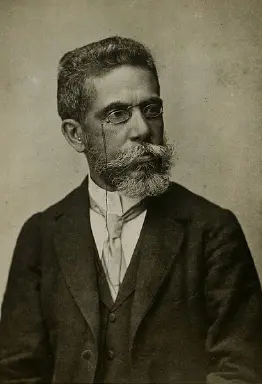
Photograph from the Academia Brasileira de Letras, 1909