Chapters (39)
- Cover
- Other Books By Joseph Bruchac
- Dedication
- CHARACTERS
- Willstown, Alabama,1821
- CHAPTER 1
- CHAPTER 2
- CHAPTER 3
- CHAPTER 4
- CHAPTER 5
- CHAPTER 6
- CHAPTER 7
- CHAPTER 8
- CHAPTER 9
- CHAPTER 10
- CHAPTER 11
- CHAPTER 12
- CHAPTER 13
- CHAPTER 14
- CHAPTER 15
- CHAPTER 16
- CHAPTER 17
- CHAPTER 18
- CHAPTER 19
- CHAPTER 20
- CHAPTER 21
- CHAPTER 22
- CHAPTER 23
- CHAPTER 24
- Afterword
- Sequoyah’sCherokee Syllabary
- CHEROKEE WORDS:
- FURTHER READING
- ACKNOWLEDGMENTS
- Special Excerpt from CODE TALKERS
- Listen, My Grandchildren
- CHAPTER ONE
- CHAPTER TWO
- What’s next onyour reading list?
Sequoyah never stopped trying to bring his people together. In 1842, he heard that one band of Cherokee people had ended up in northern Mexico. He was determined to bring them back together with the rest of the nation. Even though he was not well, he made the long trip down through Texas accompanied by Tessee and six or seven other Cherokees. He died somewhere south of the Mexican town of San Cranto and was buried in an unmarked grave.
Sequoyah’s life ended, but the legacy of his syllabary and the pride it inspired in his Cherokee people still lives on. Although English is today the primary language of the Cherokee Nation, Sequoyah’s syllabary is still preserved and taught to each new generation. As long as there are Cherokee people, I have been told, Sequoyah’s talking leaves will continue to speak.
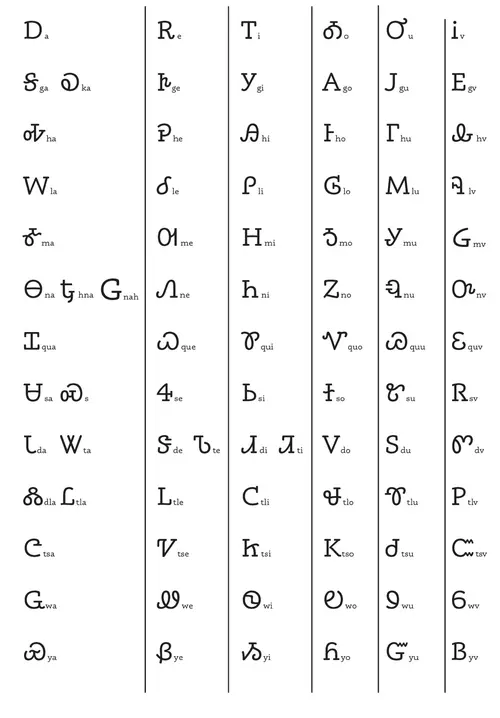
Sequoyah’s
Cherokee Syllabary
CHEROKEE WORDS:
Ah-hey: an exclamation
Ani-tsa-guhi: the bears, Bear People
Ani-tsa-la-gi: real Cherokee
Ani-yonega: white people
Ani-yunwiya: “Principal People,” the traditional Cherokee name for themselves
A-tsu-ta: my son
Awi Usdi: the little white deer, the leader of the animals
Chunkey: game played with a rolled stone and poles
Echota: the Peace Town that was the former capital of the Cherokee Nation
Edoda: father
Etsi: mother
Gah-gay-you-ee: I love you
Gi-li: dog
Ha-ha: no
Ha-wa: you’re right, a word of agreement
Losi: Lucy
Madi: Maddie
Meli: Mary
O-gi-na-li: my friend
O-gi-naw-lee: Are you home?
O-s-da-du: it is okay, it is fine
Osgutan-uhi: pine tree
Osiyo and Siyo : hello
Sa-lo-li: squirrel
Sauh: snorting sound made by the deer
Taskigee (Also spelled Tahs-kee-gee) : important Cherokee town on the Little Tennessee River that was burned by the white people
Tla: dismissive exclamation
Tlah-huh: no
Tsa-la-gi: the name that became Cherokee, probably from a Choctaw word meaning “cave dwellers”
Tsi-s-qua: bird
Tsi-yu: tulip poplar tree
Tsu-la: fox
Ukten: a water monster
U-le-la-nu-go: “Amazing Grace” (the hymn)
Une’-lahun’-ne: the sun
U-u (or v-v): yes
Wado: thank you
Wado agi etsi: thank you, my mother
Wa-heh: an exclamation
We-sa: cat
Ye-la-si-di: knife
FURTHER READING
“The Cherokees revere the memory of Sequoyah as the greatest Cherokee that ever lived. . . .” That is how Jack F. and Anna G. Kilpatrick expressed it in their collection of folktales of the Oklahoma Cherokee, Friends of Thunder.