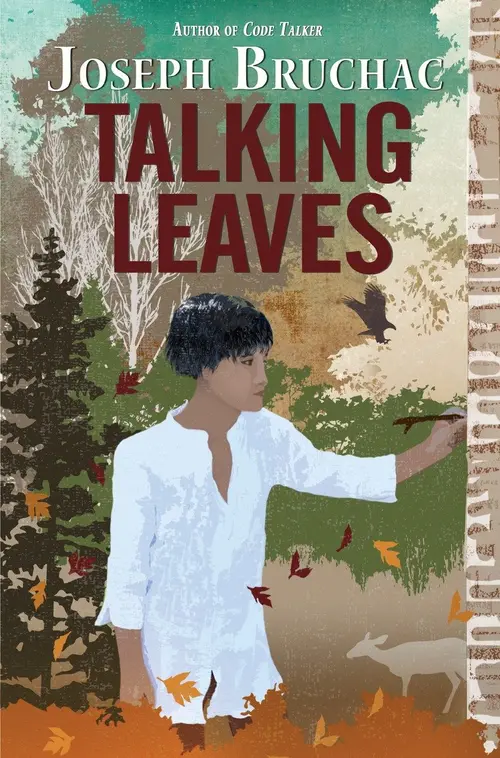
Talking Leaves
Cover
The whispers about my father grew stronger.
It was said that one group of men was planning to waylay Sequoyah with rifles and shoot him to death.
Finally, those who cared about Sequoyah decided that there was only one way to turn my father from his dangerous path. They made a plan to hide themselves in the woods near his cabin while Sally drew my father away.
“My husband,” Sally told him, “come with me. There is something you must see.”
When Sequoyah was far enough away, his concerned neighbors came out of the woods and went into the little building. They were shocked at what they saw. Those symbols that might be witchcraft were not just drawn on pieces of paper and chips of wood. They were scrawled on the walls, carved into the table and the chairs. Those brave enough to go into that cabin only stayed long enough in that frightening place to set it ablaze. Because it was filled with all those papers and dry chips of wood, it took almost no time at all before the roof collapsed as the flames roared up.

Other Books By Joseph Bruchac
OTHER BOOKS BY JOSEPH BRUCHAC
The Arrow over the Door
Children of the Longhouse
Code Talker
Eagle Song
The Heart of a Chief
Jim Thorpe, Original All-American
March Toward the Thunder
Wabi
The Winter People
Dedication
To those, past and present, who have worked to preserve our native tongues
CHARACTERS
Main Characters:
Uwohali (Big Eagle): Main character who tells the story, son of Sequoyah by Sequoyah’s first marriage
U-ti-yu: Uwohali’s mother who married Sequoyah in 1801, then divorced him
Sequoyah: Creator of the Cherokee syllabary, Uwohali’s father. Also known as George Guess.
Ahyokah (She Brought Happiness): Sequoyah’s six- or seven-year-old daughter who is Uwohali’s half sister
Sally Guess: Sequoyah’s second wife, who married him in 1815, mother of Ahyokah
Secondary Characters:
Uwohali’s Friends:
Yugi (Nail): his best, most loyal friend
Ugama (Soup)
Udagehi (Baby)
Gayusoli (Nose)
Galuloi (Sky)
Equgugu (Big Owl)
Uwohali’s Three Uncles:
Red Bird
Blackbird (John)
White Raven (Samuel)
Agili (He Is Rising): Village Chief of Willstown, where the story takes place. Also known as George Lowrey
Charles Hicks: friend of Sequoyah, son of a Cherokee woman and a Scots trader
Turtle Fields: friend of Sequoyah
Big Rattling Gourd: friend of Sequoyah
Old Turkey: a stickball maker
Wuh-teh: Sequoyah’s deceased mother
Black Fox: father of Equgugu
Gu-nun-da-le-gi: One Who Follow the Ridge, Cherokee name of the man who became known as “Major Ridge”
Oo-loo-deh-gah (John Jolly): Chief of the Western Cherokees (Old Settlers) who emigrated to Arkansas in 1807.
Tsunu’lahun’ski (or Junaluska): famous past Cherokee chief
Golanu (the Raven): the Cherokee name for Sam Houston, who they also affectionately called “Big Drunk.” Houston fought under General Andrew Jackson at the Battle of Horseshoe Bend and later was one of the founders of the Republic of Texas
Sharp Knife: Cherokee name for General Andrew Jackson
Red Sticks: Members of the Upper Creek Nation who tried to drive out the whites and were eventually defeated by a coalition of Lower Creeks, Cherokees, and white soldiers commanded by General Andrew Jackson
Willstown, Alabama,
1821
 CHAPTER 1
My Father Is Crazy
Crazy. That is the best thing they whisper about my father.
Black magic. Witchcraft. What he is doing or trying to do is evil medicine. That’s the worst.
Since he returned from the West three weeks ago I have heard nothing but bad things said about him. Is it just those bad words that have kept me from going to see him? Am I afraid that when I do see him—if I see him—I will think he is crazy, too?
I am also uncertain how he will treat me if I show up at his door. Maybe he will not be glad to see me. Maybe he will tell me to go away. He has another child now, my half sister, Ahyokah. My father spends much of his time with her. She’s his favorite, not me. I think he loved me once. I remember the stories he used to tell me in his gentle voice. But if he really cared about me, why did he leave me and go to Arkansas? Why have I never heard anything from him during the years he was gone from our town?
Others of our people who emigrated to those western places have sent messages by way of the traders and missionaries who are always moving back and forth between our people. Some, who have learned English, have even sent written letters. But not my father, Sequoyah. No word, either written or spoken, has ever come to me from him.
Maybe he has even forgotten that he ever had a son.
Still, despite all my uncertainty, I have almost gone to where he is living at the home of his second wife. Last week I walked halfway across town toward their cabin before I turned back and returned to my mother’s cabin.
How long will my father be able to stay here? Some say that if it was not for the fact that Agili, who is now the chief of our town, was my father’s cousin and oldest friend, he would have been forced to leave—or worse. I worry I will not get the chance to see him before he is driven away.
I tap the chunkey stick I am holding against the ground. The ground sounds hollow as I do so, almost like a drum. It still holds the cold of winter inside it, even though it will not be long until the leaves return.
I don’t mind the cold. I know the song to keep frostbite away before going out to hunt for food when it is cold. It’s the song that calls on the deer, whose feet cannot be hurt by frost or snow, to share that power with the hunter.
I start to sing it to the rhythm of my stick striking the ground.
Tusunkawiye. Tusunkawiye,
Tsunkawiye, Tsunkawiye
Sauh! Sauh! Sauh! Sauh!
My uncle Red Bird taught me that song, which must be sung four times, imitating that snort of the deer—Sauh!—after each verse. No boy’s uncle could have been a better teacher. He also taught me to rub my feet in the ashes of the fire before singing it and then setting out.
But no one has ever taught me a song that will keep away the memory of harsh and unkind words.
Perhaps Uncle Red Bird, my mother’s smiling older brother, knew such a song, but if he did I will never hear him sing it. Almost a year has passed since he caught the coughing sickness and made the last walk to the Night Land. I do not have the words to express how much I miss him. Remembering him just brings back the pain I felt when his spirit passed from us. I need to turn my thoughts elsewhere.
Sitting here on the steps of my mother’s cabin, I can hear her moving around inside. She is making more noise than she usually does when she is cooking, banging the rough wooden spoon I carved for her against the iron pot. She is making squirrel stew.
That’s no surprise to me. I am the one who sat patiently under the oak trees as Great Sun walked slowly up into the morning sky, casting her light down on me through the leafless branches. As always, I had taken six long blowgun darts with me and one short one. I had already fired that first short dart at random, sending it off into the woods as an offering and for good luck.
I held my long blowgun steady, pointing it up where I knew the squirrel would appear. Only my lips moved as I imitated its call, knowing its curiosity would be too much for it.
Soon I heard the scrabbling of the first squirrel’s claws against the bark high above me. I drew in a deep breath and then—as soon as it leaned out from the trunk to peer down at me—whooot! My aim was true and the first squirrel landed at my feet, its heart pierced by my dart.
“Saloli,” I said, placing a little tobacco next to it as my uncle taught me to do. “Wado.”
I picked up the leaves which had been marked by the squirrel’s blood when it fell and placed them at the base of the tree where I could easily find them. When my hunting was done, I would make a fire and take all of those leaves and burn them. In that way I would both remove the traces of my hunting and make an offering of thanks to the ancient fire.
When a hunter remembers to do as I was taught by my uncle, then he will be successful. The game animals will take note of his proper behavior and agree to give themselves to him.
Then, with that first squirrel’s warm body inside the game bag slung over my shoulder, I had moved on to the next tree where I knew I would find another squirrel.
As long as I always take care to say thanks in the proper way whenever I take an animal, I will not have to worry about Awi Usdi. Awi Usdi is the Little White Deer who is the guardian of all the game animals. Whenever he comes—as he always does—to sniff at any blood drops left behind, he can tell that I have spoken the proper words, given thanks, and shown respect. He does not follow my trail to send me bad dreams and make my hands twisted with rheumatism so that I can no longer pull back a bow or hold a blowgun steady as I did when I shot each of those four fat squirrels.

The scent of that squirrel stew drifts out to me. It smells so very good. My mother’s cooking is the best in Willstown. And I am very hungry right now.
But even my hunger and the smell of my mother’s cooking does not stop me from thinking about my father and the hard words being spoken about him. I cannot go anywhere around people without hearing such gossip. Ever since he has returned from the West, it seems as if his curious markings are all that anyone can talk about.
With the tip of my stick I scrape a rough drawing in the dirt at the foot of the steps. A body, a head with a big beak, two feet, and then wings. Most people would see that shape as a big bird. But would they recognize it as an eagle or would they think it a buzzard?
My drawing is not good. I scrape my stick across it to erase it from the ground.
Is there really a way to make shapes that are better than just drawings of things. An animal, a bird, a plant. Can shapes be made that talk Tsalagi? Can our people really do as my father tells everyone he can now do? Or do writing and books really belong only to the language of the white men?
“Uwohali.”
I turn at the sound of my name.
My mother is looking down at me from the doorway, an unhappy look on her face.
CHAPTER 2
My Mother Is Worried
“Uwohali,” my mother says, “what is troubling you?”
A little breeze comes up from the river and blows a loose strand of the dark hair in her braid across her round face.
“You know,” I say.
“Ah.” My mother sighs.
My mother is worried about my interest in my father.
Their marriage, my father’s first marriage, ended years ago.
I was young then, but I remember that day very well.
“I can no longer live with you. You need to go.” That is what she said to my father.
“Then I will leave,” he said.
Their voices were calm as they had that conversation. Neither one of them seemed angry. It was just a decision that my mother made, and my father agreed to it. My father gathered his things together and moved out of her house, his tools clinking together in a soft rhythm in his bag as he walked away.
Of course, I stayed with my mother. That is our Tsalagi way. She did not worry about my growing up without a father. My uncle Red Bird lived right next to us and among our people it is a boy’s uncle as much as his father who teaches him the things he needs to know. A Tsalagi boy always belongs to his mother’s clan, not his father’s. And my father had gone away before—for almost a year when he went to fight in the Red Stick War. He and the other Tsalagi soldiers won that war for the Americans and saved the life of General Andrew Jackson. It was when my father came back that my mother told him their marriage was over.
So his being away was nothing unusual to me. Back before he gave up liquor, when he was called “Drunken Sequoyah” by almost everyone, he had frequently gone off drinking with friends for days and days. So, even though I did miss hearing Sequoyah’s gentle voice telling stories when he was home and sober, my mother was certain that having my uncle Red Bird more than made up for my missing father.
I suppose she was right. While Red Bird was alive, I hardly ever thought of my father. That was especially easy over the last six years during which he was in Arkansas. Sequoyah was one of the party of Cherokee settlers who left Tennessee a few years after the Red Stick War. They wanted to make a new life far from the white men trying to drive them out of what was left of our homelands.
My father also had another reason for going west. It was to be in a place where he could work on his strange ideas without interference from suspicious neighbors. While Sequoyah had lived here during his last stay in Willstown—with the new wife he married after he and my mother parted—his strange behavior had resulted in his little work-cabin being burned.
But now, with Red Bird gone and my father back for some reason from the distant western lands, my thoughts seem to turn to him as regularly as the sun coming up in the east.
Since his return, my mother has not said anything bad about him. Whenever I have asked about him, her words have been careful.
“Was my father good at what he did?” I asked.
My mother nodded. “He was a talented silversmith,” she said. “He was the best blacksmith in our town. Once he stopped drinking, he worked hard at whatever he chose to do.”
“Was he unkind when he drank?” I asked. I wanted to know why their marriage had ended when I asked that question.
But my mother simply shook her head. “No,” she said. “He was always a kind person.”
“Why did he give up smithing if he was so good at it?”
“Your father has always had many ideas. And whenever he had a new idea, he would put aside what he had been doing before. He has always been very determined.”
My mother paused then and looked out the window, as if remembering something. “It is just,” she added, “that some of his ideas have been more useful than others.”
My father now lives at the house of that second wife. Sally Guess, whom he married six years ago, is her name. She comes from a family even more prominent than my mother’s.
Their marriage did not end after she destroyed his work. He did not get angry at her about the fire. But when he went to Arkansas Sally Guess and their little daughter, Ahyokah, did not go with him. She preferred to remain close to her family here in Willstown and maintain her farm. However, she and Sequoyah did not divorce. She and Ahyokah have even visited him in Arkansas, and I understand that my father is quite close to my half sister.
Their big cabin and their farm are far over on the other side of Willstown. That cabin shows that Sally Guess comes from a well-off family. It is so large and well-built that it makes my mother’s cabin look poor in comparison. Every now and then I see Sally and Ahyokah, who is now six, nearly the same age I was when my father left my mother’s house. Whenever I’ve seen her, Ahyokah has seemed like a bright little girl—her dark, serious eyes darting everywhere, taking everything in. She also has a quick laugh that sounds almost like a robin’s chirping. I suppose that to some people she would seem likable. I think I would find it rather irritating to be around her.
Still, I have to admit that seeing her has almost made me wonder what it would be like to have a little sister such as her, to not be the only young person in my mother’s home. But that is not what I want. I have no desire at all to get to know her. I have never spoken to either her or her mother. I do not think they know who I am.
“Uwohali,” my mother says again. “What is it?”
She already knows the answer. I do not have to say it. I want to go to the big cabin of my father’s second wife on the other side of Willstown. I want to see my father. I want to ask him to teach me things.
“Why don’t you want to keep learning from your uncles?” she asks. “There is still much they can teach you.”
Her words are true. Red Bird was closest to me, but he was not my only uncle. His older brothers, Blackbird and White Raven, have a lot they could teach me. They know much about the new world in which our people must live. Both of them have learned to speak English. They are as well known by their English names of John and Samuel as they are by their Indian names. Both are deeply involved in the politics of our nation. The first elections for our new Tsalagi legislature take place this fall. Everyone says that one of them will surely be chosen to go to New Echota as one of the four representatives from our district.
But, unlike Red Bird, they both have children of their own and they are as devoted to them as my father, Sequoyah, was neglectful of me. They do not have all that much time for me. They travel so much and are so busy that I seldom see them.
Also, the path my mother’s two remaining brothers have chosen is not really the one I want to follow. Politics does not interest me. I do not enjoy trying to convince people to like me better than they like someone else. I want to know how to make things, useful things.
Nor do I want to continue taking classes in English from the missionary, even though he has said I am a quick learner. No one, he told me, has learned to write the alphabet faster than me. And when I speak the Aniyonega words I have learned, I do so perfectly—or so he said.
That missionary, Reverend Worcester, is a kind man. Like many of the Aniyonega he likes our Tsalagi people and wishes to assist us. He believes that teaching us to read and write English will not just make it easier for him to “save our souls,” as he puts it. He believes it will help us to resist being forced to leave our homeland.
I like Reverend Worcester. I like many of the other white people I have met. It is only some of the Aniyonega—those who are greedy for our land—who wish to drive us away. Unfortunately, those few who wish to get rid of us are powerful men. And one of the most powerful of those who wish to remove us is one who said he was our friend.
Perhaps that is why learning more English, which is the language of those who have betrayed and cheated us, does not interest me.
“Uwohali,” my mother says, “did you hear what I just asked you?”
Ah, as it sometimes happens with me, my thoughts have made me drift away. What was it my mother asked? Oh yes, now I remember. She asked why I was so determined to go to see my father.
“My father can teach me how to work silver,” I say. “He can teach me to work iron at his forge. Everyone says that no one can draw or paint, or carve, or do blacksmithing as well as my father.”
My mother nods.
“That is true,” she agrees. “Sequoyah is a great artist. When we were first married he drew a picture of a redbird for me. It was so real I thought that it would spread its wings and fly up off the page. And as I have told you before, no one was a better blacksmith.”
Then she takes in a deep breath, as she always does when she has not yet made her point. “He could teach you. But will he? Does he do any of that these days? All he does is show people his strange markings and tell them stories that are . . .”
My mother pauses. She wipes her hands down her apron as if dusting off flour. I know what word she was about to say before she stopped herself. It is the word everyone uses to describe my father. Crazy.
I don’t reply. I stand up and take a few steps forward to look out at the river. This is a conversation we’ve had before. Seven times by my count—at least once every few days since Sequoyah’s return.
I hear my mother sigh again from behind me. Then I hear her feet coming down the steps and walking toward me. I turn to look at her.
She pushes that strand of long hair back from her face. She puts her left hand on my shoulder. She has to reach up to do that. Though I am only thirteen, I’m taller than she is.
“Uwohali,” she says, “my big eagle.”
My mother’s hands are strong from all the work she does. Chopping and carrying wood, repairing the fences that hold in Complainer, our mule, feeding the pigs, and milking the three cows. She even takes a hand in the plowing, which we will soon be doing when the days have grown a little longer and all the frost is out of the earth. Everyone says that she is stronger than most men. My uncles and I are always ready to help, but just as often as not she shoos us off and says that she wants to do it herself.
So when she squeezes my shoulder it hurts a little. But not quite as much as the pain I begin to feel in my heart. For I can sense that she is finally about to grant me permission to do what I want.
The Story Continues on BooksBarbecue!
Enjoyed this preview? ❤️ Do not stop here!
Read the complete book free online → 🔗
Continue reading now on BooksBarbecue and discover every page!
Love reading? Bookmark BooksBarbecue.com for more amazing books!
Happy Reading!