Chapters (34)
- Cover
- Sanjoy Hazarika
- RITES OF PASSAGE
- Dedication
- Foreword
- Chapter One
- Chapter Two
- Chapter Three
- Chapter Four
- Chapter Five
- Chapter Six
- Chapter Seven
- Chapter Eight
- Chapter Nine
- Chapter Ten
- Chapter Eleven
- Chapter Twelve
- Chapter Thirteen
- Chapter Fourteen
- Appendices
- Footnotes
- Chapter Three
- Chapter Four
- Chapter Six
- Chapter Seven
- Chapter Eight
- Chapter Nine
- Chapter Eleven
- Chapter Twelve
- Chapter Thirteen
- Chapter Fourteen
- Appendices
- Bibliography
- Acknowledgements
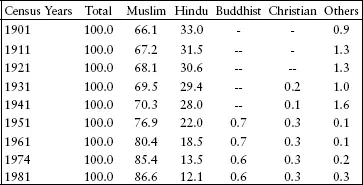
The comparative percentage distribution the population by different religious communities of the country from 1901 to 1981 have been presented in Table 2. The figures in the table show that the proportion of Muslim population in 1901 was 66.1 per cent which has risen to 86.6 per cent by 1981 and the composition of the Muslim population during the last eight decades since 1901 increased by 20.5 per cent points. Comparatively rapid increase in Muslim population are noticed from the census year 1941. The per cent variations of the composition of Muslim population between the census years 1941-1951 and 1961-1974 calculate to 6.6 and 5.0 per cent points respectively. It is observed from the table that the proportion of Hindu population has been declining from 33.0 per cent in 1901 to 12.1 per cent in 1981. The aggregate reduction in terms of percentage was about 21.0 per cent points over 1901. The differential growth rates between Muslims and Hindus, the migration of Hindus following the partition of the subcontinent in 1947, Indo-Pak war in 1965 and the Liberation war of Bangladesh in 1971 are the likely causes for decline in the Hindu proportion in Bangladesh. The Buddhists and the Christians are the minor religious communities in Bangladesh. The combined proportion of these two groups to the total population of the country is only 0.9 per cent. In terms of percentages the size of Christian population to the total population remained constant at 0.3 per cent while Buddhist population has declined from 0.8 per cent in 1951 to 0.6 per cent in 1981.
Table 2: Percentage Distribution of Population by Religious Communities, 1901-1981.
6.3.1 Urban-Rural Differentials
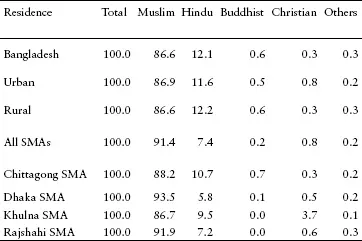
The per centage distribution of Bangladesh population of different religious communities classified by urban-rural and four Statistical Metropolitan Areas (SMA) as recorded in 1981 census is presented in Table 3. The distribution shows that the Muslims being the major religious community of the country, constitutes the overwhelming proportion also in urban areas. Their rural share is slightly less than the urban proportion. The proportion of Hindus in urban areas is marginally lower than their rural proportion. The proportion of Hindus in urban areas is 11.6 per cent as against 12.2 per cent in rural areas. It is evident from the table that like other areas, the Muslims constitute the major religious component in the SMAs also. Highest percentage of Muslim population in recorded in Dhaka SMA which has been followed by Rajshahi SMA. Somewhat lower proportion of Muslims is recorded in Khulna SMA. It is observed that comparatively higher percentages of Hindus and Buddhists have been enumerated in Chittagong SMA. The combined proportion of these two religious communities in Chittagong SMA is 11.4 per cent. It is also found in the table that proportionately larger proportion of Christian population has been recorded in Khulna SMA. The Hindus and Christian jointly constitute about 13.2 per cent of the total population of Khulna SMA.
Table 3: Percentage Distribution of Population by Locality and Religious Composition, 1981
6.3.2 Regional Variations