Chapters (34)
- Cover
- Sanjoy Hazarika
- RITES OF PASSAGE
- Dedication
- Foreword
- Chapter One
- Chapter Two
- Chapter Three
- Chapter Four
- Chapter Five
- Chapter Six
- Chapter Seven
- Chapter Eight
- Chapter Nine
- Chapter Ten
- Chapter Eleven
- Chapter Twelve
- Chapter Thirteen
- Chapter Fourteen
- Appendices
- Footnotes
- Chapter Three
- Chapter Four
- Chapter Six
- Chapter Seven
- Chapter Eight
- Chapter Nine
- Chapter Eleven
- Chapter Twelve
- Chapter Thirteen
- Chapter Fourteen
- Appendices
- Bibliography
- Acknowledgements
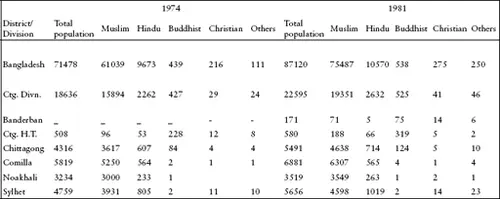
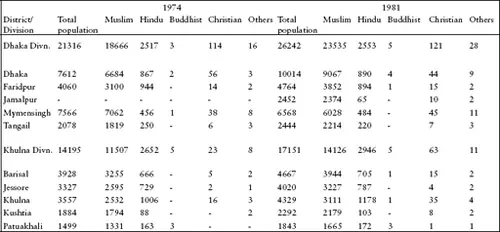
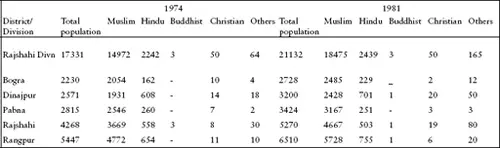
Percentage and numerical distribution of Bangladesh population by religous communities and by administrative Divisions and Districts are presented respectively in Tables 4 and 5. By Division it is found that Dhaka Division has recorded the highest proportion of Muslim population which has been closely followed by Rajshahi Division both in 1974 and 1981 censuses. In both the censuses of 1974 and 1981, Khulna Division recorded the highest share of Hindu population. The highest proportion of Buddhist population is seen in Chittagong Division where they constitute 2.3 per cent. They maintained the same proportion in 1981 census. The proportionate share of Christan population in Dhaka Division is only 0.5 per cent which has remained almsot unchanged between 1974 and 1981 and this is the highest proportion of Christian population among the four administrative Divisions.
Table 4: Regional Distribution of Bangladesh Population by Religious Communities, 1974 and 1981.
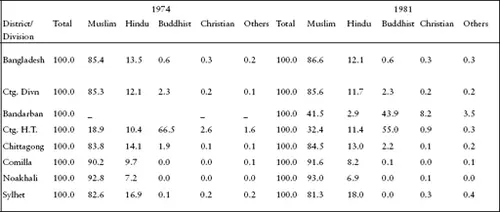
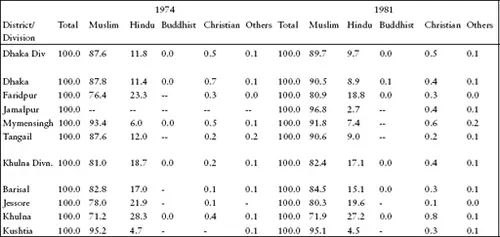
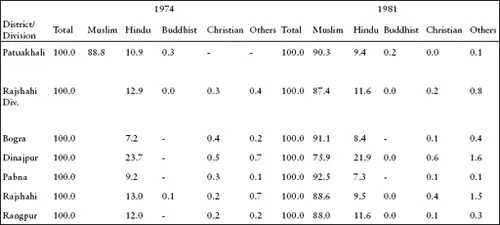
Table 5: Regional Distribution of Bangladesh Population by Religious Communities, 1974 and 1981. (In Thousand)
Appendix C
2.16 Percentage Distribution and Variation of Major Communities by Religion
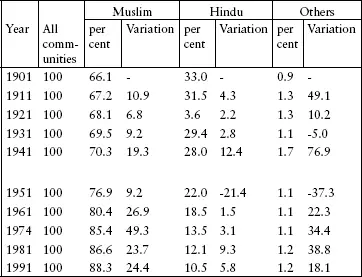
Notes: Hindus include both Caste Hindus and Scheduled Castes.
Source: Census of Population. Others included Buddhist, Christian & others.
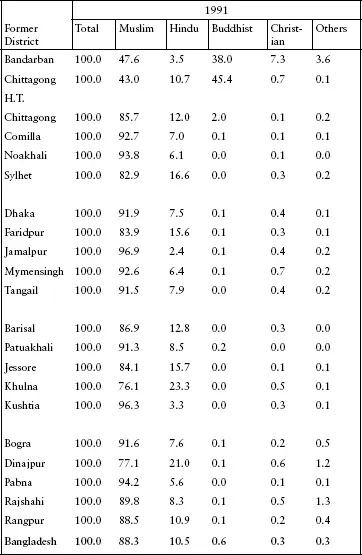
2.17 Former District-Wise Enumerated Census Population by Religion (Number)
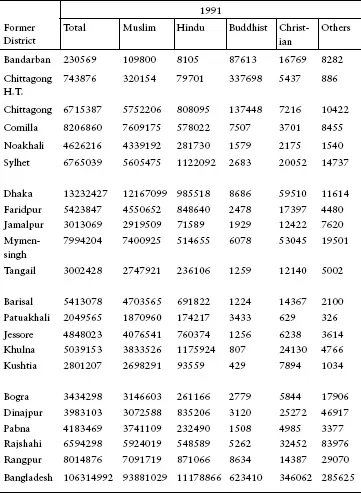
2.17 Former District-Wise Enumerated Census Population by Religion (Percentage)
Appendix D
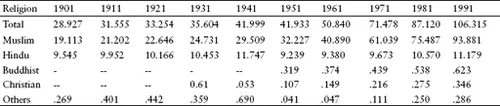
Table 2: Population of Bangladesh by Religious Groups, 1901—1991
(Numbers in million)
(percentage distribution)
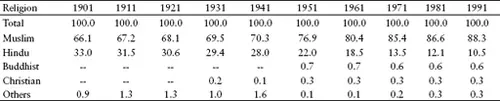
Source: Population Censuses, 1981 and 1991.
BIDS WORKING PAPER
Working Paper New Series No. 5
Population Factors, Developmental Problems, Environment and Sustainability in Bangladesh, M.R. Khan, September 1994
Appendix E
Bangladesh Population During the First Five Year Plan Period (1972-77): A Guestimate By Masihur Rahman Khan October 1972
Migration
Migration played an important role in the growth of the Bangladesh population. With the exception of 1901-11 decade when Bangladesh gained around half a million persons as result of net immigration from India, Bangladesh was losing population through net emigration mainly to India in all other decades. From an initial low net emigration figure of around 100 thousand in 1911-21, the net emigration rose to over 600 thousand in each of the decades of 1921-31 and 1931-41, to 1.9 million in 1941-51 and around 1.2 mill in 1951-61. Though no estimate of net migration could be made for the period after the 1961 census, it can be argued that Bangladesh was expected to lose population to India even after that date. The exodus was possible high in 1964-66 due to and associated with the Pakistani war in 1965 with India. Concerning the more recent migration, it is officially maintained that the exodus of around 10 million Bengalees to India from the then East Pakistan when she was still in the hands of Pakistan army was balanced out by a reverse migration of that magnitude to their motherland after the liberation of Bangladesh. In the post-liberation period there has been some inflow of Bengalees from across the border of India only possible for short stay as visitors. Given the present still unsettled socio-economic condition of the country, the possibility of a continued net emigration flow from Bangladesh, though a smaller magnitude compared to that in 1940s or 1950s, cannot be ruled out.