Chapters (34)
- Cover
- Sanjoy Hazarika
- RITES OF PASSAGE
- Dedication
- Foreword
- Chapter One
- Chapter Two
- Chapter Three
- Chapter Four
- Chapter Five
- Chapter Six
- Chapter Seven
- Chapter Eight
- Chapter Nine
- Chapter Ten
- Chapter Eleven
- Chapter Twelve
- Chapter Thirteen
- Chapter Fourteen
- Appendices
- Footnotes
- Chapter Three
- Chapter Four
- Chapter Six
- Chapter Seven
- Chapter Eight
- Chapter Nine
- Chapter Eleven
- Chapter Twelve
- Chapter Thirteen
- Chapter Fourteen
- Appendices
- Bibliography
- Acknowledgements
Population census 1981 like earlier censuses collected information on the religious affiliations of the population. Individual characteristics of each religious communities cross-classified by demographic and socio-economic variables are presented in this chapter. Aggregate measures such as over-all religious patterns, growth of population by religion over time, regional variations, urban-rural differentials etc. have also been discussed with the objective of measuring and evaluating the trend of social and economic development among the different religious communities of the country.
Source: 1981, Census of Bangladesh, Bureau of Statistics, Dhaka.
6.2 Population Growth By Religion
Numerical distribution and percentage variation of major religious communities in Bangladesh from 1901 to 1981 have been furnished in Table 1. The table shows that in terms of percentage variations over the preceding censuses, the Muslim community increased by 10.9 per cent in 1911 over 1901. On the other hand, comparatively lower increasing trends of this community have been recorded in 1921 and 1931. High mortality due to the occurrence of famines, droughts, epidemic diseases during this period might be the causes of these slow trends. A sharp decline by 10.1 percentage points in 1951 over the trend of 1941 may be explained by the net effect of migration. That is the emigrated number of Hindus after independence of 1947 was relatively larger than the immigrated number of Muslims from India. From 1961 to 1981 the rates of increase of Muslim population have been high. High fertility and moderately declining level of mortality during the last two decades may account for this rapid increase.
The decennial variations of Hindu population in Bangladesh have shown an irregular pattern over the census years 1901 to 1981. The Hindu population decreased by 21.3 per cent points in 1951. This may be due partly to the migration of Hindu from the former East Bengal to West Bengal on account of the partition of British India and the creation of the two independent and sovereign states of Pakistan and India in 1947 and partly due to the prevalence of relatively lower fertility among the Hindu population.
Table 1 : Numerical Distribution and Percentage Variation of Bangladesh Population by Major Religious Communities 1901-1981.
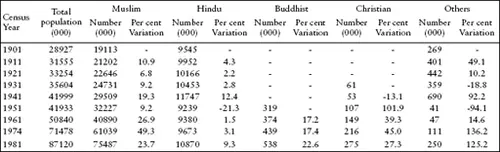
Note: (1) Hindus in this and subsequent tables include both caste Hindus and Scheduled caste.
. . . upto 1941 Buddhist and upto 1921 Christian communities are not available separately and as such these two communities have been included in ‘Others’. Christian community is not available separately in the district of Sylhet in 1931 Census and as such they have been included in ‘Other’.
It may be noted that due to the rounding of the totals in thousand, slight difference from the actual figures may appear.
6.3 Religious Composition Over Time