Chapters (34)
- Cover
- Sanjoy Hazarika
- RITES OF PASSAGE
- Dedication
- Foreword
- Chapter One
- Chapter Two
- Chapter Three
- Chapter Four
- Chapter Five
- Chapter Six
- Chapter Seven
- Chapter Eight
- Chapter Nine
- Chapter Ten
- Chapter Eleven
- Chapter Twelve
- Chapter Thirteen
- Chapter Fourteen
- Appendices
- Footnotes
- Chapter Three
- Chapter Four
- Chapter Six
- Chapter Seven
- Chapter Eight
- Chapter Nine
- Chapter Eleven
- Chapter Twelve
- Chapter Thirteen
- Chapter Fourteen
- Appendices
- Bibliography
- Acknowledgements
Urging that humanitarian considerations aligned to national interests light the way for government policies, Weiner concludes that ‘states will not and cannot allow others to decide who will permanently live and work in their own societies.’16
If Assam perishes, then who will live? Can India survive such a brutal body blow?
I do not know the answers to these questions. But they will be answered, if not in my lifetime, then certainly in that of the next generation of Indians, Assamese and Bangladeshis.
Appendices
Appendix A Excerpts from Population Census Report.
National Volume.
(Bangladesh Bureau of Statistics, Dhaka, 1977)
BANGLADESH
Religious Communities: Table 20 focuses on the percentage distribution of the Muslim and Hindu communities from 1901 to 1947; all other communities are grouped under ‘other’. It will be noted that Muslims and Hindus constitute together almost 99% of the total population in Bangladesh. The proportions of Muslims and Hindus, however, have changed continuously since the census of 1901. The proportion of Muslims was 66% in 1901, and it has increased to 85.4% in 1974. On the other hand, the proportion of Hindus was 33% in 1901 and has continuously decreased to 13.5% in 1974. The proportion of Hindus decreased each decade by at least 1 percentage point upto 1941 and then decreased more rapidly about 6 per cent during 1941-1951, 3 per cent between 1951-1961 and 5 per cent between 1961-1974. These decreases were paralleled by similar increases in the proportion of Muslims in the corresponding decades.
Table 20—Percentage Distribution and Percentage Variation of Major Religious Communities in Bangladesh—1901-1974
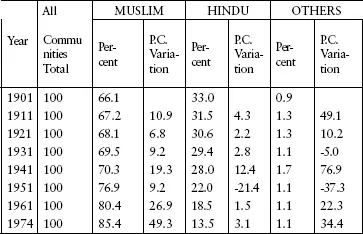
Sources: 1901—1961, Census of Pakistan, 1961, Vol, 2, East Pakistan, Statement 2—I, p. II—15.
1974, Census Data, Table 7.
The Muslim community constituted slightly more than 85 per cent of the total population of Bangladesh in 1974 and largely accounted for the overall growth of population of Bangladesh in all the past decades. They increased by about 9 per cent in the three decades upto 1931, when the overall population growth was about 2 percentage points lower. The unprecedented increase of 19 per cent in the decade ending in 1941, followed by the comparatively lower increase of 9 per cent in 1951, may be attributed to over-reporting in the 1941 Census. The number of Muslims grew by 27 per cent during the decade 1951-1961 and by 49 per cent during the 13 year period 1961-1974 as against the overall population growth of 21 per cent and 40 per cent in the respective periods. The fastest growth of the Muslim population (about 3.8 per cent per annum) thus occurred in the recent past.