Chapters (34)
- Cover
- Sanjoy Hazarika
- RITES OF PASSAGE
- Dedication
- Foreword
- Chapter One
- Chapter Two
- Chapter Three
- Chapter Four
- Chapter Five
- Chapter Six
- Chapter Seven
- Chapter Eight
- Chapter Nine
- Chapter Ten
- Chapter Eleven
- Chapter Twelve
- Chapter Thirteen
- Chapter Fourteen
- Appendices
- Footnotes
- Chapter Three
- Chapter Four
- Chapter Six
- Chapter Seven
- Chapter Eight
- Chapter Nine
- Chapter Eleven
- Chapter Twelve
- Chapter Thirteen
- Chapter Fourteen
- Appendices
- Bibliography
- Acknowledgements
In terms of percentage variations over the previous censuses, the Hindu community increased by 4% in 1911, 2% in 1921 2% in 1931, 2% in 1961, and 3% in 1974. Thus the growth of the Hindu population in Bangladesh has shown an almost uniform pattern over the last 7 decades. The greatest increase of the Hindu population in any decade was 12% observed in 1941. This figure is subject to doubt, since both the major communities inflated their numbers in the 1941 census. The number of Hindus, however, decreased by 21% in the, 1951 census, which reflects partially the overcount in 1941 and mainly the migration of Hindus from the former East Bengal to West Bengal, on account of the partition of India and the creation of the independent countries of Pakistan and India in 1947.
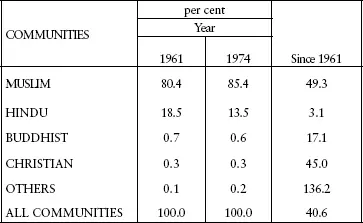
The small religious communities viz the Buddhists and Christians formed only 0.61% and 0.30% of the total population of Bangladesh in 1974. Table 21 provides data for 1961 and 1974 on these two communities. The Christian community increased by about 45% during the period 1961-1974, while the Buddhists increased by 17% compared with the overall population increase of 40% during the period. The proportion of Christians in the population increased slightly from 0.26% in 1951, 0.29% in 1961 to 0.30% in 1974. On the other hand, although the number of Buddhists increased by 17% in both 1961 and 1974 over the previous censuses, the proportion of Buddhists decreased from 0.75% in 1951 to 0.74% in 1961 and 0.61% in 1974. This could be due to misclassification or to a lower fertility rate as compared to that of the general population. The large increase in the percentage variation of ‘others’ would imply that several Buddhists have been classified as ‘others’ in the 1974 census.
Table 21—Percentage Distribution and Percentage Variation of Various Religious Communities in Bangladesh 1961-1974
Sources: 1961—Census of Pakistan, 1961, Vol. 2, East Pakistan, Table 5, pp. II-98 to II-99.
1974—Census Data, Table 7,
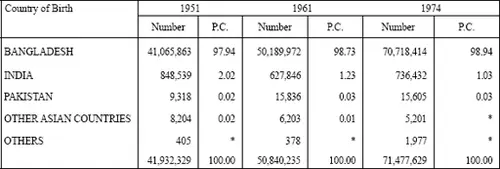
Table 22—Enumerated and Percentage Distribution of Population of Bangladesh by Country of Birth—1951, 1961, 1974.
Source: 1951, 1961—Census of Pakistan, 1961 Vol. 2, East Pakistan, Table 8, p. II—116.
1974—Census Data, Table 8. * Negligible
Country of Birth : Table 22 gives the percentage distribution of the population by country of birth for the 1951, 1961 and 1974 censuses. The statement shows that almost 99% of the population of Bangladesh, as enumerated in the 1974 census, were born in the present territory constituting Bangladesh. Slightly more than 1% of the population was reported to have been born outside Bangladesh, of which the greater proportion was born in India, however, shows a decreasing trend, from 2.02 in 1951, 1.23 in 1961 to 1.03 in 1974. About 0.03% of the total population of Bangladesh was reported to have been born in Pakistan in the 1974 census. Only about 7,000 persons were reported in this census to have been born in countries other than the subcontinent area of Bangladesh-India-Pakistan.
Appendix B
RELIGIOUS COMPOSITION
6.1. Introduction