Nightingale
Chapters (33)
- Cover
- Title Page
- Note to Reader
- Dedication
- I
- Psalm
- Knitted Thylacin
- The Cry
- Four Marys
- Psyche
- The Wolves
- Tiresias
- Horn of Plenty
- Astyanax
- Io
- II
- Philomela
- Nightingale: A Gloss
- III
- Quiver
- Gokstadt/Ganymede
- Telling the Wasps
- IV
- Marsyas
- Pasiphaë
- The Olive Tree at Vouves
- Driving to Santa Fe
- Pear
- Pythagorean
- About the Author
- Books
- Acknowledgments
- Special thanks
Cover
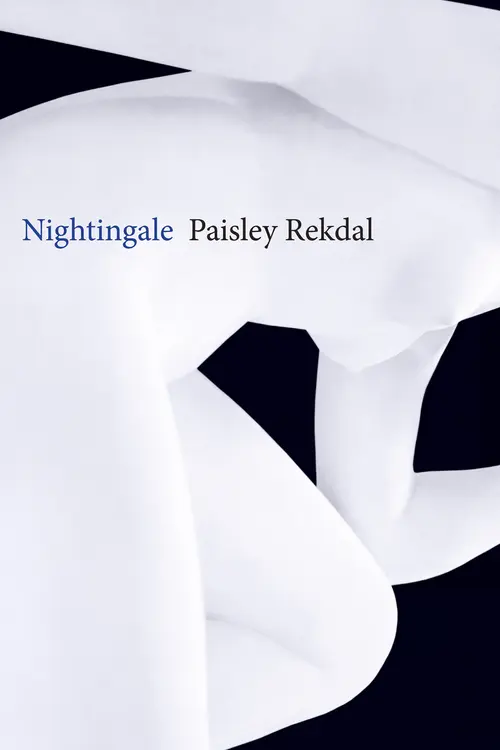
Title Page
Nightingale
PAISLEY REKDAL

COPPER CANYON
PRESS
Note to Reader
Note to the Reader
Copper Canyon Press encourages you to calibrate your settings by using the line of characters below, which optimizes the line length and character size:
Lorem ipsum dolor sit amet, consectetur adipiscing elit. Pellentesque euismod magna ac diam dignissim condimentum.
Please take the time to adjust the size of the text on your viewer so that the line of characters above appears on one line, if possible.
When this text appears on one line on your device, the resulting settings will most accurately reproduce the layout of the text on the page and the line length intended by the author. Viewing the title at a higher than optimal text size or on a device too small to accommodate the lines in the text will cause the reading experience to be altered considerably; single lines of some poems will be displayed as multiple lines of text. If this occurs, the turn of the line will be marked with a shallow indent.
Thank you. We hope you enjoy these poems.
This e-book edition was created through a special grant provided by the Paul G. Allen Family Foundation.
Dedication
In memory of Gregory Beckelhymer
The substance is not chaunged, nor altered,
But th’ only forme and outward fashion;
For every substance is conditioned
To change her hew, and sundry forms to don
Edmund Spenser, The Faerie Queene, bk. 3, canto 6
Why do you remove me from myself?
Ovid, The Metamorphoses, 6.385
Nightingale
I
I
Psalm
Psalm
Too soon, perhaps, for fruit. And the broad branches,
ice-sheathed early, may bear none. But still my neighbor
waits, with her ladder and sack, for something to break.
A gold, a lengthening of light. For the greens to burst
into something not unlike flame: the pale fruit
blushing over weeks through the furred cleft creases:
a freckling of blood. Then the hot, sweet scent
of August rot, drawing wasps and birds and children
through the month. So much abundance, and the only cost
waiting. Looking at the tree, I almost expect the sound of bells,
a stone church, sheep in flocks. But no sound of bells,
no clarion call. The church is far down in the valley.
This tree should be an ancient, revered thing placed
at the heart of a temple. Instead, it is on a common
lot, beside a road, apartment buildings, a dog
sleeping in its yard. My neighbor has come here
neither as master nor supplicant. She simply plans
to fill a plastic sack with whatever she can take:
the sweet meat giving under the press of a thumb,
covering what is its true fruit: the little pit, hard
and almond-brown, that I’ve scooped out,
palmed, and planted to no avail. A better gardener
could make demands of such a seed, could train a tree
for what desire anticipates. But here the tree grows
only for itself. And if it bears no fruit for the killing