Chapters (40)
- Cover Page
- Title Page
- Dedication
- Prologue A Brief History of Banting
- Part One
- Chapter 1
- Chapter 2
- Chapter 3
- Chapter 4
- Part Two
- Chapter 5
- Chapter 6
- Chapter 7
- Chapter 8
- Chapter 9
- Chapter 10
- Chapter 11
- Chapter 12
- Chapter 13
- Part Three
- Chapter 14
- Chapter 15
- Chapter 16
- Chapter 17
- Chapter 18
- Chapter 19
- Chapter 20
- Chapter 21
- Chapter 22
- Chapter 23
- Chapter 24
- Epilogue
- Notes
- Bibliography
- Acknowledgments
- Illustration Credits
- A Note About the Author
- Also by Gary Taubes
- Footnotes
- Copyright
Some factor of diet and/or lifestyle must be driving weight upward, because human biology and our underlying genetic code cannot change in such a short time. The standard explanation is that in the 1970s we began consuming more calories than we expended and so as a society we began getting fatter, and this tendency has been particularly exacerbated since the early 1980s.
Authorities phrase this concept differently, but the idea is invariably the same. The psychologist Kelly Brownell, director of the Yale Center for Eating and Weight Disorders, coined the term “toxic environment” to describe an American culture “that encourages overeating and physical inactivity” and so encourages obesity as a consequence. “Cheeseburgers and french fries, drive-in windows and supersizes, soft drinks and candy, potato chips and cheese curls, once unusual, are as much our background as trees, grass, and clouds,” says Brownell. “Few children walk or bike to school; there is little physical education; computers, video games, and televisions keep children inside and inactive; and parents are reluctant to let children roam free to play.” In an editorial entitled “The Ironic Politics of Obesity” published by Science in 2003, the New York University nutritionist Marion Nestle summed up this hypothesis of obesity and the obesity epidemic in two words: “improved prosperity.” Nestle, like Brownell, considered the food and entertainment industries culpable: “They turn people with expendable income into consumers of aggressively marketed foods that are high in energy but low in nutritional value, and of cars, television sets, and computers that promote sedentary behavior. Gaining weight is good for business,” Nestle wrote.
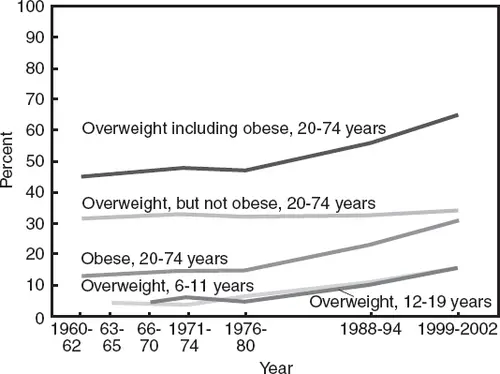
SOURCE: Centers for Disease Control and Prevention, National Center for Health Statistics, Health, United States, 2005, figure 15.
Obesity rates in America, according to the Centers for Disease Control, with the upturn of the obesity epidemic apparently beginning in the 1970s or early 1980s.
More than one billion adults worldwide are overweight, according to the World Health Organization; three hundred million are obese and obesity rates have “risen three-fold or more since 1980 in some areas of North America, the United Kingdom, Eastern Europe, the Middle East, the Pacific Islands, Australasia and China.” In these regions, too, prosperity is seen as the problem. “As incomes rise and populations become more urban,” the WHO said, “diets high in complex carbohydrates give way to more varied diets with a higher proportion of fats, saturated fats and sugars. At the same time, large shifts towards less physically demanding work have been observed worldwide. Moves towards less physical activity are also found in the increasing use of automated transport, technology in the home, and more passive leisure pursuits.”