Chapters (40)
- Cover Page
- Title Page
- Dedication
- Prologue A Brief History of Banting
- Part One
- Chapter 1
- Chapter 2
- Chapter 3
- Chapter 4
- Part Two
- Chapter 5
- Chapter 6
- Chapter 7
- Chapter 8
- Chapter 9
- Chapter 10
- Chapter 11
- Chapter 12
- Chapter 13
- Part Three
- Chapter 14
- Chapter 15
- Chapter 16
- Chapter 17
- Chapter 18
- Chapter 19
- Chapter 20
- Chapter 21
- Chapter 22
- Chapter 23
- Chapter 24
- Epilogue
- Notes
- Bibliography
- Acknowledgments
- Illustration Credits
- A Note About the Author
- Also by Gary Taubes
- Footnotes
- Copyright
The following December, the National Institutes of Health hosted a “consensus conference” and effectively put an end to thirty years of debate. Ideally, in a consensus conference an unbiased expert panel listens to testimony and arrives at conclusions on which everyone agrees. In this case, Rifkind chaired the planning committee, of which Steinberg was a member. Steinberg was then chosen to head the expert panel that would draft the consensus. The twenty speakers did include three skeptics—Ahrens, Robert Olson, and Michael Oliver, a cardiologist with the Medical Research Council in London—who argued that the wisdom of a cholesterol-lowering diet could not be established on the strength of a drug experiment, let alone one with such borderline results. A month after the conference, the NHLBI epidemiologist Salim Yusuf described the controversy to Science as remaining as polarized as ever: “Many people have already made up their minds that cholesterol-lowering helps, and they don’t need any evidence. Many others have decided that cholesterol-lowering is not helpful, and they don’t need any evidence either.”
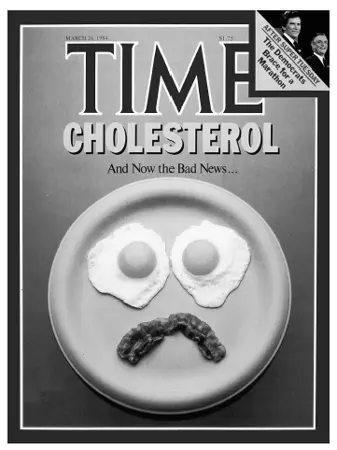
March 1984: the results of a drug trial are translated into the message that fatty foods will cause heart disease. (Time magazine © 1984 Time Inc. Reprinted by permission.)
But this was not the message of Steinberg’s “consensus” panel, which was composed exclusively of lay experts and clinical investigators who “were selected to include only [those] who would, predictably, say that all levels of blood cholesterol in the United States are too high and should be lowered,” as Oliver wrote in a Lancet editorial following the conference. “And, of course, this is exactly what was said.” Indeed, the consensus conference report, written by Steinberg and his panel, revealed no evidence of any discord or dissent. There was “no doubt,” it concluded, that low-fat diets “will afford significant protection against coronary heart disease” to every American over the age of two. The NIH Consensus Conference officially gave the appearance of unanimity where no unanimity existed. After all, if there had been a true consensus, as Steinberg himself later explained, “you wouldn’t have had to have a consensus conference.”
Chapter 4
Chapter Four
THE GREATER GOOD
In reality, those who repudiate a theory that they had once proposed, or a theory that they had accepted enthusiastically and with which they had identified themselves, are very rare. The great majority of them shut their ears so as not to hear the crying facts, and shut their eyes so as not to see the glaring facts, in order to remain faithful to their theories in spite of all and everything.
MAURICE ARTHUS, Philosophy of Scientific Investigation, 1921