Chapters (25)
- Title Page
- Dedication
- Introduction
- I - Into the Wild Blue
- Chapter 1 - Every Man a Tiger
- Chapter 2 - The Big Lie
- Chapter 3 - The Vision of Bill Creech
- II - Shield in the Sky
- Chapter 4 - Mission to Jeddah
- Chapter 5 - CENTCOM Forward
- Chapter 6 - Planning the Storm
- Chapter 7 - Band of Brothers and Sisters
- III - The Thousand-Hour War
- Chapter 8 - Storm!
- Chapter 9 - Hits and Misses
- Chapter 10 - Lost and Found
- Chapter 11 - Punch and Counterpunch
- Chapter 12 - A Day in the War
- Chapter 13 - The Ten Percent War
- Chapter 14 - Shock and Awe
- Chapter 15 - Building Coalitions
- Chapter 16 - Beyond Iraqi Freedom
- Acknowledgements
- BIBLIOGRAPHY
- INDEX
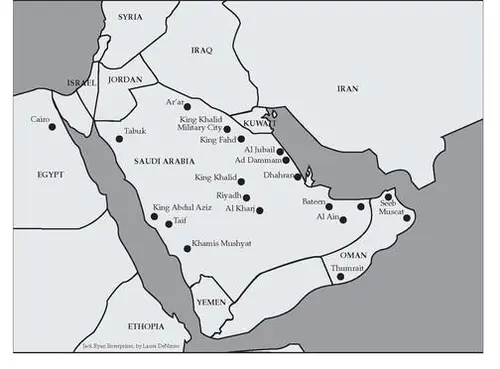
In Desert Shield, the F-15Es had been deployed initially to Thumrait, Oman. Thumrait was a fighter base, it had the fuel and munitions storage required, and much of the Air Force’s pre-position housing was stored there. The F-15E was a long-range attack aircraft, so the nearly eight-hundred-mile one-way trip to the (projected) battlefield (near the Kuwait-Saudi border) was not a problem. In fact, this distance was desirable if the battle started to move south and the Iraqis overran the more northern airfields. However, now that the projected battlefield was about to move north, the long round trip became a big disadvantage. It was therefore decided to move them five hundred miles north to the runway/parking apron the RSAF had built at Al Kharj. This move would put them an hour closer to the war.
Colonel Ray Davies and the 823 Red Horse Squadron, the Air Force’s heavy construction battalion, having just finished building ramps at Al Minhad in the UAE, and taxiways and parking at Sheikh Isa in Bahrain,51 were sent north by Colonel Hal Hornberg to build a base and a host of living facilities throughout the desert for Air Force, Army, and Navy troops. The Red Horse would raise a city for over five thousand people in a matter of days.
The problems were daunting. For starters, the sand would not hold the tie-down stakes for the Air Force’s temper tents—air-conditioned and heated desert tents that were the envy of their army brothers. Red Horse’s answer was to lay down a deep base of clay over the sand. The clay hardened like cement and gave the camp a stable base. It’s easy when you can think big.
They found and dug out ton after ton of clay, then overlaid miles of desert where they wanted to set down the tents. The next problem was no water or fuel. Their solution was to bring huge rubber bladders from pre-positioned stocks in Oman and Bahrain. Hangars for the airplanes were also up in hours, again from pre-positioned supplies. Munitions storage areas, dining halls, shops, a chapel, operations, even a sand golf course, all rose in weeks. By December, the base was ready to receive two F-15E squadrons, two F-16 squadrons, an F-15C squadron, and a C-130 airlift squadron.
★ The creation of the quick-turn base at KKMC was even harder.
Quick-turn is a simple concept: The great reliability of modern American military aircraft allows them to make several sorties a day, like airliners, lugging bombs instead of passengers. It therefore made sense to locate a base close to Iraq, where the aircraft could be quickly refueled and reloaded, and the pilot could be given target information for a new mission. In that way, they could strike the enemy four or five times a day—in a tempo that would leave the Iraqis reeling.
Coalition Air Bases in the Middle East