Earthly Joys
Chapters (56)
- PHILIPPA GREGORY
- April 1603
- April 1603
- July 1604
- August 1604
- October 1605
- May 1607
- June 1607
- August 1607
- Summer 1608
- January 1610
- Summer 1610
- Autumn 1610
- Spring 1611
- Autumn 1611
- May 1612
- October 1612
- November 1612
- September 1616
- Summer 1618
- Spring 1620
- 1622
- 1623
- 1624
- March 1625
- Spring 1625
- May 1625
- Summer 1626
- Summer 1627
- Autumn 1627
- November 1627
- Winter 1627
- Spring 1628
- Summer 1628
- Late Summer 1628
- November 1628
- December 1628
- Spring 1629
- 1630
- Summer 1631
- Winter 1632–3
- Summer 1633
- Winter 1633–4
- Spring 1634
- January 1635
- Spring 1635
- Summer 1635
- 1636
- December 1636
- 1637
- December 1637
- Spring 1638
- About the Author
- Also by the Author
- Copyright
- About the Publisher
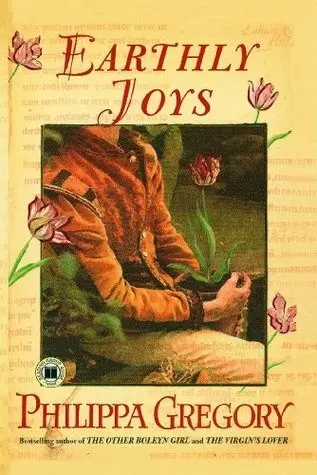
PHILIPPA GREGORY
Earthly Joys

April 1603
The daffodils would be fit for a king. The delicate wild daffodils, their thousand heads bobbing and swaying with the wind, light-petalled, light-stemmed, moving like a field of unripe barley before a summer breeze, scattered across the grass, thicker around the trunks of trees as if they were dewponds of gold. They looked like wild flowers; but they were not. Tradescant had planned them, planted them, nourished them. He looked at them and smiled – as if he were greeting friends.
Sir Robert Cecil strolled up, his uneven tread instantly recognisable in the crunch of the gravel. John turned and pulled off his hat.
‘They look well,’ his lordship observed. ‘Yellow as Spanish gold.’
John bowed. The two men were near each other in age – both in their thirties – but the courtier was bent under a humped back and his face was lined by a lifetime of caution at court, and with pain from his twisted body. He was a small man, little more than five feet tall – his enemies called him a dwarf behind his hunched back. In a beauty-conscious, fashion-mad court where appearance was everything and a man was judged by his looks and his performance on the hunting field or battlefield, Robert Cecil had started his life with an impossible disadvantage: crooked, tiny, and struggling with pain. Beside him the gardener Tradescant, brown-faced and strong-backed, looked ten years younger. He waited in silence for his master to speak. It was not his place to prolong the conversation.
‘Any early vegetables?’ his lordship asked. ‘Asparagus? They say His Majesty loves asparagus.’
‘It’s too early, my lord. Even a king new-come to his kingdom cannot hunt deer and eat fruit in the same month. They each have their season. I cannot force peaches for him in spring.’
Sir Robert smiled. ‘You disappoint me, Tradescant, I had thought you could make strawberries grow in mid-winter.’
‘With a hothouse, my lord, and a couple of fires, some lanterns, and a lad to water and carry, perhaps I could give you Twelfth Night strawberries.’ He thought for a moment. ‘It’s the light,’ he said to himself. ‘I think you would need sunlight to make them ripen. I don’t know that candlelight or even lanterns would be enough.’
Cecil watched him with amusement. Tradescant never failed in the respect he owed his master, but he readily forgot everything but his plants. As now, he could fall silent thinking of a gardening problem, wholly neglecting his lord who stood before him.