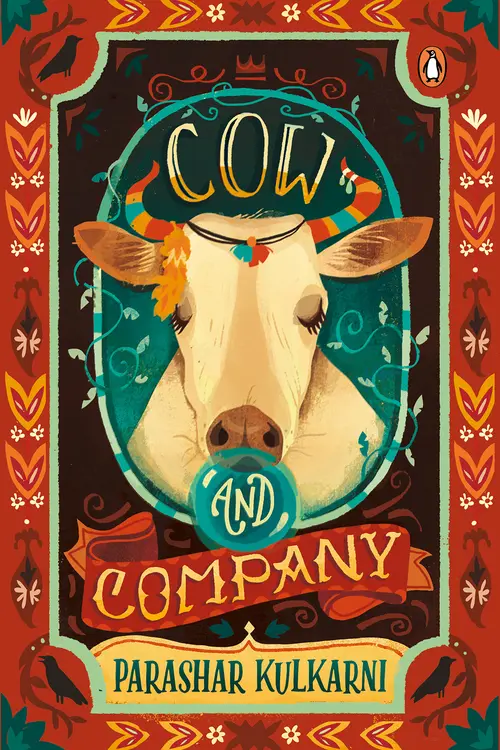
Cow and Company
Chapters (46)
Cover


Dedication
For Bhau and Aai
Mother cow is in many ways better than the mother who gave us birth. Our mother gives us milk for a couple of years and then expects us to serve her when we grow up. Mother cow expects from us nothing but grass and grain. Our mother often falls ill and expects service from us. Mother cow rarely falls ill. Here is an unbroken record of service which does not end with her death. Our mother, when she dies, means expenses of burial or cremation. Mother cow is as useful dead as when she is alive. We can make use of every part of her body—her flesh, her bones, her intestines, her horns and her skin. Well, I say this not to disparage the mother who gives us birth, but in order to show you the substantial reasons for my worshipping the cow.
M.K. Gandhi
(Harijan 8 [31]: 15 September 1940, p. 281)

1
Metro House, the headquarters of the British Chewing Gum Company, stood at the intersection of Colaba Causeway, the artery of the old town with its hundred or so commercial establishments, and a side street leading towards Apollo Bunder, the Bombay port that had become the centre of the cotton trade. Three-storey high and defended by one guard with a baton, what was lost in size was recovered in ambition—to introduce chewing gum to all the Crown’s colonies. Where to inaugurate this grand design from, if not the jewel in the crown—India? If setting up shop was a struggle, what lay ahead was war. All mouths were full . with betel leaves—paan—that stood guard against the changing tide of time. The empire of paan—the sun never truly set on it—was on all streets and in all homes. It was in alliance with a hundred odd partners: Afghani dates, Malabari cardamom, Kashmiri saffron, Ahmedabadi gold leaves . It presided over all events: births, rebirths, weddings, funerals. It was referenced in all texts: written by man, written by God. It left no lip unblemished. It was invincible: in public or private, by day or night, on land or water, by man or beast.
Every couple of hours, millions spat in support. The walls were red. The streets were red. The British Chewing Gum Company too was infiltrated. Two corridors were stained. Three of the twelve employees were daily paan-chewers. Nothing short of a revolution was in need.
Day by day, the Company had begun to know the who, why, what, where and how of paan-chewing. Their survey, work in progress, informed them that the Muslims added saffron, Hindus added cardamom. Men added tobacco, women added mint. Lower classes added lime, upper classes added gold. Bengalis liked theirs sweeter, Madrasis, smaller. Afghanis added opium. Soon, the Atlas of Paan-Chewers was drawn up with tables, maps and legends.