Chapters (56)
- PROLOGUE: KERRICK
- Title Page
- CHAPTER ONE
- CHAPTER TWO
- CHAPTER THREE
- CHAPTER FOUR
- CHAPTER FIVE
- CHAPTER SIX
- CHAPTER SEVEN
- CHAPTER EIGHT
- CHAPTER NINE
- CHAPTER TEN
- CHAPTER ELEVEN
- CHAPTER TWELVE
- CHAPTER THIRTEEN
- CHAPTER FOURTEEN
- CHAPTER FIFTEEN
- CHAPTER SIXTEEN
- CHAPTER SEVENTEEN
- CHAPTER EIGHTEEN
- CHAPTER NINETEEN
- CHAPTER TWENTY
- CHAPTER TWENTY-ONE
- CHAPTER TWENTY-TWO
- CHAPTER TWENTY-THREE
- CHAPTER TWENTY-FOUR
- CHAPTER TWENTY-FIVE
- CHAPTER TWENTY-SIX
- CHAPTER TWENTY-SEVEN
- CHAPTER TWENTY-EIGHT
- CHAPTER TWENTY-NINE
- CHAPTER THIRTY
- CHAPTER THIRTY-ONE
- CHAPTER THIRTY-TWO
- CHAPTER THIRTY-THREE
- CHAPTER THIRTY-FOUR
- CHAPTER THIRTY-FIVE
- CHAPTER THIRTY-SIX
- CHAPTER THIRTY-SEVEN
- CHAPTER THIRTY-EIGHT
- CHAPTER THIRTY-NINE
- CHAPTER FORTY
- CHAPTER FORTY-ONE
- CHAPTER FORTY-TWO
- CHAPTER FORTY-THREE
- CHAPTER FORTY-FOUR
- CHAPTER FORTY-FIVE
- THE WORLDWEST OF EDEN
- THE YILANÈ
- THE TANU
- THE PARAMUTAN
- DICTIONARIES
- ZOOLOGY
- ACKNOWLEDGMENTS
- ABOUT THE AUTHOR
- About this Title
All of the names of these small tribal groups are descriptive, e.g. Wedaman means ‘the island ones’; Levrewasan ‘tent-black-ones’, that is the people of the black tents. Like man, hannas, woman linga, plural lingai, has widespread similarity. A person, sex not specified, is ter, while the plural tanu is generally accepted as referring to all other people.
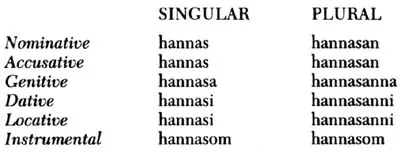
The most common masculine noun declension is:
THE PARAMUTAN
Like the Tanu, the Paramutan are descended from the New World primates. Although fossil evidence is lacking, gene analysis reveals that Tanu and Paramutan are genealogically quite close and only their great physical separation has prevented inbreeding up until this time. Although superficial resemblance does not seem to bear this out, i.e. the furcovered Paramutan and the relatively hairless Tanu, it should be noted that both groups have approximately the same number of hair follicles. Many Tanu are born with rudimentary tails, merely an external projection of the coccyx, which contain exactly the same number of bones as the Paramutan tail.
Therefore the obvious physical differences between the groups are of little importance; what is relevant are the social and cultural factors. The Paramutan migrated further north than any of the other primates. We may postulate population pressure from behind or relevant technology that made subarctic existence first a possibility, then a necessity. Their dependence upon a single major source for food, raw materials, existence itself (the ularuaq) allows no other possibility. Their use of north-temperate materials (wood for their boats, oak-tanning of hides) is still important—but the ularuaq is irreplaceable to their existence as their culture is constituted now.
It must be pointed out that Paramutan is a misnomer since this is a Marbak word that means “raw-meat-eaters”. The correct term in their own language is Angurpiaq, meaning “real people”, for this is how they see themselves. In their solitary existence in the northern wastes they feel, with some good reason, that they are the real people, the only people. This is why they call the Tanu Erqigdlit, the fantasy people. Strangers who come from an unreal world who therefore must be unreal themselves.