Weird Tales
Chapters (21)
- Cover
- Foreword: Writers Are Weird
- The Peacock’s Shadow – E. Hoffman Price
- The White Lady of the Orphanage
- The Terrible Old Man
- The Woman of the Wood
- Bat’s Belfry – August W. Derleth
- The Curse of Everard Maundy
- The Tomb
- Saladin’s Throne-Rug – E. Hoffmann Price
- The Dog-Eared God – Frank Belknap Long, Jr.
- The City of Spiders – H. Warner Munn
- The Cats of Ulthar
- Back to the Beast – Manley Wade Wellman
- A Suitor from the Shades – Greye La Spina
- Pickman’s Model – H.P. Lovecraft
- The Atomic Conquerors
- Original Publication Information
- About the Editors
- If You Liked…
- WordFire Classics
Cover
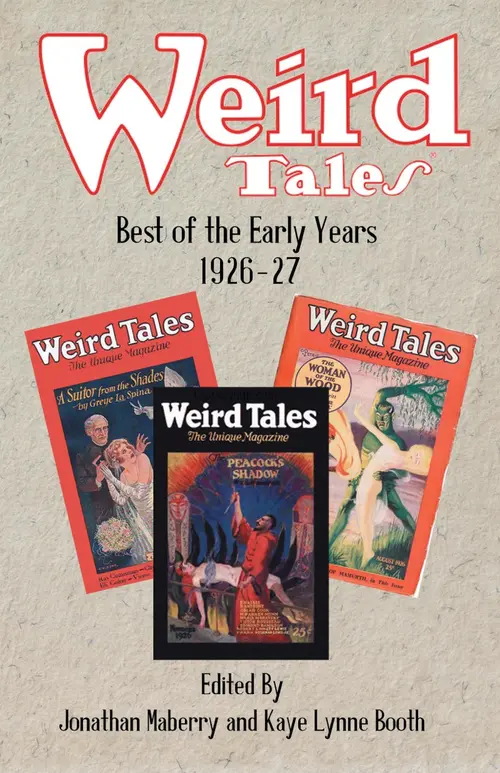
Foreword: Writers Are Weird
Jonathan Maberry
Writers are weird.
Yes, I know, what a news flash. Who would ever have thought?
So, on one hand, anyone who sits alone in a room, making up outrageous lies in the hopes someone pays them to do so, and acts very much like the semi-benign god of their own universe is a bit odd.
On the other hand, some writers are on the “nice and safe” end of that spectrum, and others are way the hell over into the ‘there’s something wrong with that one’ zone. Not that these more extreme writers are dangers to society or are antisocial misanthropes who should be on watch lists. It’s not like that at all. In fact, except in a few notable cases, the writer is seldom an obvious champion of the genre in which he or she writes.
Stephen King, for example, is a pretty nice chap. I had a lovely conversation with him and his charming wife, Tabby, at the Edgar Awards banquet back in 2007. It was the year he was receiving the honor of Grandmaster. We talked writing, baseball, family, blues music, and cars. At no point did spurting blood, unspeakable horrors, or ghouls from beyond come up in that conversation. Same thing when I first met Peter Straub. I believed we talked 19th-century mystery literature. I talked about the evolution of the publishing industry in the post-digital world with Anne Rice; and on a very long call with George Romero, the writer-director of the landmark Night of the Living Dead, we talked about our favorite reality competition TV shows. He was a fan of Project Runway. And that, in itself, is weird.
Fans often think that the story and the storyteller are two sides of the same coin. If that’s true, then I recommend that anyone who holds to that pull out a quarter and look at both sides. Different images, different themes, different design philosophies.
Writers are like that.
What we write comes from a lot of different sources. Usually, it begins with something we’ve read—a novel, short story, or comic book—or something we’ve seen on TV, a movie screen, or on stage.