Weird Tales
Cover
Foreword: Writers Are Weird
Jonathan Maberry
Writers are weird.
Yes, I know, what a news flash. Who would ever have thought?
So, on one hand, anyone who sits alone in a room, making up outrageous lies in the hopes someone pays them to do so, and acts very much like the semi-benign god of their own universe is a bit odd.
On the other hand, some writers are on the “nice and safe” end of that spectrum, and others are way the hell over into the ‘there’s something wrong with that one’ zone. Not that these more extreme writers are dangers to society or are antisocial misanthropes who should be on watch lists. It’s not like that at all. In fact, except in a few notable cases, the writer is seldom an obvious champion of the genre in which he or she writes.
Stephen King, for example, is a pretty nice chap. I had a lovely conversation with him and his charming wife, Tabby, at the Edgar Awards banquet back in 2007. It was the year he was receiving the honor of Grandmaster. We talked writing, baseball, family, blues music, and cars. At no point did spurting blood, unspeakable horrors, or ghouls from beyond come up in that conversation. Same thing when I first met Peter Straub. I believed we talked 19th-century mystery literature. I talked about the evolution of the publishing industry in the post-digital world with Anne Rice; and on a very long call with George Romero, the writer-director of the landmark Night of the Living Dead, we talked about our favorite reality competition TV shows. He was a fan of Project Runway. And that, in itself, is weird.
Fans often think that the story and the storyteller are two sides of the same coin. If that’s true, then I recommend that anyone who holds to that pull out a quarter and look at both sides. Different images, different themes, different design philosophies.
Writers are like that.
What we write comes from a lot of different sources. Usually, it begins with something we’ve read—a novel, short story, or comic book—or something we’ve seen on TV, a movie screen, or on stage.
For my part, to give an example, I had a creepy grandmother. Not bad creepy—she didn’t lure children into her gingerbread house, though I would have nominated some jerks from my neighborhood—but was closer to, say, Luna Lovegood from the Harry Potter books. She believed in everything. Ghosts, vampires, werewolves, night haunts, demons, witches, crisis apparitions and all the rest. She was a child of the late 19th century (aged forty when my mother was born; and eighty-one when my mother had me in 1958) and was born in Alsace-Lorraine on the border of Germany and France, but with strong Scottish forebears. She was a rural kid in a world as unlike our contemporary one as the surface of Mars is to the Amazonian rain forest. Her house was filled with books in five languages, maps of exotic places, black cats, raptor birds she’d nursed back to health, countless decks of tarot cards, crystals for gazing, and abstract paintings that made no sense to anyone but her.
I loved her to pieces.
It was she who introduced me to what she called the “larger world.” But she encouraged me to do more than just indulge in old tales of things that creep through the shadows. She pushed me to read the anthropology and psychology, so I understood why people believed what they believed. My older sisters were deeply creeped out by her. I was her biggest fan. Then, and now, even though she passed, at age 101, when I was still in my twenties.
I was exposed to the folkloric monsters before I even met the literary ones. The connective tissue there is that by considering why people believed in monsters—and what those beliefs meant to them—I was able to more clearly understand why writers were drawn to write about them. Since I always wanted to be a writer pretty much since I was an embryo, understanding the “why” of it mattered.
Roll forward to when I was an avid reader and as-yet unpublished writer, I would gobble up interviews with authors to try and get inside their heads. I wanted to know why they chose the genres they did, how they took that genre and bent it to their will, and how they managed to craft tales that were uniquely and compellingly their own. Funnily enough, the introductions to anthologies and short story collections were often a great source of insight into these writers. Nowadays up-and-coming writers get a lot of the same juice from panels at genre conventions, podcasts, interviews, TikTok and YouTube subscriptions, and social media posts. Same effect.
Along a similar line, the genre and/or thematic path some writers take are chosen because a doorway opens up and, if there is success in terms of a sale, money, good feedback, and the potential for more of the same, often the writer keeps driving in that lane. I, for example, never intended or wanted to write fiction for teens. But a novella I wrote for Christopher Golden’s New Dead anthology—which was marketed exclusively to adult readers—somehow put me on the YA radar. My agent took that story out and suddenly I had a multi-book deal—the biggest of my career to that point—for post-apocalyptic zombie novels for kids. The first in that series, Rot & Ruin, is required reading in hundreds of schools and remains my biggest-selling book. And I wound up writing six sequels.
When opportunity knocks, sometimes you invite it for more than a cup of coffee. Sometimes it pulls a Gandalf and invites you along for quite a long and unexpected adventure.
And, sometimes a publisher, an editor, an agent, or a magazine becomes a kind of magnetic lighthouse, in that it shines so brightly you take notice, and it pulls you toward it.
Weird Tales was that for a lot of writers. A hell of lot of them. Some you’ve never heard of, some who were one-shot wonders, and some who not only yielded to that magnetic pull…but ran toward it like Olympic sprinters.
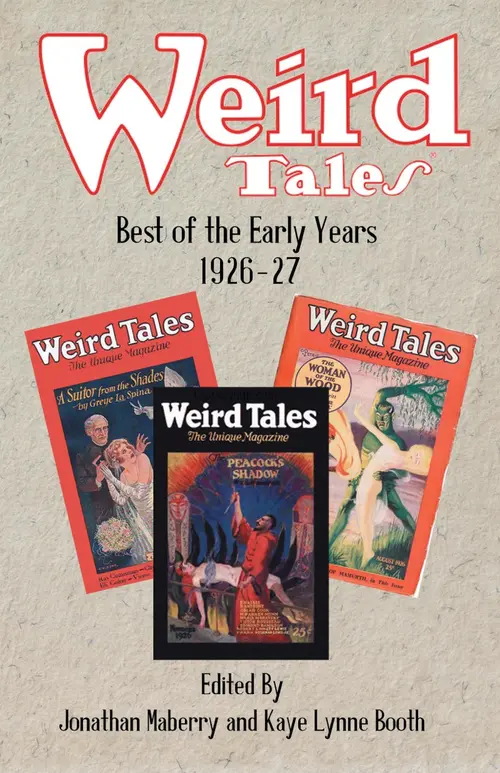
With the stories collected in this volume and its companion (Weird Tales: Best of the Early Years 1923-25), we get a snapshot of young writers, largely or completely unknown at the time, who went on to become key figures in genre fiction.
The careers of some key contributors are inextricably tied to Weird Tales. The two that most quickly spring to mind are Robert E. Howard and H.P. Lovecraft.
Howard was a brash young man from Texas who created some of fictions most enduring, if brutish, heroes. Conan the Cimmerian is by far the most famous, and arguably the most famous character ever to emerge from our pages. Conan became a household name because of the enormous success of the Lancer Books reprints of the Conan stories—including many that were originally written about other characters but revised by L. Sprague de Camp and Lin Carter—and the box-office success of Arnold Schwarzenegger’s films, Conan the Barbarian and Conan the Destroyer. Sadly, Howard was a troubled person and took his own life in the mid-1930s, but his legacy lives on. Various publishers hired a bevy of top writers to pen new Conan tales—including Andrew J. Offut, Karl Edward Wagner, John C. Hocking, Sean A. Moore, Poul Anderson, Leonard Carpenter, Steve Perry, John M. Roberts, Roland Green, Harry Turtledove (leading creator of the alt-history sub-genre) and Robert Jordan (author of the magnificent Wheel of Time novels, now on cable). And Marvel Comics established a long-running and wildly popular Conan the Barbarian comic book that ran for 275 issues, with Roy Thomas writing the first 115 issues.
Howard would go on to write fifty-four stories for Weird Tales before, sadly, he took his own life.
As for Lovecraft, he was a moody writer from Providence, Rhode Island who took elements of cosmic horror first established by Robert W. Chambers in his disturbing 1895 book, The King in Yellow, and greatly expanded upon it. The sheer scale of Lovecraft’s vision is incalculable. And he did something unique that echoes a century later—he invited other writers to take his story elements and use it for their own works. That opened a floodgate of new cosmic horror stories—variously known as “Lovecraftian” or the “Cthulhu Mythos” (if those writers borrowed certain specific characters). The list of writers then and since who have penned these kinds of stories would likely fill every single page of this book, front and back. And, no, that’s not really an exaggeration.
Every year there are new anthologies of Lovecraftian stories, and the writers are a who’s who of pop culture. To give you just a taste, here are some key players in no particular order: August Derleth, Robert Bloch, Clark Ashton Smith, Jorge Luis Borges, Michel Houellebecq, Brian Lumley, Thomas Ligotti, Frank Belknap Long, Fritz Leiber, T.E.D. Kelin, Colin Wilson, Joanna Russ, Mike Mignola, Christopher Golden, Richard A. Lupps, Roger Zelazny, George Alec Effinger, Phillip Jose Farmer, Ramsey Campbell, James Chambers, Gergory Frost, Basil Copper, David Conyers, Lindsay Ellis, Philip José Farmer, Sonia Greene, Lois Gresh, S.T. Joshi, Henry Kuttner, Graham Masterton, China Miéville, Joanna Russ, Carrie Cuinn, Brian Stableford, Akihiro Yamada, Victor LaValle, Matt Ruff, Jonathan L. Howard, Ruthanna Emrys, Nick Mamatas, Edward Lee, Khurt Have, L. Sprague de Camp, Lin Carter, John Langan, David Wong, Ted E, Grau, Ron Marz, Jeff VanDerMeer, Gemma Files, Alan Moore, Laird Barron, David Drake, Caitlín R. Kiernan, Junju Ito, Joe Hill, Josh Malerman, Brett Talley, John Hornor Jacobs, Algernon Blackwood, Ruthanna Emrys, Peter Clines, Jim Butcher, Nick Cutter, Joe R. Lansdale, Richard F. Searight, Hugh B. Cave, Gordon Linzner, J. G. Ballard, William S. Burroughs, F. Paul Wilson, Gene Wolfe, Harlan Ellison, Alan Dean Foster, Thomas F. Monteleone, Tim Lebbon, Richard Laymon, Yvonne Navarro, Poppy Z. Brite, Weston Ochse, Brian Hodge, Elizabeth Bear, Cherie Priest, Tim Pratt, Joh Shirley, David J. Schow, Molly Tanzer, Michael Chabon, Cody Goodfellow, Tum Curran, Steve Rasnic Tem, Carrie Vaughn, Neil Gaiman, and Stephen King.
And again I say…that’s just a snapshot.
Lovecraft’s contributions to Weird Tales included forty-nine stories written on his own, but he also did another four in collaboration with friends and colleagues. There are a number of stories for which he did revisions and others he ghost-wrote, and even now that exact count is in debate.
Both Howard and Lovecraft made indelible marks on the magazine, and that, in turn impacted the whole of horror, science fiction, and fantasy fiction that is felt strongly to this day.
Countless authors graced Weird Tales with stories that were not tied to Lovecraft, however. One of the things that made Weird Tales so popular with writers as well as readers is the career building. The editors not only published stories by established “names,” but went out of their way to find newer writers, and in many cases writers with new characters, and they would cultivate that. A lot of landmark characters and story set-ups were born in those pages. Swords & Sorcery fiction, which existed in an uncategorized way prior to Weird Tales, became a certified genre. The Conan tales of Robert E. Howard were a huge part of that, as well as his tales featuring other popular and enduring brawny heroes who first drew swords in those pages, such as Kull, King of Atlantis; the brooding puritan swordsman, Solomon Kane, and the wise and fearless Pict, Bran Mak Morn.
C.L. Moore created the sub-genre of female swords and sorcery with her Jirel of Joiry character. Seabury Quinn’s crafted over ninety adventures of occult detective Jules de Grandin, many of which resulted in some of the more racy and lurid cover stories (often with artwork by the legendary Margaret Brundage). Two of his stories are included in this volume.
Other writers in those early issues made huge splashes with readers as well.
A. Merrit, one of several Weird Tales writers who was later inducted into the Science Fiction Museum and Hall of Fame, and his 1926 story, The Woman in the Woods (included here) was voted by readers as the most popular tale of that issue. He went on to write many excellent works of prose and poetry.
Robert Bloch, author of Psycho, made into a film by Alfred Hitchcock, is often credited with creating the slasher genre. He contributed fifty-four absolutely compelling stories for the magazine, many of which have been staples of reprint anthologies ever since.
August W. Derleth, who’s “Bat’s Belfry” was one of the first Weird Tales stories I ever read, and the tale that introduced me to his oeuvre, is included here. He was a friend and correspondent of Lovecraft’s, and it was Derleth (not, as many people insist, Lovecraft) who coined the phrase “Cthulhu Mythos.” And he was the first to collect Lovecraft’s stories following that author’s death. Derleth was a prolific writer and one of the earliest authors of popular pastiche fiction with his amusing and entertaining “Solar Pons” stories that had fun with and yet honored Sir Arthur Conan Doyle’s legendary Sherlock Holmes. He is also the writer who sold the most stories to the magazine…a whopping 101!
Edmund Hamilton, best known for his Captain Future stories, was also a fan favorite who penned seventy-six tales, often with a strong science fiction bias. And one of his earliest tales, “The Atomic Conquerors,” included here, is an alien invasion story with a real twist.
Poet and prose author, H. Warner Munn, was a meticulous craftsman of fiction who got his real start with a pair of stories that appeared in early issues of Weird Tales. “The Werewolf of Ponkert,” which is in the companion volume to this one; and the creepy “A City of Spiders” in this book. He wrote for a number of pulps, including Argosy, Air Wonder Stories, Astounding, and Amazing Stories, but much of his most inspired work was for Weird Tales.
Manly Wade Wellman, remembered as the king of Appalachian horror and fantasy, wrote thirty-nine tales for the magazine, including this volume’s “Back to the Beast,” which takes a bit of inspiration from H.G. Wells’ Island of Doctor Moreau. He would go on to write folkloric fantasy tales featuring Silver John, John Thunstone, and others, largely at the request of his literary agent, Oscar J. Friend, who was a partner in the Otis Kline Literary Agency. A pair of Kline’s creepy tales are included in the companion volume out of the nine he wrote for the magazine. Wellman was also a popular writer in what is now called the “young adult” genre.
Interestingly, Otis Adelbert Kline and Oscar J. Friend—apart from being pulp writers and editors themselves—represented many of the authors who wrote for Weird Tales. And that list includes Ray Bradbury (who wrote four stories), Wellman, and Robert E. Howard.
E. Hoffman Price, who, alas, has mostly been forgotten today, wrote two dozen stories for Weird Tales. He was a fan, friend, and avid correspondent with Lovecraft, and their plans to create a kind of literary supergroup—since they were both high output writers—was never realized because of Lovecraft’s death. It’s rather delightful that this volume contains a pair of Price’s stories, each showcasing different aspects of his considerable skill. Included in this volume are “The Peacocks Shadow” and “Saladin’s Throng Rug”.
And we can’t forget Frank Belknap Long, a beloved, prolific, and versatile writer of short stories, novels, poetry, essays, nonfiction, and plays over his seventy-plus year career. He wrote twenty-eight stories for the magazine and got his start in the writing business in Weird Tales. One of his later works for the title, The Hounds of Tindalos, is regarded as a masterpiece, but there’s a whole lot to love in the story we present here, “The Dog-Eared God.”
As with the list of writers who penned Lovecraftian fiction, the list of amazing storytellers who graced the early pages of Weird Tales goes on and on. And that right there is part of the reason no one wants the magazine to fade into obscurity. It’s why we’ve brought it back, why we worked out a deal with Blackstone to launch a new Weird Tales Presents novel imprint, and why the bright young creatives at Western Colorado University have worked with us at Weird Tales to curate these two volumes of stories from nearly a century ago. Too much literary history is tied to Weird Tales to let it be a footnote. Too many careers were launched or propelled forward in that magazine’s pages. Weird Tales is one of the Great Wonders of the modern literary world. Without doubt or fear of contradiction.
So, settle back and turn the page and let the weirdness sweep over you and through you.
And…never be afraid to be weird.
—Jonathan Maberry
Editor of Weird Tales Magazine
San Diego, 2022
The Peacock’s Shadow – E. Hoffman Price
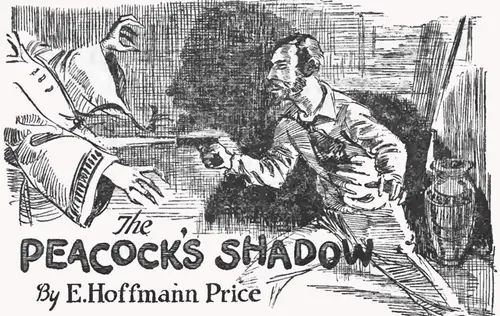
Mon Vieux, what do you say to a bit of housebreaking?”
This, from Pierre d’Artois, a gentleman of France and a master of the sword, seemed unusual, to say the least.
“Well, why not?” I agreed, not to be outdone by the d’Artois nonchalance. “But whose house do we invade? What the devil, do you fear I will become homesick if from time to time there is not something to remind me of my own native land of liberty?”
“Mais non! No, we are not going as prohibition agents. Not at all! And it is no ordinary house into which we are to break. We invade the château of Monsieur the Marquis de la Tour de Maracq,” announced Pierre as he stepped on the accelerator of his favorite car, the Issotta roadster.
“But what of Monsieur the Marquis?” I suggested with what seemed to be a touch of reason.
“He is very busy at Biarritz at a fencing tournament.”
Well, this solved one riddle: I now knew why d’Artois, that fierce old ferrailleur, had overlooked a chance to demonstrate his exquisite mastery of the sword.
“But, mon Pierre, what of the housebreaking? What loot are we after?” I ventured as we cleared Pont de Mousserole and left behind us the gray battlements of Bayonne.
“The truth of it is, I am playing what you call the hunch,” he evaded, then continued: “But he is the good hunch. There has been an elopement, and it is for me to locate the lady.”
Worse and worse yet! A quiet month in Bayonne.
“Who is the girl?” D’Artois laughed.
“A princess, and the daughter of a king.”
“Not bad for a marquis. And young and beautiful?” I retorted to the mockery I saw in his keen old eyes.
“Beautiful, yes. If you like such beauty. But young, no. In fact, older than I am.”
“The devil!”
“The truth! Thirty-seven hundred years old at least.”
This was too much!
“Mais non. I do not jest,” continued Pierre. “She was stolen from the Guimet museum of Lyons and carried all the way to the château of the marquis.”
“Well, and that is a case for the police, is it not?”
“No. For one is not really certain; it is but strongly suspected that he accomplished the almost impossible feat of looting the museum and carrying the mummy to his château. Monsieur the Prefect of Police, not being any too sure of himself, has taken me into his confidence and asked me to investigate unofficially. A false move would ruin him, since Monsieur the Marquis is a man of influence.”
“But why should anyone steal a mummy, especially de la Tour de Maracq, who is rich as an Indian prince, and of a house as old as Charlemagne?”
The Story Continues on BooksBarbecue!
Enjoyed this preview? ❤️ Do not stop here!
Read the complete book free online → 🔗
Continue reading now on BooksBarbecue and discover every page!
Love reading? Bookmark BooksBarbecue.com for more amazing books!
Happy Reading!